
Uncontrollable Folly
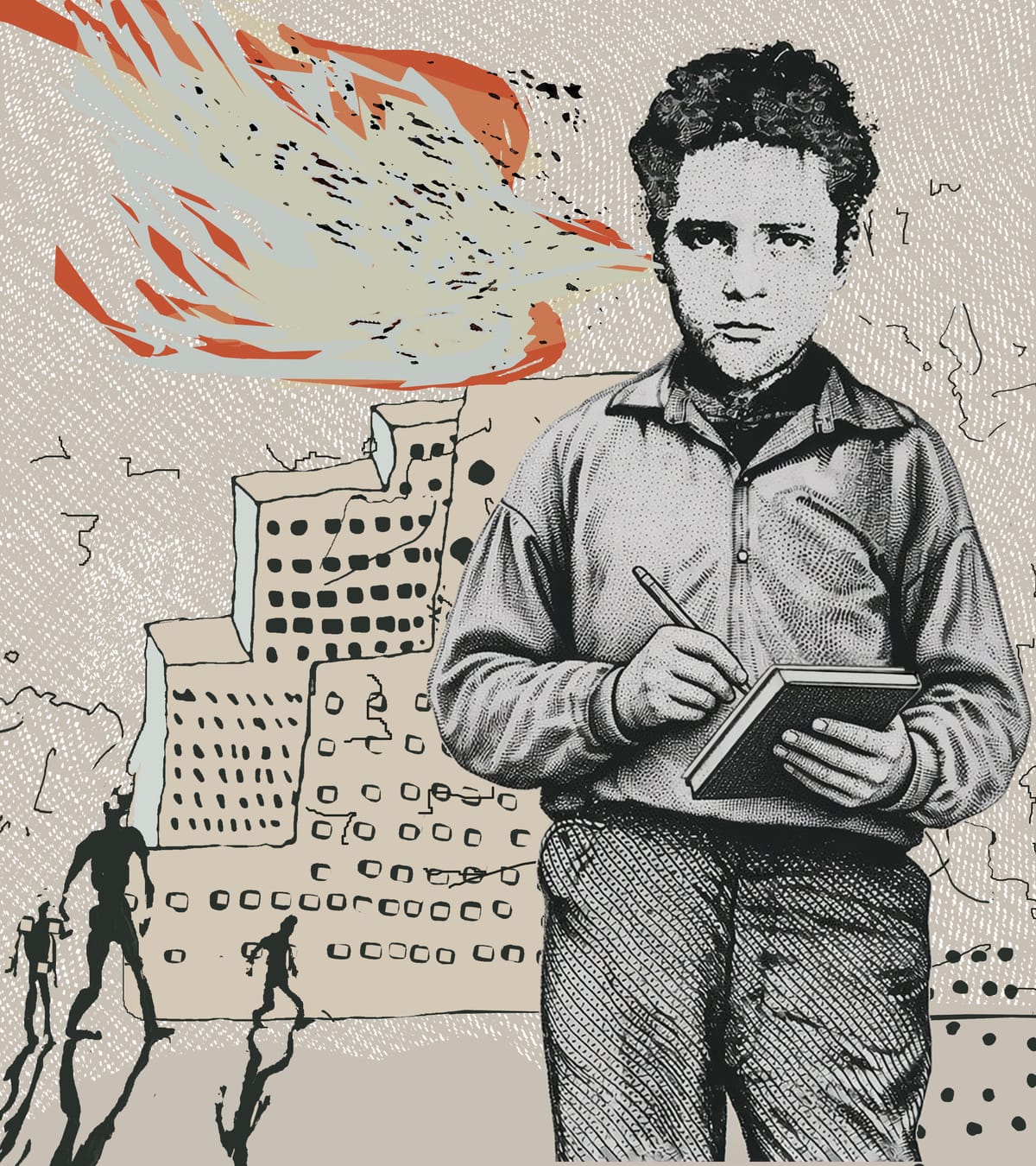
The Devil in Carlos Castaneda: American Trickster & a Sorcerer's Redemption, Part Three
(Art by Michelle Horsley)
Reading American Trickster, and then talking to Miguel Carballal (La Vida Secreta de Carlos Castaneda) for three hours, opened up an abyss before me.
Whatever happened between my consciousness and those books, to this day, it remains somewhat active, as proven by how much resistance I felt while reading American Trickster.
Tom Mellett wrote in a note: “having a south node in Scorpio usually indicates a past life devoted to all around [sic] debauchery, sexual excess, lying, secret agendas—just about everything Casteñeda did as laid out in the new book!”
Karmic affinities? To what extent did I form a “pact” with Castaneda, with “the allies,” or with some mysterious “lineage” that his books are hooked into, because I was born into this life carrying forward a pact from previous lives/ancestrally?
American Trickster, Finally
The good news about Ru Marshall’s American Trickster is it is well-written and impressively researched.
The bad news is that it is extremely limited—one might even say blinkered—in both its perspective and orientation. It is ideologically slanted. Most of the time this slant seems minor or incidental to the subject; but it indicates much larger blind spots in the author’s consciousness.
As repellent as its depiction of Castaneda is, Marshall’s own viewpoint proved almost equally repellent to me, in ways that had nothing at all to do with Castaneda. In fact, many, if not all, of the things that repelled me could easily have been excluded from the book (and would have been, with a better editor).
There is, for example, the repeated use of the pronoun “she” as a “gender-neutral” (!) alternative to “he.” Here’s a particularly onerous example:
Perhaps [Castaneda] was filled with excitement, and possibly terror, at the audacity of the project he’d undertaken. A writer wants nothing more than for her book to succeed. In the eyes of the world, the not-quite-young man who’d just begun calling himself Carlos Castaneda had, in spite of his brilliance and charm, achieved pretty much nothing (p. 351, emphasis added).
This is frankly an idiotic, barbarous use of language. What is the reader—male or female—to make of Castaneda’s transitioning into a female in the middle of a passage, all for the sake of a “simpification psyop” as “reparation” for the sins of “Patriarchy”?1
Replacing “he” for “she” (instead of simply using “they” or “s/he”) is deliberately intended to annoy certain readers, on the premise that anyone who balks deserves what s/he gets, for having aligned with a literary convention that inflicted the exact same ignominy on women for generations. It is the righting of wrongs by writing new ones.
Such toxic nonsense can—and should—be laid at the doorstep of the publishers, as much (or more than) the author, though Ru (formerly Robert) Marshall is presumably some sort of “gender-fluid” individual himself. Ironically, Trans-ideology renders pronouns entirely meaningless anyway, since one can adopt and disown them on a whim, in an ideology that eats itself. As for women who also object to being “politically corrected,” they can also be dismissed as self-hating TERFs.
Other egregious examples: in chapter 2, Marshall cites belief the 2020 US election was stolen, that climate change isn’t real, or in anti-vax conspiracy theories (and the conspiratorial mindset in general), as examples of our crazy times, thereby reassuring the reader as to where his own allegiances lie. He thereby let this reader know, unequivocally and within the first 60 pages, that I am not the book’s “target audience.”
On page 175, he even describes the JFK assassination as the day when “a grandiose loner darkened history.” Really? This is the researcher I am supposed to trust to get to the truth of Castaneda—a true riddle wrapped in a mystery inside an enigma, if ever there was one?
American Trickster declares at the start that Castaneda’s books are fiction, and that this is a foregone conclusion which the book will demonstrate. The language used throughout is similarly self-confirming; it expresses opinions as facts.2 It offers periodical riffs on the subjectivity of knowledge, riffs which invariably include ideologically-loaded examples of what crazy/stupid people believe. When talking about a study of a UFO cult as an example of “high control groups” on the cultic continuum, Marshall writes:
Why do voters who inhabit certain self-enclosed information milieus remain oblivious to evidence that contradicts their deeply, emotionally held beliefs? Why, in the face of overwhelming evidence, do some in overlapping info-milieus hold fast to anti-vaccination conspiracy theories? Because the dissonance caused by the contradicting evidence . . . is too much. The dissonance causes them to hold on even more strongly to their previously held beliefs. There is no underestimating the need to make the world cohere (p. 320n).
Later on, he mentions “the cult-like behavior of the MAGA movement” (p. 593), and blames Donald Trump for “contributing to the deaths of hundreds of thousands” by downplaying the gravity of the pandemic (p. 564). Can we infer from all this that Mr. Marshall is mRNA-ed up to the eyeballs?
The Art of Lying
The other good/bad news about American Trickster is that Marshall—while thoroughly debunking Castaneda’s credentials as a Nagual, or a decent human being—is less convincing when it comes to debunking the books as the confabulations of a disordered mind, cynically and opportunistically disguised as non-fiction.
American Trickster adds nothing much to the evidence amassed by Richard DeMille, forty years prior, in Castaneda’s Journey and The Don Juan Papers. DeMille’s books did prove that Castaneda either lied, fudged, or was confused about the dates of his encounters with don Juan, and that his accounts were anthropologically unconvincing regarding Native American (much less Yaqui) drug rituals, familiarity with the Sonora desert, and so forth.
From here, it might seem a small step to claim that Castaneda fictionalized his accounts whole-cloth. But is it? A memoir that includes word-for-word dialogue has fictionalized its author’s life, but no one tries to denounce it as a hoax. I had to give up reading Terence Stamp’s otherwise entertaining Double Feature because of the pages and pages of dialogue that no one could possibly remember verbatim.
Yet this never bothered me about Castaneda. In fact, Castaneda provides an “explanation” for his precise and ample recreation of the events of his apprenticeship, including vast swaths of verbatim dialogue, by claiming that he was taking notes the whole time.
This would be somewhat credible if Carlos knew short-hand (something he never mentions, maybe because he didn’t want to get caught in that particular lie?). and was taking notes openly from the start. Instead, for reasons known only to him, Castaneda claimed he was taking notes for the first couple of years covertly, having learned the truly amazing ability of writing in his notepad while it was secreted in his windbreaker trouser pocket!
When don Juan finally notices (some seer!), he asks Carlos if he is “playing with [his] wanger.” Carlos comes clean and is then given permission to write notes openly, but chided for it endlessly by don Juan and don Genaro.
The question is: how is it possible anyone ever believed this? How did I ever believe it?
On the other hand:

(source)
Actually, the truth is that I never really did believe it. Frankly, it is less credible than a man turning into a crow, or jumping off a cliff and not dying. So how is it that I managed to overlook it the whole time?
Another, related question is this: what did Castaneda hope to achieve by inserting such an absurd literary conceit, as an essential (non-) explanation for how he managed to write his books (based on field notes he could never provide)—a conceit he must surely have known no one would really believe?
I suspect it was part of his sorcerer’s “stalking”: a means to test—but also mock, deride, and crow about—the reader’s prodigious capacity to “suspend disbelief” about obviously impossible claims, out of a desire to believe in the magic and the story. Once the reader has committed to believe such an obvious lie, they will be that much more susceptible to the rest. They have given their consent.
Literary Sorcery
There is some license in any non-fiction account for blending factual reportage with embellishment, simplification, streamlining, and dramatizations, without thereby reducing the whole thing to fiction. Yet this was de Mille’s verdict about Castaneda’s first four books in 1976, and American Trickster follows suit with all ten (or thirteen, if we include spin-offs and cash-ins).
By 2026, this view has the social consensus behind it. The point of view that Castaneda made it all up is a done deal.3
Inevitably, the evidence for don Juan’s non-existence is itself non-existent. Any evidence that Castaneda’s passion for lies and storytelling—his inferiority complex and blind ambition—was the sole basis for his tales of power is circumstantial, at best. Had Castaneda not ended up as he did, it’s a safe bet there would be no consensus about it.
Castaneda ending up as a psychopathic cult leader is not in itself proof—or even especially strong evidence—that the books are made up, however. Castaneda’s going off the deep end might have been the result of his encountering a genuine ancient sorcery tradition. It might have been the tragic consequence of being recruited as a spokesperson for something he never succeeded in understanding, much less embodying.
It is possible he became unhinged in the very attempt to translate the sorcerers’ knowledge into action in his own life, within the urban world of Los Angeles, as a major celebrity who erased his personal history. A practitioner of uncontrollable folly.
If so, he not only died trying; he led others to their deaths also.