
Jobcast # 127: La Vida Secreta de Carlos Castaneda
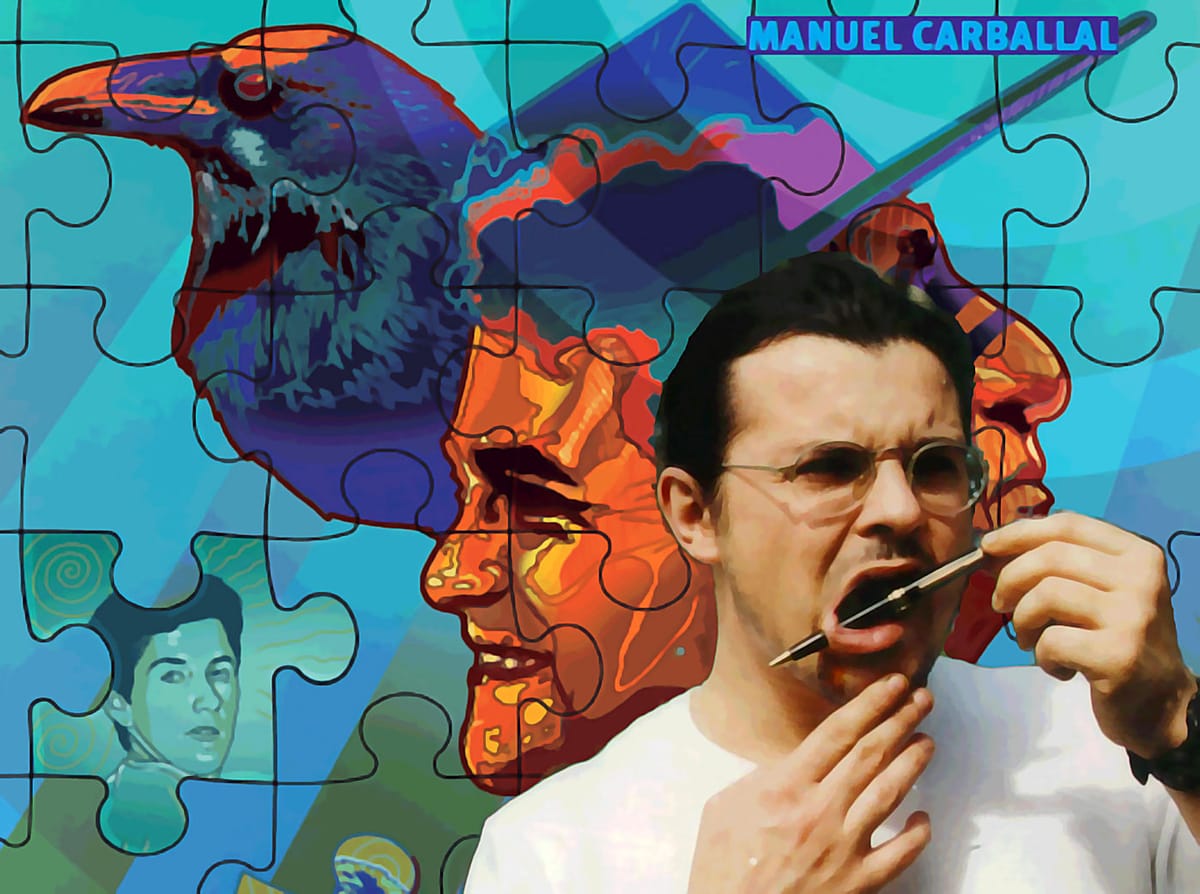
Entrevista de 3 horas en espanol con Miguel Carballal, el author de La Vida Secreta de Carlos Castaneda.
https://www.manuelcarballal.com
The substack automatic transcript, weirdly, seems to be in a mix of Spanish & English. I have translated this transcript into English w/ an online program, and C & P-ed the results below. But be advised it will be full of errors, especially when it comes to proper names.
Songs: “Vampire” by Belaver; “Pale Horse” by Bird in Belly; “Jesus is a Mighty Good Leader” by Resurrection Choir
Let’s start with the basics. Where did you begin your research and your interest in Carlos Castaneda? What was your initial interest?
Well, before doing the research, I was a big follower and a great admirer of Carlos Castaneda’s work. I read it when I was very young. Because I come from theology, I study theology, my subject is comparative religions, it’s my main subject. And when I read the teachings of Don Juan and all the others,
The twelve or thirteen books Castaneda has published, I fell in love, I fell in love with him. And in the early nineties I was lucky enough to meet Concha Labarta, who was in charge, she was the leader of the Nahual student group in Spain. The Nahual had three important groups, one in Los Angeles, where he lived,
where all the witches were: Taisha Abelar, Florinda Donner, Carol Tiggs, Kaylin Daj, my dear Kaylin Daj. And then she had another very important group in Mexico, which included Jacobo Grimberg and his Mexican followers. And the third important group was the one in Spain, led by Concha. And when I met Concha Labarta,
She was the editor-in-chief of Más Allá magazine, and we became great friends. One day, the topic of Carlos Castaneda came up in conversation. I had been publishing Viajes, research I had done on shamanism in Haiti, Africa, Mongolia—well, all over the world.
Then she asked me if I was interested in Castaneda’s work. I said yes, of course, absolutely. She told me she knew him personally, that she was a very good friend of Castaneda’s and that she was his representative in Spain. And she asked me if I’d like to meet him. Of course, imagine. It’s like a dream, isn’t it? What are you telling me?
To meet the Nahual, Carlos Castaneda in person. Yes, he comes to Spain every so often, and he’s coming back. In a few months, very small groups are being organized. Because he’s very discreet about his image, about his identity; he’s not very accessible. And if you want to meet him, I can take you to that meeting.
And that’s how I met Carlos Castaneda personally and his witches. They made a small selection among those of us who were there. The next day they called me to say that if I wanted to enter the Warrior’s Path, that I had chosen to receive training in the Magical Passes,
yet they were called Magical Passes, yet they were called Magical Passes, yet they were called Tensigrida. And so I was in the group of Castaneda, and for me it was Minahual. Until then, when Carlos Castaneda was born, and a little later he was born with Concha La Barta, Chris Obeck.
He is a British researcher who collaborates on a free magazine that I have been publishing for 33 years. Just coincidentally, last week we published issue 101 of The Critical Eye, because Chris Obeck sent me a very harsh article for The Critical Eye about Castaneda, questioning all his claims, all his work, saying that everything was false.
So I got really angry about that article and decided to write a rebuttal. I mean, I told him, “Cris, I’ll publish your article, but I’m going to write a rebuttal to prove you wrong.” And that’s why I began the most critical, most in-depth research on Castaneda’s work.
In other words, I’m starting the investigation to try to refute an article by Cris Aubeck.
Okay, I understand. So, in what year did you meet Carlos Castaneda?
Well, I think it’s all in the book. I believe it was in April 1992, I don’t remember exactly, in the mid-90s, about four years before his death.
Wow, it’s incredibly emotional because I was living in Pamplona from ‘91 to ‘98, and I know more about it than I knew about, but I never found out about this because if I had, it was because I was so involved in everything that
But I never knew that Carlos Castaneda was coming to the public until after he died, I think. But well, that’s true.
In fact, he didn’t appear in public; the meetings were closed meetings. You could only access them by direct invitation from his group, Castaneda’s group in Spain. It wasn’t something that was advertised; they didn’t let us record, they didn’t let us take photographs. It was very clandestine, and then accessing information was also very difficult.
Because when Kaylin Dagh, this tall, blonde woman, came—I’m very sorry to say this—she appears in the videos on YouTube of the magical passes, when the tensegride thing starts. It was Cale who noticed me. I remember her walking through the crowd of us who were there listening to Castaneda’s talk.
She was staring at us intently. It was a little scary. She was a very large woman, she looked like a Valkyrie. And she was the one who chose me and told Concha, “Hey, that guy with the long hair, he has to come in.” Then Concha called me the next day and told me that Kyle had spoken with Taisa Velar.
With Florinda Donner and the Nahual, she said yes. I think I was the only one they chose at that meeting, and there were almost 50 of us. And from that moment on, since I live in Galicia, in A Coruña, two of her witches, Concha and her partner, came
She came to my house in Galicia for a week to teach me the magical passes. It’s amazing. It’s also very unusual because magical passes are normally taught in gatherings with other people. I received the training in the Tesigrida tradition for a week alone in my house. Because she had shown much interest in me joining the group, I entered and
from there I did all the work of the recapitulation, what is the formation of the Vida del Guerrero.
Wow. How a dream I have come true, right?
Well, in my case, Kaelin Dagg said I was a great stalker. I’m not a dreamer, but even though I’ve had experiences with peyote, San Pedro, and various power plants in Mexico, Peru, and several other countries, she emphasized, and she was right, that my strength was stalking, the art of stalking.
And during those years you didn’t come across Richard DeMille’s books? Yes, of course. But you weren’t impressed by what you read.
No, because I have a library, and I think that when I start an investigation, Jasun, I’m very obsessive. I mean, I don’t stop, I don’t stop, I don’t care what happens, I don’t stop until I reach the end. And I can take a year, two, three, four, in this case, five years of my life, dedicated only to the investigation.
I spent all the money I had, in fact, I’m still paying benefits, because, of course, I have to travel. I had to follow the track of Castaneda for half the world. I had to go to Venezuela, I had to travel throughout the world, because that nobody pays me. That’s what I do.
And I compiled a bibliography—to give you an idea—only paper books. I have over 150 books on Carlos Castaneda, published worldwide. Some are doctoral dissertations. I remember buying one—the most expensive one I ever bought—which was a doctoral dissertation.
I have a doctoral thesis that was done at the University of Cajamarca, where it was Castaneda, which cost more than 100 euros. Imagine the money that I have spent. So, everything that I have published on Castaneda I have in paper and then I have hundreds of articles, articles,
Books, e-books, but only in paper, because it takes several days, so more than 150. That is, I have read everything that has been published about Castaneda.
Okay, but that’s after the investigation. I’m referring to before, when you were so enamored with Castaneda’s books. I suppose you were aware of the belief that it was fiction, that he had invented it, you already knew, right?
No, no, no, because I learned about Demil’s situation later, because when you’re in a sect, you experience several phenomena, in addition to cognitive dissonance; you suffer from information selection. For example, any Jehovah’s Witness reads a great deal. Jehovah’s Witnesses have the largest bibliographic output of all the religions on the planet.
New books are published every 15 days, new copies of the Watchtower and Awake! magazines are released. There’s a peculiarity among Jehovah’s Witnesses: you can’t buy a book for a household—that is, a family—where the father, mother, and three children are Jehovah’s Witnesses.
There can’t be one Jehovah’s Witnesses book for everyone to read. There have to be five copies, one per person, which, as you can imagine, is a huge expense in the publishing business, isn’t it? It’s enormous. And in all sects, you read what reaffirms your beliefs, not what contradicts them. I wish the prudent, the intelligent,
The reasonable thing would be to read what people who don’t think the same as you say. But we, the followers of Nahual, we read books of Thais Abelard, we read books of Florinda Donner, we read books of Castaneda, but we didn’t read the detractors. Because it’s like if a Christian was going to read anti-Christian books.
Do not even read books of other religions, only read books that reaffirm their beliefs.
Yes, but how many years It was to discover Castaneda by books and find her. How many years did you have in that period? Three.
I suppose I started reading Castaneda’s books around... When I was about 18 or 19, which is when I was studying theology and had already started traveling and learning about other religions, but Castaneda was just one of them. I wasn’t obsessed. I mean, I read about shamanism, but I also read Jim Butas, I read a lot of other authors.
Castaneda was fascinating, of course he was, but he’s not the only one who has written about shamanism. Shamanism is just another religion. I’ve read a great deal about Judaism, a great deal about Buddhism, a great deal about Islam, about other religions, in order to compare them, to be able to study comparative religion.
It’s not that I only discovered Castaneda and only read Castaneda. Castaneda was part of my life; just recently, last year I published a book, Desperately Seeking God, which is my journey through all religions, especially through the physical phenomena of mysticism, the great physical phenomena of miracles, levitation, bilocation,
The gift of tongues, many of the things Castaneda said Don Juan Matus or Don Genaro Flores or any of the members of their group did. This is described in all religions, and you can see my journey there, especially when, in the early 1990s, I took my first trip outside of Spain.
To Malawi, a country in Africa, where I learned about animism, African shamanism, where there are also miracles, where there are also wonders, and then I went to India, I went to America, and I saw that we are not really so different. All human beings have the same fears and the same desires, and we make the same mistakes.
The same mistakes are made, and we are deceived in the same way. In short, Castaneda wasn’t my only reading material.
Okay, so you weren’t that deeply involved in the system, nothing like that. It was only when you met that woman and then Castaneda that you got more deeply involved. In my case, I never met Castaneda, but I read the books—there were eight—when I was 21 and learned Spanish. And I went to Oaxaca looking for, not Don Juan, but that kind of alignment.
And I had been trying to practice the teachings for 20 years without having a Nahual, right? So I was very, very involved, but personally, independently. And I knew about Richard DeMille, but I wasn’t interested in it because I thought I had confirmed the teachings directly because of my dreams and other things.
So I thought I didn’t care what he said because he didn’t understand. Then I read something, or rather, I read, but it didn’t impress me that much, only when I read Amy Wallace’s book. That’s what we call “The Penny Dropped” in English, but it happened, like, the bubble burst, I don’t know how to say it in Spanish.
But when I read that book, and also when Castaneda died, I began to delve into how he was in his personal life with people, and the chasm between his books and historical reality. Then I started to reevaluate his teachings and everything. But right now I’ve just finished reading American Trickster, and so I’ve gotten back into that whole thing.
I still have a doubt, because I’m not 100% convinced about American Trickster either. You’ve read my book. No, I had it in Spanish, but that’s just how I am. Reading Spanish is difficult for me. I wanted to translate it into English. In fact, I was talking to my publishers a couple of years ago about translating it, but I couldn’t because no one has translated it yet.
But I’ve read something, but it’s been...
Forgive me if I sound a bit pedantic, but I think everything is in my book. Everything. You think I was a believer. My friends were believers. Concha, whom I loved madly, was a believer. Susana was a believer. My whole circle of friends were believers. So, when I wrote the book, I was there many times
I was about to throw in the towel because it was so difficult. I’ve published about 30 books. I’m a researcher. I dedicate myself to research. But never in my life have I done anything as difficult as reconstructing the Carlos Castaneda puzzle. Because everything was a lie. But when I say lie, I mean that the names,
All the names, birth dates, all the information was false. So, when I went to UCLA in Los Angeles, I would contact the FBI or the CIA, the U.S. Department of Defense, or people in Costa Rica or Venezuela. Every lead I followed led to a dead end.
Of course, because the data was wrong, because he forced them to do so. It’s impossible. It’s impossible. It’s impossible. It’s impossible. But if I leave it, nobody else will do it. Because I knew Nahual, and I had a motivation, which was my guide to the end, which was Concha, Concha Labarta. I needed to know if Concha had wasted her life,
because she, like all of us, she made her hair, she cut the hair, you know, you know how that worked. So I had a motivation that I had no one. I had a year, two years, three years, four years, and back, and back. So when I read the book,
My goal is to leave no question unanswered, any question you might have: Who was Doña Soledad really? Who was La Gorda? Who was Don Genaro? Who was Don Juan? Where did he go?
And yet, I knew that believers would feel offended, because the Nahual was God. It’s like messing with Jesus Christ for a believer, right? And I had a lot of problems afterward—death threats, blackmail, well, Castaneda’s followers did everything to me—but I had to be perfect, as he said, I had to be flawless.
The book had to be flawless, it couldn’t have a single crack, and in fact there isn’t one. You’ve read American Trickster.
You don’t read in English, of course.
No, no, but well, you can get the PDF and translate it, but I was in contact with him when I was doing the research and he came along much later and everything he says, from what I’ve seen in the reviews and what friends who have already read it have told me
I’ve read it, it’s all in my book too.
But he’s very... He’s convinced that everything is fiction, that all books are fiction, and that’s not... Well, let’s see what he says. So, I want to talk about the details, but before that, let’s get to the end. If you could tell me, in summary, more or less what you’ve concluded with your research.
Well, look, it’s very simple. Carlos Castaneda. When I spoke with his family, with his sister, of course, I would ask her about Carlos, and at first she didn’t understand. “Carlos, who is Carlos?” “Well, Carlos, your brother.” “Carlos, little Carlos.” “But, how can Carlos? I don’t have any brother named Carlos. You’re talking about César.”
Oh, right, yes, of course, he was César, not Carlos. When I spoke with his schoolmates in Cajamarca, I asked about Carlos Castaneda, and they didn’t understand me either. “But who is Carlos Castaneda?” “Carlos Castaneda, your teammate on the soccer team, at the high school, at school.” “No, no, I don’t know any Carlos Castaneda.”
Yes, man, he went to America, that year, he was a very good friend. Oh, you’re talking about the Black man. Because they called him the Black man. And why did they call him the Black man? Because he had a very dark complexion. He was Peruvian. But he wasn’t a white-skinned Peruvian, he was a dark-skinned Peruvian.
In fact, in the photos I published in the book of his childhood, you can see that he was very dark-skinned, right? And he was five feet two inches tall. So, imagine, a Latino immigrant, five feet two inches tall, very dark-skinned, arriving in the United States as an immigrant.
He had a hell of a time, a terrible time. He had to have a lot of jobs, which is something he later reuses in Viajaitlán, the bit about Don Juan having told him to have many jobs. No, no. He had many jobs, he sold clothes, he sold books door-to-door, he was a taxi driver, a cook,
to make a living, like any immigrant who arrives in the United States. And then he used that in his books. So, the only thing he wanted—and he says this in a wonderful letter to Margaret Runian, his first American wife—he married several times, but with his first American wife, Margaret Runian,
who also has a very good book published, I told him, all I want is to have “Doctor” before my name so that I’m respected. Because he was accustomed to being humiliated, being a Latino, short, dark-skinned, in the United States, as happens now.
that they have to suffer that humiliation, either in Spain or in any other country. So he first began to study Psychology, which is what he really did well. Precisely because of a humiliation he suffered in class in front of all his classmates, one of his teachers said to him, “But you...”
Does anyone really believe that someone is going to see a psychologist?
With his indigenous appearance, he leaves psychology and then enrolls in anthropology at UCLA and writes an essay because the Californian anthropology professor had instructed the entire class that whoever presented an essay interviewing an indigenous person that semester would win a good grade.
So all he wanted was to finish his degree and get a doctorate so he could be respected in the United States and pursue the American dream, nothing more. So only three students from Professor Mayan’s class, I think his name was, submitted the essay. One of his classmates interviewed a stable boy he had on his ranch,
who was Apache or Arapajoe or Sioux, a Native American. Another of them interviews a campus waiter who was also Native American. And Carlos Castaneda arrives with a masterpiece, a marvel, which is The Teachings of Don Juan, a short story.
Then, Clay Megan is so amazed by the book that she says, hey, make it a little longer. And I speak with the Department of Publications of the university to edit it as a book. Of course, for a student who is starting the career, that the university edits a book, that is an opportunity that you can’t let escape.
And he begins to add things, to expand, to expand, to expand. He’s inventing things from other shamans that are real, because he knew several characters. I identify them one by one, and I tell you, It was a shaman, a Native American woman, who taught him about looking at his hands in dreams to access the second awareness.
It was someone else who told him about peyote, that the Yaquis don’t use peyote, it’s others, but well, he mixed everything up and to give coherence to all that information that came to him from different sources he united in a single character called Don Juan, Don Juan Matus.
In the first book, he doesn’t even mention the first and last name until the second or third book. Then he starts adding things. Why? Well, for a very simple reason: because when he published that book in 1968, he was fortunate enough to have Ronald Reagan, who was governor of California that same year,
He had banned the free sale of LSD. It had revolutionized American society; American youth believed they had found a shortcut to divinity and mystical experiences. You no longer had to do yoga, you no longer had to join the Hare Krishnas, or Charles Manson, or any guru.
You’d take a little pill and you’d access Satori, your third eye would open, and of course, at first LSD was commercially available, you could even buy it by mail. Until the first cases of suicide began, specifically one in particular, where the daughter of the owner of a very important newspaper committed suicide.
He thought he could fly, jumped out the window, and killed himself. This created a lot of political pressure, and Ronald Reagan banned LSD. And just at that moment, when he’s cut the slate clean of easy, mystical experiences for American youth, an anthropology student from UCLA comes along and begins to talk about
the plants of power, the psychopatric substances, the peyote, the mescaline, and the book turns out and appears a very important person, key to understanding the phenomenon of Castaneda, that is a talent hunt from the publisher Simon & Schuster North American, which is the most important publisher in the United States. He traveled, it tells him in his memory,
He traveled throughout the United States looking for new writers to sign for his publishing house, like they do in Spain, where there are scouts, like in football, people who go to the games of small teams to see if they can discover a Romario or a Messi as a child, right?
So this guy, when he was in Los Angeles, went around asking bookstores, “What’s selling the most right now? What’s really popular?” And everyone told him, “Well, there’s a book published by UCLA by a student...”
Anthropology that talks about a Yaqui sorcerer and the plants of power, and this is blowing up, and then this guy is the one who buys the rights from UCLA to publish Don Juan’s teachings with a major national publisher. And from one day to the next, from night to morning,
That poor Peruvian, short and dark-skinned, who had to do 40 jobs simultaneously to pay for a living room with two friends, which I had to do with two friends, overnight becomes a multimillionaire, able to buy a mansion in Los Angeles,
The covers of all the big magazines from Rolling Stone, Time, all the big media appear. And this is what I’ve told you about Castaneda. When he invited him to the scenes in Hollywood and when he met all the actors and directors of Hollywood who invited him to his reception to talk about Don Juan Matus.
Imagine who could resist that. I mean, if overnight you become the most famous person in your country, a multimillionaire, rubbing shoulders with music and film stars, John Lennon says he loves you, George Lucas makes the Star Wars series based on your books,
I mean, what ego can withstand that? And although he, and with this I’ll finish, although he, in the first book, in the teachings of Don Juan, ends the book saying, well, and this is where my research ends, this cannot continue, this is a very demanding subject, I have no more interest, it’s over, the end, there’s no more to it.
Of course, when this talent scout from Simon & Schuster comes along and says, “Hey Carlitos, you’ve sold a million copies, you’re a multimillionaire, man, you can’t just leave it at that, we have to do a sequel.” Imagine, you’ve sold a ton, you have to publish a second book.
So he writes a second book, and the second book ends the same way. That’s it, that’s all my experience, there’s nothing more, the end. But it sells like crazy again. Then they tell him, hey, no, man, we have to do a third one. It just so happened that he was finishing his doctoral thesis to finally get his doctorate.
He got it, by the way, it was a gift. A doctorate in Anthropology. Well, there you go, here’s the doctoral thesis, but that’s it, it’s over. But he kept selling and kept becoming more famous and earning more and more money, and then he published a fourth, a fifth, a sixth, a seventh, a ninth,
Then he kills Don Genaro, he kills Don Juan, he becomes the new Nahual, and in the end, things get out of hand. But any of us in his circumstances would surely have experienced something similar. And there’s one more element, and with this I’ll finish, to understand why Castaneda did what he did.
And the thing is, Castaneda really liked women. We all like women, but he liked them even more. He was a great selector. And this was told to all his friends, from a very young age. In fact, he went to the United States because she got pregnant with a friend from the Lyceum.
Of Pinture in Lima, she gets pregnant and never again. And it takes many years to meet his only wife, a biologist, who now lives in Sweden. So, the guy liked women more than a fool likes a pencil. And of course, there’s a line Margaret Runian says in her book,
Speaking of her husband, Carlos Castaneda, she said, of course, it’s easy to understand. Why did Carlos do what he did? Because without having even finished his degree, he was so, so, so famous in the United States that they gave him an office at the University of Berkeley, even though he was a student at UCLA.
At Berkeley, they gave a student his own office, and he gave lectures, and there were people, Margaret Runian said, kids who crossed all over the United States to spend weeks hitchhiking, taking trains, taking buses, just to be able to attend one of Castaneda’s lectures, and especially those young women with
Skirts so short and shorts so short that they sat in the front row and gave him the eye. Like he was a rock star at a big concert. And that temptation, the temptation of sex, naturally, well, for a young guy, you can imagine, that was also a very important factor.
Several questions about what you just said. The man who discovered the teachings... I’ve lost his name. What was that man’s name?
The uncle the professor discovered, Clay Megan.
What’s it called?
I think I remember—my English isn’t great—he was the professor for the Californian anthropology course. I think his name was Clay Megan. It’s all in my book; I can look it up if you want.
Clay Megan. But you said you were asking what book is selling and then... Oh,
No, no. That was the Headhunter. It’s all in my book, but it’s really thick. Let me see if I can find it for you. Okay... We’ll keep talking and I’ll look for it.
Yes. And the Garfinkel thing. There’s... The theory that Garfinkel, his UCLA professor, was inspired by Don Juan, the art of the stalker, breaching, as Garfinkel was teaching students how to break social reality by acting in such unexpected, strange ways, all that. I suppose you looked into that. What do you think of Garfinkel’s influence on Castaneda and his ideas?
There are so many... You think that Castaneda’s work doesn’t emerge spontaneously in a year, but is the product of a lifetime. And as he has to write new books, he has to look for new sources. For example, when the plants are also outlawed in the United States,
And as his sales began to decline, he invented the concept of tensegrity. That was it, there was nothing more to explore about power plants, so now they would invent magic passes. And these magic passes later evolved into tensegrity, coinciding with his change of publisher.
When Simon & Schuster told him that he wasn’t selling as much as before, around the fifth or sixth book, or maybe the seventh, that’s when he invented the concept of tensegrity. He first met Taisa Velar, she was the first, and then Florinda Donner, who was his favorite.
Because Florinda was an extraordinary woman, besides being incredibly beautiful. I met her family; it was very complicated because they lived—they’re of German origin—but they lived in a city, in the Tobar colony. I went to Venezuela and asked for the family.
of Florinda Donner. It is very long, I tell you all about it.
I have five years of investigation. I am able to find a brother. The brother gives photos because when a girl entered the Way of the Warrior, she had to break off all contact with her family. Breaking off contact meant calling them on the phone and telling them to break it off. This is what Florinda’s brother told me.
He was telling me, one day the phone rang at home, my mom answered it and said, look, it’s Florinda. We haven’t heard from her in a long time, have we? And he overheard the conversation and said to her, look, Mom, I want you to take all my letters, all the photos you have of me and burn them.
And if you tear them up, you’ll never hear from me again, and so on. And her brother was telling me, “Of course, he had photos of Florinda and Taisa, who had gone to Venezuela when he got married,” and he was saying, “I’m not going to tear up my wedding photos.”
But my sister is crazy, how could I possibly destroy the photos? And then, she gave me photos—I publish unique photos, never before seen, of Taisa or Florinda, because their family gave them to me, right? And both Taisa and Florinda were great experts in martial arts. They appear, I’m sure you already know this,
They appeared in a karate magazine, they had done demonstrations, they taught courses, and they were the ones who inspired Castaneda with the whole subject of magical passes and tensility, as well as Eastern philosophy. And he kept adding elements from different sources to write more books. And in fact,
All the fieldwork he hadn’t done before Don Juan’s teachings, he did afterward. Because afterward, indeed, when he had to write a third and a fourth and a So...
Don Juan, as you’ve already said, is a composite, many influences, many characters combined into the great chief of the stories that is Don Juan. There are characters that you’ve determined are more real, more like him. I don’t have the word, but how is he represented in his books? Is he almost identical to the character?
What is an example of a character in your books that for you exists or existed almost the same or there is no equivalent?
No, not really, because he blends several traditions. For example, peyote hunting is a tradition practiced by certain indigenous people of Mexico, but not by the Yaqui. The Yaqui experienced conflict in the Mexican Revolution, within the army, which Don Juan describes, but other ethnic groups didn’t. José Ríos. José Ríos is a true shaman.
He was the first one he met. He met Salvador López, he met Tata Cachora, he met Ramón Medina, who later inspired the character of Genaro Flores. These were real people who would tell him things, and he would add them to his own narrative, but in a single, condensed form, as if there were only one source.
And the same thing happens with women. He met Guadalupe de la Cruz. He met Elise París, who taught him about the hands. He met María Sabina. María Sabina is the queen of peyote. So, of course, he took things from María Sabina,
about the mushrooms, and he presented it as if Don Juan had told him so. The information is real. But the source isn’t. The source is different. It’s similar, I compare it, to what Sir Arthur Conan Doyle did with Sherlock Holmes. Sherlock Holmes didn’t exist. There is no Sherlock Holmes.
There are many people today who read Arthur Conan Doyle’s books and write down the number—I think it was 212 or 200 something—of Baker Street in London, and letters are received there addressed to Sherlock Holmes, but there is no Sherlock Holmes; there never was a Sherlock Holmes. What Arthur Conan Doyle did was take
He drew on various people he had known in his life—a professor who ran a university, who was very astute and had a great capacity for deduction, a Scotland Yard detective who was a friend of his—and other sources, and combined them into a single fascinating character: Sherlock Holmes. Well, Castaneda did exactly the same thing.
I assume you spoke with Tony Coram.
No, I spoke with him, but he was the only one who refused to see me. I spoke with many people in Mexico, I spoke with Jacobo Grimberg’s entire team, because Grimberg is an important figure in Castaneda’s story, I spoke with his daughter, Estusha,
I spoke with the entire group in Mexico and insisted several times to Toni Karan, “Hey, look, I’m a friend of Concha Labarta, I’m in Mexico investigating this topic, I’d like to talk to you,” and he was the only one who didn’t want to see me.
I haven’t answered my emails yet, but I saw it in a documentary about Castro.
I think that Karam, besides becoming a millionaire in Mexico with his Tibet house—they earn a lot of money—it was very traumatic for him to discover that years and years and years of his life were based on a lie. And he reacted like an ostrich, hiding, and at least that’s my experience; like I said, he didn’t want to talk to me.
I understand if that were the case, but he appeared in that documentary, and that’s why I wanted to talk to him. I mention it now because he said in that documentary, and also wrote something, that he met Pablo from the apprenticeships at the Doña Soledad school; that’s what he says.
Yes, well, we already know who Doña Soledad was, we know who La Gorda was, and yes, he met her because they were Castaneda’s lovers, and he gave them a name... I don’t remember if it was Doña Soledad or La Gorda. He literally broke her brain, he killed her brain.
In fact, they left her admitted to a psychiatric hospital to die, because he forced her to give up her children. He maintained that a woman, when she became pregnant, lost an important part of her energetic egg and was also already sold to predators, to the flyers, to all those astral entities.
So the only way to restore his energetic body was by renouncing his children, with the added complication that this woman was the wife of his editor at UCLA; that is, in Don Juan’s teachings, the husband of, I don’t remember now if it’s Doña Soledad the fat one, I don’t remember, appears as the book’s editor.
I explain everything in the book, one of the two, and Castaneda, since he fucked everything that moved and slept with all the women who appeared in his sights, also got involved with her, he brainwashed her so much that he made her leave her husband and her children.
She accompanied him on some of his trips to Mexico and Costa Rica, especially, which is how Tori Karan met her, just as I met the others. Yeah, well, but that’s nice.
That’s just using someone you know as material to create fiction, right? That’s what all novelists understand; they usually do that. Tony Karam talks about how he met Pablo, as if he were the same Pablo from those two books featuring Pablo and Nestor and the Apprentices. So, I don’t know, you think there’s nothing there, for example,
There is no one represented in those books who is going to read the book and say, yes, more or less that’s how it happened.
Of course, yes, yes, I’ve met several. For example, in one of his books Castaneda recounts an occasion when he was with a friend named Juan—which is true, his name is Juan, he didn’t change it—and they made a boat to navigate a river.
that they went into a cave, that they almost died and all that. It’s all true. He was a classmate of his, who’s still alive, by the way, he’s almost 100 years old, he still lives in Cajamarca, he’s quite old now. And it’s true. And he was telling me, yes, yes, indeed, we went to the forest, we used to do that on weekends,
We made a raft out of logs and went fishing. Everything else—the bit about going into a cave, almost dying, and all that—that’s all added on, right? That’s part of the fictional narrative he added. But Juan exists, the raft existed, they sailed on the river, but to go fishing.
Of course there are real people involved, Tata Cachora exists, Tata Cachora sells himself as the real Don Juan, even today the uncle is almost 100 years old and still alive, and he sells himself as the real Don Juan, but no, he is just one more of the real Don Juans, he is one of the characters.
Castaneda met with him four or five times, using him as an anthropological source when he was studying anthropology, and later incorporated several of the things he told Tata Cachora into the character of Don Juan. But Tata Cachora exists; he is a real person.
No, I did understand that. And the other example is Active Side of Infinity, but those are, in infinity, those are more or less everyday stories. I’m referring, well, specifically to that season after Don Juan came out and Castaneda is writing Second Ring of Power and The Eagle’s Gift about the Apprentices.
Those books are very strange, and when I finished reading *The Eagle’s Gift* recently, it was very difficult; it’s because they don’t read like novels. It has something very real about it, and I don’t know, maybe only because I’m under the spell, but I was talking specifically about those apprentices. Tony Karam says that he has known a Pablo.
If there is someone in which Pablo is based on the books, what will he say when he read the Don de Águila? Will he say that there is something true in that? Or will he say, no, he just used it as a... ...material to create a fantasy.
Well, that’s exactly what they told me. I’m real, Castaneda knew me, I knew Castaneda. What he says up to this point is true, and from here on it’s his imagination. That’s what everyone said. Except that in the case of the women, five of them ended up committing suicide.
Because they became so committed that life lost its meaning when they realized it was all a lie. No, that’s true. That’s true, I understand. Among them were Florinda and Key Lindag, which affected me particularly, because I owe my joining Castaneda’s group to Lindag. And Lindag, of course, you think...
The anecdote I told you about Florinda’s brother was much worse in Taysa’s case, and Castaneda used it as a heroic example. Taysa didn’t call her mother. Taysa went to her mother’s house and beat her up.
He physically assaulted her to sever all emotional ties with her family. He told her, “Never contact me again.” Thirty years later, when she died in La Gual, she wasn’t cremated to receive secondary care, but rather cremated in a small funeral home’s crematorium north of Los
Angeles, we know who he is, we know where they burned him. Of course, he died like a normal man. He didn’t burn with his shoes on, like he said. So, you lost contact with your family 30 years ago. Your parents are dead, your siblings don’t want anything to do with you. What do you do? You have nothing left.
The only thing you can do is shoot yourself, logical, normal. It’s terrifying. And...
Were you able to find any of the real people Castaner used to invent the apprentices? Pablo, in this...
Yes, almost all of them. They’re all in the book. With their real names, with photos, with their real identities—the Blue Explorer, the Orange Explorer... Well, they’re all there.
And what do they say about those stories? Because it’s hard to imagine there’s any truth to them, because Castaneda only had one... Wait a minute. He only had one sect later, in the 90s, but in the 70s and 80s, when he was writing those books, he supposedly didn’t have any sect. He didn’t have... Yes, yes, yes. From the beginning.
Oh, yes, he did. He literally slept with all the female anthropology students at UCLA, he was getting them all. The thing is, he was so good... In fact, when you saw him, Castaneda was magnetic. I mean, he was very short, it’s true, but he was very agile. Very athletic.
Because he practiced martial arts every day, especially with Florinda and Taisa, and he was incredibly agile and flexible despite his age, with a gift for public speaking that could sell you anything. I mean, Castaneda could open a refrigerator shop at the North Pole and sell them all.
And he goes to the Sahara and opens a stove shop and sells them all, because he was very good at selling. In fact, this is what everyone who knew him from childhood throughout his life has told me. His power was his words. He was a great orator. So, when he begins with the first one,
The first of her witches, who doesn’t appear among the well-known ones—not Escaroltís, nor Florinda, nor Taisa—was the new librarian, a tall, thin girl, and a photo at a party in which she appeared, which was the one who introduced the first Don Juan, a man she knew, and when she met her,
She met her with her, and when she met Margaret Runyan, who was almost 80 meters tall, she always said that she was a woman much taller than him, so the majority were very tall. Well, he also seduces her and brings her into the group and also convinces them that at first it was all the winds,
that he, as a shaman, had to have four wives, like the Mormons, just as Mormon women consent to share their husband with three other wives, which can be four, five, six, seven, ten. The only one that sets limits is Islam, with four.
But for the Mormons or for Castaneda, it could be four winds, five winds, ten winds, it didn’t matter. So he set up his harem and had a bunch of women who were his lovers, all of them spoiled, because they believed he was something more than human. And that was from the beginning, even before he published his first book.
Because he was already sleeping around before publishing that first book. So, that was a constant in his life. That’s why I say, sex came first, as it does with all men, as it happens to almost all of us; first, sex motivates us, and then comes fame and money.
In that order, the case of Castaneda.
Power.
Well, in the end it’s all about power.
Yes, it’s all about power, yes.
But... Castaneda could... he was very tough when you heard him speak. Extremely tough. I remember that at the meeting I was at, he started criticizing a very famous guy here in Spain, I don’t remember his name now, the one who founded the Humanist Party, I don’t remember his name now, and he almost made him cry.
Jacobo Greenberg, for example, recounted—I spoke with Jacobo Greenberg once, before he disappeared—Jacobo Greenberg recounted that he was in love with Castaneda, but Castaneda was incredibly cruel to him, and he said, “Castaneda, while with us—and I can vouch for this—while with us, Castaneda could unzip his fly.”
He could climb onto a table and start urinating on all of us, and we would be grateful. Because we considered it a privilege. That was his power. And the only thing that marked a turning point in Greenberg’s case was when he started making very indecent proposals about his daughter Astusa, who was then 15 or 16 years old.
And then Greenberg said, “Hey, stop, stop, stop, that’s it. You may be a big Nahual, but this is my daughter, and my daughter is untouchable.” Of course, he was used to sleeping with everyone, so, look, one more, right? And that was the turning point in Greenberg’s relationship with
Castaneda was nothing else, he was Astusa.
And at what point do you think Castaner started believing his own fantasies? Because it seems like he really did believe a lot of things in the end, didn’t he? What do you think?
No, I don’t think so. I think he was always aware that it was all a lie. Even towards the end, if you look at Amy Wallace’s book, it mentions how he was writing something that wasted a lot of my time.
A memoir recounting his life as a CIA agent. I spent a lot of time looking into it, wasting a lot of time following that lead, writing to the Ministry of Defense.
From the United States, writing to the CIA, I spent hours, when in February 2017 more than three million CIA documents were declassified. I spent days and days looking for information about Castaneda. I found some interesting things.
In fact, one of the things I found was what made me reconnect with Uri Geller. I already knew Uri Geller from before. Uri Geller helped me a lot because he appeared in a CIA document linked to Castaneda; at that time, he was in the process of moving.
He used to live in London, now he is in Israel, in Tel Aviv. Then I met him in contact with him, he said, hey Uri, I’m Manuel Carvallano, if you remember me, we met in Spain. He said, yes, yes, Manuel, and he said, look, it’s in a document with Castaneda, I understand, do you know Castaneda?
He said, yes, yes, yes, of course. Andrija Pujaric was one of the greatest; almost everything that Castaneda invented was invented by him. Much of what Castaneda invented, the figure of a Westerner who goes to Mexico to investigate peyote, he got from Andrija Pujaric, who was a brilliant American scientist. And thanks to that false positive,
I also got a lot of information about Uri Geller, then I spoke with Andrija Pujaris’s family.
Well, look, I can’t summarize five years of research in a few minutes, can I? I think the book is 600 or 700 pages, very tightly packed, actually it’s 900. The thing is, the printers told me I couldn’t print such a thick book, that it would break.
So we removed margins, reduced the font size, but it’s almost a thousand pages of research and it’s all there.
Is this the good CIA? What did you find?
Oh, no, of course. He claimed to have been a CIA agent, that he’d worked on MKUltra and all that, and it was all a lie, like everything else. He used that in several cases. A lot of people do that. I don’t know if you saw the movie Dangerous Lies with Arnold Schwarzenegger,
It’s about a guy who pretends to be a secret agent to pick up women. The story about his connections to the secret service is told by several women who had relationships with Castaneda, but not by any men. That’s why I say it was a story added to make the situation even more sensational.
No, no, besides being a Nahual, besides being the disciple of Don Juan Matus, on top of that I was
I was a CIA agent and I lived through extremely dangerous missions in the Spanish Civil War. He said it all himself. The Spanish Civil War was in 1936. Castaneda was 11 years old.
How the hell could I have been a CIA spy in the war in Spain? Nothing, it was all a lie.
Are you familiar with the theories about the CIA? Well, not just the CIA, but the... It’s complicated with my Spanish, but... It’s very involved. The intelligence community in the 1960s, with the musical scene, with creating the counterculture. Are you familiar with these theories?
Well, it is not a theory, it is a fact, and there is a lot of information about programs such as MKUltra, which was not the only one, but during MKUltra, especially from the war of Korea, the CIA explored the use of psychotropic substances, hallucinogenic drugs, shamanism,
about hypnosis, about a lot of things related to the paranormal. What’s more, at UCLA, for example, on the second floor, if I remember correctly, was Telmamos’s laboratory. When Carlos Castaneda was studying anthropology at UCLA, Telmamos was there with his parapsychology lab, doing experiments with the Kirlian camera, which supposedly photographs the aura.
That’s not the case, but well, it was an understandable mistake given what was known at the time; now we know more. So, the whole story about the energy egg, all of Castaneda’s descriptions, all of that, is taken from the work of Thelma Moss, who was one of his professors at his university and whom he knew, right?
That’s the real part. The CIA had recruited a lot of anthropology professors, but also musicians, editors, because in the Cold War anything went, and especially during the McCarthyist witch hunts.
He developed a paranoia about everything he would see from the United States, sorry, from Russia,
with the threat of communism, and how they had leaked that the Russians were investigating a lot of money to the parapsychology, doing laboratory work with characters like Nina Kulayina or Popovich or so many others, the CIA derived a lot of money to the investigation of paranormal and supernatural issues, which the program La Puerta de las Estrellas for years,
With multimillion-dollar budgets, as he’s doing now with UFOs, just as he did back then with parapsychology. All of that is true, it’s the truth.
Okay, so he knows quite a bit about that. It seems Carlos Castaneda can’t just be some random guy who... He had so much success, and it was really part of a much bigger agenda to promote those things and ideas, etc.
So, it doesn’t seem to be a tool in an agenda much bigger? No, I’m convinced that no.
I’m convinced they used it after the fact and in history... Look, two years ago I published a book called Siop, The Art of Deception. And it’s a book focused solely on the psychological operations of all the world’s secret services, not just the CIA.
Not just the Americans, but all the world’s intelligence services. The one I know best is the Spanish one, naturally, because it’s my country and because it’s the one I’ve worked with the most, but I’ve met agents from MI5, the DGI, the BND, and many other intelligence services. They all use beliefs. I could tell you, there are cases, for example,
I will recount two documented cases of apparitions of the Virgin Mary that were fabricated, one by the CIA on the Malecón in Havana, and I’ll tell you all about how it was, why it was, when they wanted to destroy the Fidel Castro regime. And another one was done by Pinochet.
The famous appearances of Peña Blanca were created by the Chilean CNI. They wanted Pinochet because he wanted to mine the Catholic Church. He was supporting the political movements when he took power by the force. And then what he wanted was to screw the Catholic Church and put up an apparition of the Virgin.
Does that mean that all the appearances of the Virgin form part of an agenda? No. It means that the secret services are opportunistic. And use everything that is at your disposal. If a famous singer can influence the youth and you can convince him that in his letters he speaks against communism,
You’re not inventing that singer, you’re manipulating him, you’re using him. And that’s what the CIA has done with everything: with music, with film, with anthropology, with Castaneda, but they use him when he’s already an influential figure. It doesn’t make sense to do it before. And when you examine the chronology, it’s very easy to see.
There were many other anthropologists who wrote books in the 1960s. But they didn’t publish a book about legal drugs right when LSD was banned. Castaneda had that success because he was in the right place at the right time, and then he knew how to capitalize on it, that’s all. But there’s no reason, I think,
I haven’t seen any indication of anything hidden, because the first person writes a paper, an essay for an anthropology class, and it’s the same thing that’s later published by UCLA Press, and it’s the same thing that Simon & Schuster later publishes. And it has to be successful because it’s a work of art.
Because you read Don Juan’s teachings and you fall in love. Because it’s a wonderful, great story, like all the others.
Yes, I agree. Well, it’s very complicated, very difficult. I have to read your book and investigate further, but the line between observing an asset, a potential tool, and starting to influence and help behind the scenes because their books were successful can be blurred.
That was it. And he was still saying that someone at the university read that story and said, “Ah, you have to write a book.” That might be an agent there at the beginning. It might be like shadow hands, little by little, like cultivating a plant. And then with his cult and all that—many cults, it seems—
There are sects like Rael that seem like a CIA operation or who knows what, but they create sects to experiment and observe, but then there are sects that start organically but those agencies quickly take notice and infiltrate them and use them and so it’s a very horrifying line, isn’t it?
I have no doubt about that, based on my personal experience. One of the most amazing episodes I’ve ever experienced was when I was investigating the involvement of the Spanish secret service in the world of the paranormal and UFOs. I was lucky enough to meet Colonel Juan
Alberto Perote—and if you or any of your listeners Google “Colonel Juan Alberto Perote,” you’ll be amazed because he was the Spanish James Bond, the number two in the Spanish secret service. Well, I also knew its director, General Gerardo Mariñas. I also personally met Stella Remington, the director of the British MI5.
So, my sources aren’t just some low-level soldier. I’m talking about high-ranking officials in the intelligence services. And one of the most amazing experiences I’ve ever had was when, after a long time, I finally gained Colonel Perote’s trust and asked him about others.
secret services that used the subject of UFOs or the paranormal or parapsychology as an element of psychological operations, he tells me I’m going to introduce you to someone and he introduced me to several people but specifically he introduced me to a CIA agent, this was in 1999, who put me in a car
A car that looked like a spaceship, because now there are many cars that have onboard computers and cameras and such.
I’m talking about 1999, and it was like being in a spy movie, right? Well, I was in a spy movie, a CIA car. It’s full of computers and cameras. Then it started projecting images at me. 1999, mark my words.
He started projecting images onto the smoke screen. Smoke is a story. It’s very well-known in Spain; it’s a hoax, but it’s a hoax that has transcended borders, which is like Castaneda. Smoke is exactly the same as Castaneda. We know who did it, when they did it, how they did it, and why they did it.
But the people still choosing to believe. And they continue to publish books about humor in all the world. They have created sects based on the Humitas. In Argentina, for example, there was a hospital to cure cancer with the Humitas. And no Humitas, nor Smoke. It’s all a lie. But these people from the CIA told me that,
Since they had published so many articles, series, and documentaries in Spain about Humitas, we had already done their work for them. And as in the United States, this CIA agent told me in 1999, as in the United States there are a lot of congressmen and senators, both Democrats and Republicans, who are Protestant, Evangelical,
And they really believe in UFOs, especially that UFOs are demons. We’re using this smokescreen to influence them, to shape their beliefs. And look, now everything we’re experiencing with the Pentagon, 25 years later, it turns out that it was all true.
And everything that’s happening now with the Pentagon’s UAVs and UFOs is because of those same congressmen and senators, the same vice president.
of the United States ends
Declaring that he believes UFOs aren’t extraterrestrials, but demons—well, all of that is part of this grand manipulation. Are you suggesting that Clay Megan, that first step, publishing Castaneda’s work, could be part of a hidden agenda? It’s possible, I don’t know.
But it would seem more reasonable to me to think that if the job were very bad. And we could not understand the success, because it is a normal job, but it becomes a success. But it is wonderful, it had to be a success. And any professor who read that work would do the same, would support Castaneda to death,
because he wouldn’t know that everything was a lie. So, I don’t consider that possibility, but I don’t say that it is impossible. Yes.
That’s what you just said about the books themselves, for me that’s the biggest obstacle, of course, because I’ve been colonized. Since 1920 I truly believed 100% in those books, now 40 years later, I can see that those books turned out very badly for many people, so there’s something very wrong with them, something toxic, but...
But the books themselves, as you say, are wonderful, they’re incredible. So, it’s still hard for me to believe they’re novels, because I don’t know—I don’t know any novelist, and I’ve read many—who has that talent, that Castaneda had. So there’s something like cognitive dissonance, isn’t there? It still confuses me.
And then I want to talk a little bit about how you were involved with the Nahual and those groups and all. So you could see, I suppose little by little, how neurotic and all that, the bad stuff. You also had real, genuine experience with witchcraft, with dreams, with secondary attention. Of course, of course, of course.
Look, if you read Arthur Conan Doyle’s work, it’s wonderful. I mean, I put him on the same level as Carlos Castaneda. I put Don Juan Matus on the same level as Sherlock Holmes, and if you read the Sherlock Holmes novels, besides being delightful and wonderful, they teach you many real things.
In other words, it’s the foundation of criminalistics, of police investigation. I studied theology and then I studied criminology. And here in Spain, I don’t know if you remember Dr. Fernando Jiménez del Oso, who was a more media-savvy, more famous figure, before Iker Jiménez, there was Dr. Jiménez de loso. And when they asked Dr. Jiménez de loso,
What book would you recommend to someone who wants to get started in paranormal, supernatural, or mystery research? And he always said the Sherlock Holmes books. Because even though they’re novels, they include a lot of real-world elements. You learn about ballistics, you learn about fingerprinting, you learn about a whole host of real things. Because every author wants to create a sense of realism.
He incorporated as many real things as possible into his story, naturally. And that’s what Castaneda did. Castaneda, the practices of shamanism, of Toltec neo-neutralism, helped me a lot. For me, the recapitulation—I still have the notebooks—I used to get up very early every morning; I’ve always lived in the forest.
In Galicia, not in a city or a town, but in the middle of the forest. And I would go to the far end of my property, climb onto a low wall there, and at dawn, with the sun rising over the horizon, I would begin to reflect.
I was taking notes on all the people I had met in my life, with the perspective of my relationship,
Tensility. Exactly the same. Any physical exercise is good.
So, is doing gymnastics bad? No, it’s good. It doesn’t matter if you do tai chi, kung fu, or weightlifting; any exercise is good, it’s not bad. So, of course there are good things in the teachings of Castaneda’s books, the world of dreams, which is fascinating, and drugs—I’ve taken them.
I have consumed medicinal plants, and my experience with San Pedro was a revelation, as was my experience with peyote in Mexico. But look, regarding the experience with peyote, it’s very interesting because when I took peyote with some Toltecs, Indians, Mexicans, Mexicas, in Mexico, with Tostily,
that was my little Don Juan in Mexico, it was physically very hard, it was a very hard experience, because, also, the peyote,
he gave me them in a Temazcal for Guerreros, which is exhaustible, that physically is very hard, six hours there, And of course, I flew like a crow,
Of course I flew. When you take a psychotropic substance, you have the perception that you leave your body. And since I had already started down a crazy path at that time, I’ve always been very radical when it comes to research.
I’ll do whatever it takes. I don’t care if I have to storm an airbase, or if I have to steal documents from a Civil Guard headquarters, I’ll steal them. I’m very radical when it comes to investigations. So, I was investigating the issue of the pilots who had seen UFOs, and I
I had joined a skydiving club so I could gain access to the control towers and talk to pilots,
with controllers, radar operators, and so on. Of course, I was skydiving. So, my experience of flight, when I took the peyote and, in theory, left my body, was super, super, super real. Much more real than the one Carlos Castaneda experienced when he took peyote. Because I already knew what was happening in the physical plane.
because I already knew what was going on in a plane, and until you open the bell, you’re not going on, you’re going on, you’re going on, you’re going on, you’re going on, you’re going on, but you’re going on with the aerodynamics of your body. So, my experience of flight from Mexico,
To Galicia, crossing the entire Atlantic Ocean, until reaching the coasts of Portugal, there I turn left towards the north, I see the Cies Islands in great detail, because I used to go skydiving at Peinador airport, which is in Vigo.
Right before 10 o’clock. Then the whole flight was super, super real. If they put me on a polygraph or put me through regressive hypnosis, I’d swear.
I flew like a crow. And I arrived home and saw my house in the woods from the air, and I landed softly, and there I met my two guides. I mean, all very real, right? Until Google Maps came along. And when Google Maps arrived, I could finally see what my house looked like from a satellite.
Up above, it had nothing to do with what I had seen. I mean, it wasn’t a real flight. I had reconstructed it in my imagination.
What would that experience be like, right? I mean, real peyote? Yes. Does peyote produce the out-of-body sensation? Yes. Is it as Castaneda describes it? Absolutely.
But you don’t really fly.
But there are people who do or do not think, you don’t believe in remote viewing or astral projection.
Well, that’s very easy to verify, and parapsychology has been trying to do it for decades. I offer you access to the parapsychology laboratory at Comillas University in Spain and the University of Granada. Here we have at least two universities that have a laboratory to do this.
You bring me a person who says that he’s out of his body, we connect to electrocephalography, we connect to electrocardiography, we put in another room an object and we tell him what he’s out of his body. Super easy to demonstrate. I tried it even with LSD. I have done this experiment with LSD.
We’ve tried everything. And the subject has the perception that he’s doing it, but he never guesses. Why? It would be super easy.
It’s easy to prove. It’s like you telling me you’re telepathic. Hey, I’m going to think of a Zener card figure and put it right here on the table. Which one am I thinking of? The circle, the waves, the star?
The cross or the square? Well, tell me. Don’t tell me, well, no, at this moment your vibration, no, damn it.
If I tell you I play the piano, give me a keyboard and I’ll play the piano. I won’t say, “No, I’m not ready right now, your energy level is too high, you can’t play the piano.” I’m a magician, I do magic tricks. I can perform an illusion for you anytime you want, under any circumstances. I won’t make excuses.
I’m not going to tell you that you’re not energetically prepared. If you know how to do something and you have a real ability, you demonstrate it. And with this, I’m not saying that there aren’t people who lack those abilities. I apologize for always giving you bibliographic references.
My most voluminous book, which is almost 700 pages long, is called Research Yes. And the subtitle is A History of Scientific and University Parapsychology in Spain. 700 pages. And in it I explain how, since 1973, in Spain—I’m not talking about the United States or Russia—since 1973, parapsychology experiments have been conducted in Spanish universities.
The paranormal exists; it’s been empirically proven. I’ll give you links to thousands—not hundreds, but thousands—of academic papers published in high-impact, peer-reviewed journals, conducting experiments on telepathy, precognition, clairvoyance, micro-PK, replicating and re-replicating them, and metadata studies.
In other words, anyone who says the paranormal doesn’t exist has absolutely no idea what they’re talking about. It exists. But it’s not that spectacular. That’s why we call it paranormal. Because it’s exceptional. They’re anomalies. They’re like someone who has six fingers on their hands.
I don’t know anyone who has six fingers in the hands, but the polydacty exists. I’ve never seen a Gorilla Blanco, but in Barcelona we had a Gorilla Albino for a long time, a Copa de Nieve. There are things exceptional in nature, real, that then generate exaggerated narratives,
that feed back into each other and create these stories that disturb us so much because we know that there is a real part, but then it’s full of deafening noise that makes us
To lose what is real at the beginning. And this is Castaneda too, really.
Hot dry winds forever blowing. Dead men to the graveyard’s going. Constant hearses, funeral verses, number dead there is not knowing. Priests retreating from their pompadies. Some in heart and some in cold face. In bad temper of this camp, believing us unapical prayers. Do you see the pale horse? The pale horse can rise on its back.
The ones we have loved, trail after Doctors raving and disputing Death’s belongings still recruiting Water pour the one and the other Some are writing, some are shooting Nature’s poison’s here collected Water, Earth, and Air Infected. Oh, what pity such a city was in such a place erected.
Do you see the pale ones, the pale one’s been right on his back? The ones they have love trail after laughter and they know We’ll be right back. Do you see the pale horse, the pale horseman rides on his back? The ones we have love trail after after and they never know, never look back.
Do you see the pale horse, the pale horseman rides on his back? The ones we have love trail after after and they never know, never look back. American Trickster
Demil claims that the stories are fictional, that there are real people involved, etc. But regarding the teachings, the occultism, the esotericism, he’s saying that it all comes from other sources, right? For example, he’s mentioning Nietzsche, Satra, and so on. There’s a Buddhist who says, “Ah, there’s nothing in Castaneda that you can’t find in tantric writings,” and so on.
Well, I haven’t read all the books, of course, nobody has, but I’ve been reading about occultism and esotericism for, let’s say, 60 years. And I haven’t found anything like Castaneda. There are things in Castaneda like the assemblage point—I don’t know how you translate that—the assemblage point.
The lace point.
Assemblage point, yes. Even second attention seems to be just language, but then there are the old and new seers, it’s very, very complicated, isn’t it? Witchcraft, Castaneda’s system of witchcraft. Above all, I believe in, well, The Eagle’s Gift, The Fire Within, and The Power of Silence.
I think those three books have the most complicated esotericism, more like that. Well, there are many, many things. And, as I say, in 20, 30 years I have investigated internally with dreams and stalking, practicing and finding things, I can’t say it’s confirmed because it could be my imagination,
But I haven’t found anything, so it seems to me that it all doesn’t make sense. I still think there’s knowledge in those books that doesn’t exist anywhere else. So I still have the question of where he got that knowledge. I still don’t understand that.
No, there, you see, we don’t agree. And I believe there is no knowledge, except for what...
Imagined, except for the fictional, there is no knowledge in Castaneda’s books that is not imagined
in other sources. And there’s a lot of knowledge in Castaneda’s books. But if you read the works... There are anthropologists... Well, even Jacobo Grimberg, gosh, Jacobo Grimberg
He knew all the groups in Mexico, all of them. That’s why at the end he said, it’s impossible. Don Juan Matos, and that I don’t know him, because he has an eight-volume collection called “The Sorcerers of Mexico,” then he has many more books, but he has eight volumes. I have met several of the sorcerers that Grimberg met.
And Grimberg spent his life traveling through the towns of Mexico, interviewing witches; he even convinced some of them to go to Mexico City, to the National Autonomous University of Mexico (UNAM), to his laboratory, to subject them to scientific tests. He met Pachita, he met, well, a lot of mythical witches, right? I mean, that’s real, all of that is true.
And each one had their own system. As with all witchcraft around the world, there is no single university, no universal system of witchcraft, because witchcraft depends on many elements, many factors that also have a lot to do with local traditions. Tibetan witchcraft is not the same,
The fact that there is Buddhist witchcraft in Tibet has nothing to do with what they call Moorish magic, which is witchcraft within Islam, which is very powerful, among the harshest there is, or with shamanism, or with African animism, or with Toltec witchcraft in Latin America.
Or the Guatemalan tradition, or the Inuit tradition in Greenland. All traditions have their belief systems and their forms of witchcraft. So, of course, if you take things from here and there, unless you’re a scholar who knows all the world’s traditions, there’s something you won’t know.
But now we have the tools because you can access, for example, very specific papers on Google Scholar. I bought them in paper form back in the day; I told you before that one cost me more than 100 euros—a paper, a thesis on witchcraft in Cajamarca—and things appear there.
like sewing a person’s eyes shut
Lizard, that’s real. And it’s done in Cajamarca, but Castaneda presents it as if Don Juan Matus had explained it to him. No, no, Don Juan Matus didn’t explain it to you, your uncle explained it to you, he was the one who introduced hypnosis to Cajamarca, at the University of Cajamarca.
And it already appears in a doctoral thesis published by the University of Cajamarca. So, it’s real. He didn’t make it up, no, no, it’s real, but he added those real things to the narrative as he had to write more books, because they were selling.
And if you have the goose that lays the golden eggs and you know that if you write a book, you’ll get money from the bank
15, 20, or 30 million dollars, what do you do? Well, you write the book, of course, and you write
The book with whatever you can think of, with anything. It’s not that strange, come on, I think that there is no mystery in Castaneda, that it is all very logical and very comprehensive.
Well, the reason, yes, but the evidence of the books is more difficult for me to combine with that theory. But I haven’t investigated so much as I have done, so that’s what I want to know.
If you ever read my book, it’s all there. I’ve been lucky that
Before doing the research on Castaneda, I had already traveled all over the world, I already knew shamanism well, I had already been to voodoo rituals in Haiti, which is the most intense thing there is, several times, I had already been to Guatemala, I had been to Nicaragua, I had been to Africa, to India, to Mongolia, that is,
I had already been halfway around the world and already had a perception.
Perhaps a little more expanded to be able to identify when I was already doing a critical reading. Because this is something else. I’ve read all of Castaneda’s books an average of five times each. And when you do devotional reading, it’s very similar to what happens when you read the Bible. For the first time,
If you’re Christian, or when you read the Talmud; if you’re Jewish, or when you read the Quran; if you’re Muslim, you do a devotional reading. But if you do a critical reading, a
Scientific reading is like reading a different book. It’s something else entirely. You see things that the devout don’t, right? And the same thing happens here, when you already have all the pieces and you reread the books, and besides, the first part of my book is the
An autopsy of Castaneda’s work. Book by book. I’ll take each book and list which characters appear, when they appear, when it was written, where it was written, and in what circumstances I contextualize each book.
One by one, the thirteen. And then, of course, you see it with different eyes, you realize things that you don’t see at a devotional height.
Well, yes, that’s what I need to do, because I’ve read the books maybe 20 times over 20 years, but always with a sense of disillusionment, well, you know, right? The only book that really resonated with me was The Art of Dreaming. When I read that, I wasn’t convinced. For me, it didn’t have Castaneda’s voice; I couldn’t believe the stories.
For me it’s objective, but I don’t know if you’ve also noticed, if you have an experience with that book that didn’t have the same quality as the other books.
No, the later ones, especially the last three, are aberrations in my opinion. Castaneda is very old; he no longer traveled to obtain new documentation, he relied on memories. In fact, the later ones include many anecdotes from his youth, from his childhood, mixing things that are real. But he exaggerates them, for example, when he brings up the film director, this Italian guy.
Fellini.
Fellini, well, that’s something... But it’s all very vulgar now, very crude, he even dares to talk about sex, but very sordid sex. The last ones... But that happens with all authors. It’s just not the same as the creativity of a young and passionate author, who’s conquering the world, who’s motivated,
Someone who’s already seen it all, who already has all the money he could want, all the sex he could want, all the fame he could want. And in the end, as he realized, look, there’s a moment that for me is key in Castaneda’s story, and I’ll mention it,
When he had already published his third or fourth book, that’s when the truth came out, right? It was with the old and clamorous. Time magazine published the true identity of
Carlos Castaneda. Carlos Castaneda wasn’t born in Brazil, as he claimed, but in Peru, in Cajamarca. They go to Cajamarca, talk to his family, do the same thing I did, right? But they did it first. And they publish a devastating article, which is what makes Castaneda change. But it’s all so clear.
When you look at the timeline, it’s all very clear. Up until that point, Castaneda was giving lectures. Castaneda was being interviewed on radio programs.
There are recordings, there are photographs, there are audio recordings of his lectures. The whole thing about erasing personal history, he makes it all up.
After she revealed her identity to Time magazine, because her uncle was earning millions of dollars and had left a daughter in Peru who could choose, who could claim her share of the inheritance. That’s the reason. I mean, when it was discovered, because in Peru they didn’t know that the Black man, that Cesita was the Black man,
that he had gone to the United States and never saw his family again. In other words, his father died devastated. His sister told me this. His father died devastated because he knew nothing about... The last news they had, listen, this is very powerful, and I’m reproducing the letter. The last news the family has of...
From Castaneda in Peru, by Carlos, is a letter he sends to his sister saying that he is writing a novel that will be very successful.
I even commissioned a handwriting analysis from a court-appointed expert, who published the report to prove that the handwriting in those letters was indeed Carlos Castaneda’s. It wasn’t just that he gave me the letter to his family, no, no. I also obtained many books autographed by Carlos Castaneda.
And I ordered a handwriting analysis from a court-appointed expert. I mean, he himself tells his sister that he’s writing a novel and that he’s going to make a fortune. And when he starts earning a lot of money, he stops writing to his family, cuts off all contact, and just makes up all that stuff about personal importance, about erasing his personal history.
Don Juan told me this when he realized that now his partner, the mother of his daughter, and his daughter were going to find out that the guy was a millionaire and they could ask him for money.
And that’s when he stops giving lectures, stops having his picture taken, stops appearing in the media, but until that moment, no, I mean, it’s all perfectly clear. But regarding power, there’s a moment, I think, when he realizes the immense power that
He has, which is with the double thing, when he talks about the double, which is later on, right? Because he marries Margaret Runian, since he already had a biological daughter in Peru, he didn’t want to have more children because he didn’t want to divide his fortune, so he has a vasectomy so he can’t have more children.
But of course, his wife wants to be a mother. Then his wife tells him, hey, Carlos, we’re married. I want to be married, I want to have a child. The famous Jeremy Castaneda, who is saying that he is the son of Castaneda, is not biological. Because Castaneda asks a friend to be married to his wife,
who wants to be married, to have a child. Well, despite that, then they divorced. And now divorced, he,
Since all he has is money, he does pay for Jeremy’s studies, he gives her an allowance, and at one point she wants to meet up with him, taking advantage of the fact that he was going to New York to work at the publishing house.
They signed copies of their books, then arranged to meet at a hotel. He reacted very violently, very rudely, as she recounts in her memoirs, and left the hotel, saying, “Well, I’m leaving, I don’t want to be here with you,” and he left. And he called, after a few days,
and he recriminates the gross and violent that he had been with his days ago in New York. And then he does not occur another thing, because he was a genius, he said, who was I? Who was I? Who was I? Who was I? Who was I? Who was I? Who was I? Who was I? Who was I?
Who was I? Who was I? Who was I? Who was I? Who was I? Who was I? Who was I? No, no, it’s something like that. So, of course, what he does... Ah, I’m not responsible. And he brings it up in the next book, The Story of the Double. So,
The same people from UCLA recounted that when they crossed paths with Castaneda, they doubted whether it was the real Carlos Castaneda or his double. So, Castaneda could walk into you on the street, spit on you, punch you, or kick you, and when you turned around...
Imagine running into him in the faculty elevator the next day and him saying, “Damn, dude, why did you hit me yesterday?” “Me?” “No, no, it was my double.” You realize the power that has. He could do whatever he wanted. He could do anything. That power is intoxicating.
Even Charles Manson didn’t have that kind of power.
Deleting personal histories is in Ixlan, right? But when did the article come out in Time?
Around that time, yes, around the time of the publication of Ixlan, more or less,
Yeah.
I don’t remember the chronology offhand, but it’s all documented in the book, all the dates.
And about the... recordings. I’ve only been able to find two on YouTube. There’s the interview with Teodor Rozak, and then there’s a presentation he gives in a bookstore or something. Have you found more than two?
Yes, I opened an audio and video file, some of which I think are on the page I made. The thing is, I didn’t update it because it costs money, and I don’t know if it’s still working. One is in English and the other in Spanish. The Secret Life of Carlos Castaneda.
blogspot.com and the secret life of Carlos Castaneda, blogspot.com. I had put some there. I also found some from Florinda, I also found some from Taisa, even though they supposedly couldn’t be recorded. Exactly the same, right? In the end, there are documents.
Okay, yes, after we finish today I’ll see if they’re there, and if not, maybe you can send me links or something because I’d like to hear more from Castaneda himself; it helps me get a sense of him. What I’ve seen of your book, Because in PDF,
it wasn’t 70 or much less than 1,000 pages, so there are several editions.
Well, there’s an edition I paid for, a self-published one. It’s 600 pages. I mean, it’s 600 pages, but if you look at the book, the print is very small. I mean, when I wrote the book, it was almost a thousand pages. I asked for help from Carlos Fernández, my friend Carlos Fernández, who owns the publishing house Cidonia.
so he could help me with the layout, because I don’t know how to do layout. I do now, but back then I didn’t. So, of course, Carlos told me, look, this is unfeasible, you can’t make a book with so many pages because it’s going to fall apart, I mean, it’s going to be incredibly expensive, because I paid for the printing,
I mean, it’s a self-published book, I paid for it myself, and so I said to him, what can we do? I don’t want to cut any content. And then he suggested, well, let’s reduce the margins, make the font smaller, the photos smaller, and so, even though the book is physically 600 pages, it’s 900.
And have you tried to make a translation in English, or have you found an editor for a translation in English?
I’m not a person, I’m a fan of these topics, I’m not a person known, I don’t know anyone from abroad, I don’t know how to do this, I don’t know how it works. The other day wrote me a French reader, very angry, I could look for your email, it’s very funny, very indignant,
So, I’d been waiting for years for the French edition to be published, just to see what would happen. When was the French edition coming out? Sure, I said, but wait, how do you even do a French edition of a book? I have no idea. I’ve heard the same thing about Italy.
Hey, but what about the Italian edition? Well, I have no idea. I don’t speak Italian, I can’t translate the book into Italian, I don’t know how it’s done. And of course, I’m just a regular person who’s done...
who had this experience with Castaneda and shared it in a book that I self-published. I am not able to translate other languages.
I understand, but only if you’re interested.
I just don’t care, I don’t mind at all. Look, I do care if he reads the book. When I started the research, I felt very frustrated. I felt very powerless because, except for Edemil’s book, there was nothing critical. I repeat,
I have every book that has been published about Carlos Castaneda on planet Earth. Every single one.
150 in physical edition, on paper, and the rest in PDF, ebook, digital edition. I have all the doctoral theses, the latest one, by the way.
In 2005, at a Spanish university. Doctoral theses on Castaneda’s work. Tons of them, there are tons all over the world. And there wasn’t anything critical, except for the one in a thousand, right? So I thought, damn, it’s not fair, there has to be something that gives you the other point of view. And now it exists, it’s here.
If anyone is truly interested in learning the real story of Carlos Castaneda, they only need to read my book, that’s all. Then they can look for it themselves, I don’t know, I can’t do any more, I simply don’t have the capacity to do more. The information is already out there, and it’s available to anyone.
Anyone can find it online, on Todo Colección, on Amazon, anywhere, it’s there. If you’re not interested enough to read it, what can I do? I’m reading it because it’s only for anyone.
who speaks Spanish. I’d love to speak Japanese, I’d love to speak Chinese, but I don’t speak it.
What can I do? What do you want to do? I could translate it to German. Well, maybe for the Brazilian it would be easier, but why would I translate it to German?
Ask if you’d be interested if I did it, because I want to read it, but I have trouble reading in Spanish, and well, one way for me to really get into it would be to do an English translation, if I can find a publisher who wants to publish it, maybe in two volumes. Fantastic, I’d love to.
In fact, I have an Italian friend, Valeria Surcis, who...
He suggested the same thing. He told me, “I might be willing to translate it if you want.”
That’s great, fantastic. In English?
No, no, into Italian. Valeria, she’s Italian, she speaks Spanish very well. She’s Italian, she’s bilingual, and she also suggested translating it into Italian. That’s great, I have no problem with that. And the more languages it’s translated into, the better, because the problem is that Castaneda is universal. Castaneda is a myth that is constantly being renewed.
Books about Castaneda are constantly being published, it’s terrifying, constantly. Every now and then, out of curiosity, I go on Amazon and do a search, and new books always appear. On a cinematic level, it’s incredible, because all the great Hollywood directors knew Castaneda and incorporated his teachings; Castaneda’s influence on film is astounding.
This year
I’ve already located two American series, which also
They call him by his first and last name, as Carlos Castaneda said, in super famous series, in Lost, in The Sopranos, in tons of series. In other words, Castaneda is immortal and the Castaneda myth will continue to be renewed. It’s like smoke, or it’s like Christianity. And this is much more serious.
Today we know who Jesus of Nazareth was, the historical one, the historical figure, the real one, not the Jesus Christ of belief.
Jesus of Nazareth was a Jewish rabbi, a messianic figure, a healer,
An exorcist, like many others at that time, an independence advocate who proclaimed Israel’s independence from Roman colonization, and he died. He’s a real person, and look, he’s relatively similar physically to Castaneda, because like all Palestinians of his time, he was around 1.65 meters tall, had very dark skin, and short hair.
Without a beard—that’s how the first physical representations of him appear. The beard, the long hair, that Nordic look—tall, blond—all that came centuries later. So there is a real Jesus, the historical Jesus, and then there is a narrative that is growing, that is enriching with the years, but that is unbeatable.
No one can end with the myth of Jesus. And the same happens with the myth of Castaneda. No one can end with the myth of Castaneda.
Well, this is this, but when it came to American Trickster, there was a review, I don’t know how it was, what’s the word? Review, a critique in the New York Times and it begins with the question if there is anyone under 50 who knows about Carlos Castaneda, who knows Carlos Castaneda.
So I have groups and people that almost nobody knows who Carlos Castaneda is.
Now, I would qualify that because anyone who has seen the series The Sopranos has heard the name Carlos Castaneda. Anyone who has seen the series Lost has seen Carlos Castaneda’s books. Anyone who has seen The X-Files or Star Wars or... knows that he exists.
Even if it’s at an unconscious level, because it’s something that’s being renewed. That some of them decide to read his books? Obviously, he doesn’t have the same social influence he used to. But look, I was talking to Rodrigo Cortés not long ago. Rodrigo Cortés is probably the best Spanish film director.
I had the opportunity to work with him on the film Red Lights, with Robert De Niro, Killian Murphy, and Sigurdney Weaver. And I’ve known Rodrigo for a long time. He hired me to teach Robert De Niro and Killian Murphy the illusionist tricks they use in the film. And I’m very good friends with Rodrigo.
Rodrigo knows about it; he read my book on Castaneda. And Rodrigo, as a film director, told me, “Forget it, Manuel, it’s a lost cause.” What Castaneda writes in his books is so seductive. It’s as inspiring for people like me, he told me, a film director, as it is for any novelist, for any artist.
You’ll never be able to eliminate Castaneda’s influence because it’s too great. It’s like trying to eliminate Christianity. That’s never going to happen.
It’s another topic about Christianity. I’m writing a lot about it, but... Novels can have influence, they can, like Lord of the Rings, which has had a huge influence, but nobody believes it’s true. According to American Trickster and the New York Times, there’s more or less a consensus, a general agreement, that Carlos Castaneda’s books are fiction.
Although they haven’t changed the category in the editions, officially they’re still listed as nonfiction in libraries and bookstores. It seems that it’s more or less been decided that they’re fiction. So there are two things: because they can still influence people, but there are far fewer people now, and I don’t know any, apart from myself.
I’m conflicted; what do you think is really true in those books?
Well, look, if you read a special issue we published in my little magazine, El Ojo Crítico, issue number 2, it’s about Castaneda. It deals with the consequences I’m experiencing after publishing The Secret Life of Carlos Castaneda. And it’s been savage harassment, with insults, death threats... Castaneda’s followers even went so far as to impersonate me.
specifically from Mexico, For me to buy tickets to avion, reservations of hotels. I wrote to my blog for inviting them to be satanicals, homosexuals, in my name. I gave them high notes on pornography and pornography. Well, it was a brutal crime. No, don’t argue with me, please,
that there are millions of people who think radically that Castaneda is an Agual. And that is the Messiah, because I can assure you that they are a legend and very fanatics. You have complicated a lot of life for me.
Yes, it’s like jihad.
When jihad comes to the Messiah. Yes, it’s like if you’re going to get Jesus Christ. If you take the Ku Klux Klan, you’re going to burn alive. Of course, you’re the same. You’re going to get with the Nahual, with the Prophet, with the Messiah, with the only one who can save the eagle.
In other words, and of course, none of them read the book. If they had read it, they would have changed their minds. As has happened, many, many people have written to thank me, people who followed Nahual and who, after reading the book, wrote to me saying, “Hey man, thanks for opening my eyes.”
Of course, there’s nothing left here; I’m not leaving you any loopholes, no way out. There’s no lifeline you can cling to to keep believing. When you have all the information, and especially the chronology of how everything happened, that’s why it’s a biography, because I’m not analyzing Castaneda’s work.
I’ll tell you about Castaneda’s life, year by year, what he does, where he goes, who he meets, why he writes, what he learns about each person, and what he writes about. That’s why it’s a biography.
Well, it’s strange, because it’s like there are two fields, maybe more than two, but as I say, in the everyday world, which I don’t trust in that New York Times world, there seems to be an effort to debunk, how do you say debunk in Spanish?
Yes, to destroy, to refute.
Refute, discredit Castellera. And at the same time, it’s already forgotten, but your experience says that there is still a fanatic sect that is distributed by the planet. Who knows?
But look, Klergrin is still operating. The center he set up in Los Angeles is still operating. They’re still offering tensility courses all over the world. Tensility is a registered trademark. The heiress, the clever one, the intelligent one, who already explained why, because she was the first to realize it was all a lie,
Carol Tix became the main beneficiary of the inheritance. In fact, I inherited it, and I’m the last one because he reformed it several times. The final inheritance, which he left to his heirs upon his death, starting with Carol Tix, continues to operate, continues to generate income, and the Tensility courses continue to be offered all over the world. It’s a franchise.
You can open your gym or your sensitivity center by paying the rights. In Spain, there are several; in France, in the United Kingdom, Castaneda is still alive. Obviously, in the anthropological field, in the academic field, anyone is inexcusable. Carlos Castaneda’s elite didn’t present a single note, recording, or photograph. I have anthropologist friends,
I just returned very recently from an expedition with the Galician Anthropological Society to Tassili, in Algeria. We were a team of Spanish researchers led by Professor Rafael Quintía, Professor of Anthropology at the University of Pontevedra. Of course, he was telling me, “It’s unacceptable that they awarded Castaneda his doctorate with what he presented.”
Because there wasn’t a shred of evidence. But of course, he’d already sold two or three books worth millions of dollars. So the university said, wow, it’s in our best interest to have this recruit. That’s not a test. That’s not a test. That’s not a test. But on an emotional level, and in terms of beliefs and feelings,
And you yourself are telling me that it affects you just as it affected me; on that level, Castaneda remains relevant to many people. And woe betide you if you dare to question him.
Is Carol Ticks alive?
Yes, she’s alive, yes. She’s very old now, but she’s still alive.
I suppose he doesn’t do interviews. No, no, not at all.
He was only there once, 7 or 8 years ago, when he traveled to the United Kingdom to present one of the tensibility courses, when they were opening a franchise there, but as far as I know, that was the last public event he did.
So it’s a bit like Scientology now, the Clair Green. Yes, yes, yes. To the smaller one, of course. Because what I see on YouTube, everything about Castaneda, apart from an interview with you or a couple of exceptions, let’s say, but who is promoting or still wondering, but in favor,
Like Michael Harner, for example, is still defending Castaneda to this day, I think. It doesn’t seem very convincing. Do you know the word “cheesy” in English? Do you know what “cheesy” means?
No, no, no.
It smells like cheese. It’s really low quality. It’s silly. It’s kind of silly. That’s my impression. Although for me the books are, as we agree, wonderful and there is profound knowledge in them, the following of Castaneda is of very low quality.
People don’t seem to... Like everything else, my friend, like everything else, YouTube content is garbage on any topic related to mystery. I actually think all the YouTubers should be in prison; if the legislature worked in office, they would have to put them in prison.
because you see any content about UFO, about psychology, and all is noise. The cases that we have solved for years have been sold on the issue of the UFO, but because the consumer of YouTube doesn’t interest the truth. Even, I would say more, to the majority of the consumer of mystery books or paranormal themes,
What they’re looking for is for you to reaffirm their prejudices, to reinforce their beliefs, not to tell them the truth. No one is interested in the truth because the truth is usually unpleasant. There’s a quote by Manuel Vicen that I find wonderful and that, for me, is a motto for life.
He said that whoever seeks the truth risks finding it. And maybe you won’t like what you find. So YouTube, social media, generate consumer products, entertainment, the superflush. Banal things to generate monetization so that whoever makes them gets money and gives
Whether it’s true or not, whether it’s real or a lie, the fact that the mystery surrounding Castaneda continues to be sold is real. It’s the same thing that happens with smoke-filled UFOs, or satanic mushrooms, or so many other things. We’ve known the truth, the real truth, for a long time. Look, for three issues now.
My magazine is free. Anyone can download it for free. I’ve been publishing El Ojo Crítico for 33 years. You can go to www.elojocritico.info and get it for free. And four, three, four, or five issues ago—I don’t remember exactly—we published a compilation of investigations, starting with Castaneda’s.
It’s titled something like “50 Fake Mysteries They Keep Selling You on the Internet.” And these are stories we’ve already explained, cases we’ve already solved. There are others that haven’t. But there are cases that were solved decades ago and yet they keep coming up again and again. We call them zombie mysteries.
Because they’re like zombies. There’s no way to kill them. I mean, they keep coming back to life. And Castaneda is a zombie mystery.
Yes. Yes, but that’s a shame. Because it’s a... It’s a very serious matter, it’s not something to be taken lightly, and it’s not just a matter of discrediting it, at least for me, because I might have to abandon that belief too, but there’s a baby in the mud, as we say in English.
As with Jesus Christ, for me, Christianity isn’t all bad; there’s something there that needs saving. The same goes for Castaneda; at least I’m hoping there’s something to salvage from all the mess he’s created.
Created. Do you think there’s any religion that doesn’t have something good in it? Do you think there’s nothing good in Judaism? Or nothing good in Islam? Or in Buddhism, or in Hinduism, with its terrible caste system—that there’s nothing good in Hinduism?
All religions have good things, because otherwise there wouldn’t be thousands or millions of people who practice them.
People may act as if it’s a religion, but I don’t really see it as a religion. But that’s another issue, I think. For me, what I’m still investigating, or at least what I’m keeping an eye on—just in case there’s something here, I’ve written about it—is that dreams can be real, that second attention is a real idea.
that we can enter another reality, a separate reality, through dreams. I’ve had too many experiences in my life that have confirmed this. I maintain the possibility that Castaneda dreamed parts of his books, that he somehow made contact with some kind of dream magic, and that parts of his books originated in dreams.
So that’s a bit more mysterious.
Actually, not much. I mean, there are tons of academic papers on lucid dreaming. Scientific research is being published. So, what you said is absolutely true. There are communities all over the world that consider the dream world to be the real world.
And the idea that we live in the waking state is an illusion, that reality is the world of dreams—that’s a belief held worldwide, but scientific and academic research is being published. As neurology advances, we are learning more and more about the world of dreams.
Dreams, especially lucid dreams, which is another thing entirely. There’s an amazing topic: all the studies being done on dimethyltryptamine. Castaneda died before they were completed. If Castaneda had been aware of the DMT research that’s being done,
I’m telling you, we’d have 14 or 15 more books with everything that can be gleaned from that about DMT creatures, the world of DMT, which is a parallel reality. But it’s what we’re repeating all the time, that there is a lot of reality in Castaneda’s books.
although all the constructs are fictitious and, above all, not to follow any altruistic purpose as to help us escape from the Águila, but to gain money and to gain sex. That was the mobile, like the majority of the writers. On the other hand, there is nothing special in that.
And the eagle, that mythology of the eagle and escaping to the eagle, you have found a source for that belief.
Yes, they’re in tons of North American traditions. Wow, life is super important to all Native Americans. There are also a number of totems, nahuales, and tonals that are repeated in all cultures because they are what Carl Gustav Jung called archetypes of the collective unconscious. I mean, why are they in all religions, and as I was saying,
We just got back from a scientific expedition to Altasili in Algeria. The great thing about that expedition was that there was an archaeologist, an ethnobotanist, a sound engineer, an anthropologist—experts from different disciplines, right? And of course, when we were looking at the cave paintings, we were saying, damn, but they’re the same cave paintings!
The same petroglyphs we have in Galicia, in Venezuela, in Ireland—how is that possible? Were they communicating with each other? Did they all come from Atlantis? No, no. It’s that there are archetypes that are universal. There are experiences of human perception that occur in any human brain, from any era, of any race, in any language.
That’s why these myths are repeated. For example, why is the sun, ra, associated with light and good, and conversely, darkness and cold with bad? Well, because the sun is what gives us light and life in all cultures, and that’s why.
Whether you are an Inca or a Toltec in America, or an Egyptian in Pharaonic Egypt, the sun is God and is universal, and the phenomena, the eclipses, the totemic animals, the serpent, the eagle, the vulture, the condor in the case of Latin America,
Because it exists there, but why are they associated with gods and the supernatural? Well, because they are divine animals, because you see the flight of the eagle or the slithering snake. Carl Gustav Jung, who traveled extensively, was not a theorist like Sigmund Freud. Jung was an adventurer.
And when he analyzes those myths that are repeated in different cultures, it’s because he was there, with the indigenous people on the ground, and explains why these interpretations of the fauna or even of the flora. The plants also have a lot of protagonism in the religious symbology, but for a logical reason.
And the atmospheric or meteorological phenomena are exactly the same. The rainbow appears in all traditions as something supernatural, even in the Bible, in the Book of Judges, in the Testament. Why? Because throughout history, any human being who suddenly looked at the sky
After a storm, I would see a colorful door in the sky; I was seeing it, it was real. And I would interpret it either as a door or as a bridge. And then you see that in Mesoamerican mythology, in Norse mythology, in Asian mythology, they talk about the rainbow.
Some interpret it as the bridge that leads to Odin’s realm, Asgard, because it’s based on Norse mythology. Others interpret it as a gateway to another dimension. Why? Because they didn’t understand the physical origin of light particle refraction.
Water molecules in suspension are what create rainbows. So it was interpreted as something supernatural, and like everything else, it was seen as such. It’s real, it exists, but then there are the interpretations made by each culture and tradition.
And the contrasting stitching point, Fuentes?
Yes, that also has a lot to do with Eastern influence, with Tai Chi, with Kung Fu; he was very influenced by it. There was also a character, a Qigong master, who appears in almost everything Castaneda recounts; there are parallels, many parallels, in Qigong. And he mentions him in some of his books.
At the end he gives his name and says, mi maestro tal, That was a kind of new Don Juan, but with his slanted eyes. He is recognizing that much of the influence of his books comes from the Orient. But this is already detected before, because of the relationship he had with Florinda and Taisa in the world
of martial arts.
Yes, but later later, when you knew Florinda,
Florinda was a student at UCLA. Florinda had a husband who was a businessman. She had a lot of free time and was bored, so she enrolled in Anthropology at UCLA and there she met a student who captivated her, and that student was Castaneda. At the very beginning, there are... Taisha and Florinda... It was Taisha first.
Well, first there was the other one, I just can’t remember her name. I can’t remember her name now, the tall, thin girl, the one whose hair I also had cut, the librarian, the new one, the one who had just arrived at the UCLA library, the one who introduced him to the first warlock he met.
All of those have been there from the beginning, since he enrolled at UCLA.
And do you see anything tragic in Castaneda’s story?
Man, Florinda, and I can’t say anything about the others because I didn’t know them personally, but I did know Florinda, damn it, and I knew Listag, and they took their own lives, they committed suicide because of him. How could it be otherwise? And many more. And after the witches killed themselves,
There were more people who committed suicide and there were people who killed because of their obsession with Castaneda.
Yeah, I don’t mean that.
Of course it’s tragic, it’s utterly tragic. And my friend Concha Labarta lost her whole life, she lost the best years of her life chasing a ghost, chasing something unreal.
No, that is undeniable. I was referring to Castaneda himself; his life seems like a tragedy.
Man, I don’t know if I could sleep at night. I think, from my experience in the criminological world, from my experience in the criminal field, the only explanation I have is that Castaneda was a psychopath, that Castaneda had an absolute lack of empathy, of compassion, because you can’t go around destroying people’s lives.
You can’t do it. To have sex, to have your harem, you can’t allow, if you have a minimum of compassion, if you have a minimum of affection, you can’t allow your lovers to break with their families, to disown their children, their parents, their siblings, to fuck, that’s why, man.
With all the money you have. I mean, either you’re a psychopath, like Charles Manson, like the founder of Scientology, like Bhagwan Ragnes, like all modern spiritual leaders, and probably the ancient ones too—they were psychopaths. Like all the great heroes of history. The Odyssey, the film based on Homer’s book, has just been released.
All the great heroes of history, the great generals, the great conquerors, were fucking psychopaths who invaded, ravaged, raped, and killed for the greater glory of their egos, by definition, like all politicians. But this has been extensively studied; I’m not just saying it now in a fit of rage. If you read the works of Robert Hart,
He’s the leading expert, and I was lucky enough to meet him at a conference on psychopathy in Valencia. He’s conducted the best studies ever done on psychopathy, and the conclusion is terrifying. He says, the successful people we admire have achieved success. Everyone wants to be successful. Every actor wants to be a Hollywood star.
Every singer wants to be the one who sells the most records. And the road to success is paved by stepping over all the other contenders. And those who ultimately triumph—the famous people, the top politicians, the great politicians—are a bunch of psychopaths who got there by leaving everyone else behind.
And you can’t succeed at practically anything if you’re not willing to pay that price. I’m not just saying this about Castaneda, I’m saying it about human society in general. Castaneda, I think, when you analyze his biography and see how he got to where he is, he’s a textbook psychopath.
So you don’t have a conflict, you don’t see a contradiction in that. The fact that Castaner was a psychopath, or as it’s said, was a psychopath, yet he wrote masterful works, marvels, full of beauty and poetry and art for you—doesn’t that confuse you a little? Because for me…
Absolutely not. Picasso. Pablo Picasso is considered one of the greatest painters in the history of humankind, and he was a psychopath. A very cruel psychopath, at that. Albert Einstein, the greatest genius of physics, to whom we owe our understanding of reality, our perception of reality, and how he behaved with women. He was a textbook psychopath.
Gandhi, the architect of peace, the great champion of nonviolence who slept with young girls. Ethics, morality, have nothing to do with your artistic ability. You can be a great artist, you can be a great creative and have no scruples. Adolf Hitler, the greatest murderer,
One of the greatest murderers of the 20th century was an extraordinary painter; I wish I could paint like Hitler. He also loved animals; he was a great animal lover. But then he killed 6 million Jews in the gas chambers, which is not the whole story.
I think so. I thought Hitler was a bad painter, that’s what I’d heard, but oh well.
Well, maybe compared to Velázquez, maybe compared to how I draw, I’m telling you, he’s a genius. I’d love to paint Hitler half as well as I do, as bad a painter as I am. But hey, I mean, it’s relative. You can be a great musician and then be an abuser and hit someone.
To your wife when you get home. He might be a great comedian, I can’t remember the name of this British comedian who was involved in a scandal a few years ago because he was a pedophile, he was having sex with minors. Chemi Sabo. Yes, I think so. Well, a great comedian, he made us laugh, look at what a nice guy, how could he be a bad person.
Well, then when he got home he’d have sex with a six-year-old girl. Man, he’s still a great comedian, but he’s a psychopath. I don’t think one thing has anything to do with the other.
Jimmy Savile was more or less obviously something a little weird or wrong with him, but I wrote about Leonard Cohen, I’ve always loved his music, but from what I’ve found out and meeting a woman who knew Leonard Cohen, it seems that he was perhaps a psychopath, let’s say.
Remember, I think you’re British, remember Arthur C. Clarke. Arthur C. Clarke, the author of some of the most wonderful science fiction novels in history, along with Asimov, the author of 2001, a space-age goddess, Arthur C. Clarke was a pedophile. And when they were going to give him a knighthood, they were going to make him a Lord.
The Queen of England, and the scandal broke, because some statements she had made in her refuge in Thailand were published, I think she was, of course, she had gone there, because there she could have sex with children, saying no, no, that she gave love to children, children had to be loved, yes, sexually, right? Well Arthur C.
Clarke was a psychopath, like any pedophile, and yet he was a genius at writing, just like Castaneda.
Yeah. Yeah.
Forgive me, forgive me, but that’s my opinion, okay?
No, it’s just that what you’re saying, I’ve generally written about this thesis in several books, more or less, but of course, we always have our sacred cows, right? And although I knew that Castaneda ended up an abuser and a cult leader, I already knew how it ended.
But I’ve always wanted to believe it didn’t start that way, that books have some good in them, and that I have the ability to tell the difference. But well, it’s really difficult because when we encounter something young, it enters our consciousness, and we’re very susceptible to allusion. So I really need to read your book to help me.
To escape that allusion Castaneda gave me. A question about that is about you mentioned a list of psychopaths from history. In American Trickster, he decides at the end that Castaneda Cesar Araña comes from a Cesar Araña who was a psychopath who killed many natives, who had a rubber business, I think.
You’ve found that whole story.
I don’t know, I don’t remember, it’s just that in the field of criminology I have published several books on criminology, on serial killers and on psychopaths, and I was going to tell you, it’s not that there are thousands of cases, it’s that almost all the famous people we know and admire, we probably admire them because they are psychopaths.
That’s why they’ve triumphed in their respective fields. And this is devastating. This is terrifying. That you like a singer, that you like a politician, that you like an actor, that you like a musician, and that you consider that hero of your youth,
That the idol you worshipped could be a psychopath and that’s why he triumphed, it’s devastating, it’s terrifying, but that’s the reality.
Yes, it can be. And do you think that it’s something about the history of centuries and centuries, like Dostoevsky or Shakespeare, or do you think it’s more in the last century? How do you think about that?
Well, I think it’s something universal; in some professions it’s very evident, logically in the case of politicians and the military it’s more evident because they have shaped the history of humanity, and the history of humanity has been written in blood; obviously, it’s terrifying, history.
If an extraterrestrial comes and sees the history of our planet, the smartest thing it can do is run away and put a lot of distance between itself and the world. In the case of writers, painters, and artists, I believe—I’m not a historian—but I believe that the history of humanity hasn’t changed that much. I believe that to become...
For example, whether you wanted to be a court painter, or a famous writer in the 16th, 17th, 9th, or 4th century—it didn’t matter—there was a lot of competition. There would be many others. In any painting workshop, there would be many aspiring painters to be the painter of Charles V or the Pope.
There would be a lot of competition, and people would pull the same dirty tricks and underhanded tactics on each other that they do now, just to make sure I win and you don’t get elected. I think that’s an inherent human trait, and that it’s been present throughout history. That’s my impression.
What I know is the world of religion. I was telling you at the beginning of this conversation that I recently published that book, Desperately Seeking God, which also has a very beautiful backstory. It’s a very magical book that was lost for 30 years and that materialized...
Suddenly, an amazing story, that book, My Journey in Search of God. And when you analyze it with that critical eye, not with a devotional one, those texts of the great spiritual masters of history and then compare them with their real biographies, it’s terrifying. It’s terrifying. You read the autobiography of a yogi, of Paramahansa Yogananda,
or you read the teachings of Bhagwan Esri Satya Sai Baba, or you read the mystic Sufi of Dulnum or Al-Halad, or the same mystic Christian. And then you compare it with the books of the authors, and it’s terrifying. Many great spiritual masters of India brought the knowledge of Hinduism and spirituality and yoga to the West,
And then they ended up in prison for murder, for murder, for banality, for corruption. Those terrible things. So I think it’s a bad endemic problem. Something that affects all of humanity throughout all time. It’s not just something Castaneda did.
Castaneda is a blood sample that you have analyzed to see the state of the entire body.
Of course, and especially because he was the one who directly affected me, the one I knew personally. I’ve met many spiritual teachers over the years, but Castaneda affected me above all through Concha Labarta.
And did you spend time with Castaneda alone, talking to him one-on-one?
No, but there’s a book, actually a series of books—I can’t remember the name, forgive me—by another member of the Spanish Group, who’s very much in your situation. He knows the truth, but he doesn’t want to acknowledge it. He’s published several books, and one of them...
I think it’s volume 1 or volume 2, where he mentions me, recounts the meeting, that first meeting in Majadahonda, which he organized with Chalabrata. I was with Javier Sierra, the famous Spanish bestseller author. Javier and I met. Well, Javier was 15 years old. Imagine, we shared a lot, including our great supernatural experience in ‘87. We’ve shared many things.
And since Concha was Javier’s colleague at the magazine Más Allá, she also invited him to that meeting. Later they told me to bring Javier, but I was invited. And I think it was decisive, as the author of Trapped in the Tremendous recounts, that at a certain point,
When the Nahual finished speaking, he gave us the opportunity to ask questions. And no one dared to ask. And I raised my hand, I was the only one who raised my hand. In his book, he criticizes me for having the audacity to ask the Nahual a question directly; that is, everyone else was in reverential silence.
And this Galician guy raises his hand and asks questions, keeps asking them, he gets really insistent, really rude, because, of course, it’s like you’re—imagine you’re a Christian who travels through time and can be at the Sermon on the Mount, face to face with Jesus. And Jesus finishes the Sermon on the Mount and says, “Any questions?”
Of course, what are you going to ask the Son of God? I mean, who’s going to dare raise their hand and ask Jesus? Well, I did, didn’t I? And I had a little run-in with the Nahual, and I think, because my energy is very normal,
So I think the only thing that made Elisdaj and Florinda notice me was that small act of rebellion. Since they still believed Castaneda, they believed that Castaneda was what he said he was, and since he recounted his persistence when he asked and re-asked Don Juan and so on, I don’t know, it’s a deduction.
Because the only thing that set me apart from the others at that meeting was that I was the troublemaker who asked questions, but in public. I didn’t go for beers with Castaneda or have that opportunity, no, no, that was in public, but I think that’s what made the difference.
And what did you ask him, for example?
Well, nothing important, due to the issue of UFOs. Because in many books he mentions that when they were in the Sonoran desert, he and Don Juan had seen some strange things in the sky. Then, later on, when he incorporates into the system of beliefs of the Toltec neonatalism, the UFO phenomenon, which he does, in fact,
The only proof, when—and I tell you this all in the book, the photo is all in the book—in Mexico, when, of course, people were asking him, “Hey, but seriously, don’t you have a single damn photo of Don Juan Matus? Or of Don Genaro, or Doña Soledad, or La Gorda, or any of them? Don’t you have any videos?”
But what kind of anthropologist are you? And your notes? Where are your notes? You said you were jotting them down in your pocket, which is a lie. I have... I have notebooks and notebooks and notebooks full of notes, because everyone who does fieldwork writes everything down. And if you ask me, just listen to what I’m telling you,
If you ask me where I was at any time, on any day, in any year, on any of my trips, I can tell you exactly where I was, because I’m a stickler for details. Just a few days ago I was talking to Professor Quintía about the trip to Tassili, and he was saying to me, “Hey...”
You have the 3rd written down, the day we left, and yes, we got up at 7:48, ate eggs with chorizo, left at 12:23, stopped at a gas station at 12:47, filled up with 4 liters of gas, it cost this much, I have it all written down, which is what any anthropologist has. He had nothing.
He didn’t have a single damn fact, he only provided a photo of what he claimed was a flying object. That is a supposed UFO, I think it was in Tenochtitlán, or in Tiahuanaco, I think it was in Tiahuanaco, that had taken a photograph, well, I also tell you the whole story of the photo, what it is,
and he the incorporates, as we were talking a lot of UFOs in that time, it was a lot of fashion, he the incorporates like a graph of what he tells us, and it is the only photo that he has brought, Jamás Castaneda, of any supposed supernatural or paranormal phenomenon, related to his reveries.
It’s a picture of a UFO. That’s why I was asking the UFOs.
Wasn’t that the photo of the flyer?
The flyer. Exactly, the flyer.
I think Toni Karam brought it out, didn’t he?
No, no, no. That came out in a Mexican ufology magazine. That’s why Toni Karam knew about the photo and why he mentioned it to her. But the photo was published in a magazine—I even bought it! You can’t imagine how much money I’ve spent on it.
I wanted to have everything physically, all the information, to touch it, to smell it, not just online. I even have the original magazine. Just like I have the original Time magazine, I have the original Rolling Stone magazine, I have all the American magazines, all the British magazines, all the Spanish magazines that published articles about Castaneda, I have them all physically. I said 150 books,
But well, it’s much more than that, because there are 150 books and then all the magazines, articles, it’s crazy. An obsession.
That writer I just mentioned, a Spaniard, whose book appears, could it be Amando Torres, perhaps?
No, no, Amando Torres is someone else. Amando Torres is American.
Ah, Mexican or something.
No, the one I’m talking about is Spanish, but if you look it up, I think it’s called “Trapped in the Tremendous.” I’m not sure, I’m going from memory, because I published the book in 2018. Imagine, seven years have passed.
Did you speak with Amanda Torres?
Yes, yes, I had a huge fight with him.
Yes, because he is a believer.
Of course, because I accuse them of being accomplices to crimes. Everyone who’s perpetuating the Castaneda myth, knowing it’s a lie, should be in jail, in my opinion. And I told him that, of course. We had a huge argument. Because I self-published the book. I’ve published with Planeta. In fact,
My latest book, which came out a couple of weeks ago, UFOs: The Perfect Witnesses, is published by Luciérnaga, an imprint of Planeta. Why didn’t I publish it with Planeta or any other major publisher? Because I accuse the publishers that have published and continue to publish Carlos Castaneda’s books of being complicit in crimes.
Because they’re the ones who keep giving it a voice and perpetuating the myth. And I think they should all be in jail.
Wouldn’t it be difficult to find out if someone is consciously lying or just acting under a delusion?
No, I think it’s that they don’t care, it’s that they make money, it’s that their whole lives, I mean, in the case of publishing houses it’s obvious that they make millions, I mean, if Castaneda became a multimillionaire with his books,
Just think, I only received 10% of each book’s earnings. 90% of what each book generates goes to the publisher and distributor.
If Castaneda earned, I don’t know, a billion dollars, then his publishing house earned 100 billion. How could they not continue publishing Castaneda’s books?
Everyone, everyone in jail,
Everyone who gives courses on tensility, everyone who organizes seminars on Neo-Toltec shamanism, everyone who gives lectures on the Nahual—I think they should all be in jail; to me, they’re accomplices. The same goes for everyone who continues to proclaim the teachings of Ron Hubbard, all the Scientology centers,
The Hare Krishnas are all in jail because they’re all accomplices. I mean, damn it, if proclaiming the jingo in a mosque is a crime, if the Ku Klux Klan is a crime, if you cross me and kill black people, well, this is the same.
Well, but it’s a cult, so a cult has victims, too, because they’re brainwashed, and they genuinely believe they’re doing something good and telling the truth. So that’s more madness than a crime.
Well, that’s debatable. This would be an interesting topic for discussion.
Okay, one... The Court. The Defense, and the other. Teon Mares. You know who Teon Mares is, right? I’m not sure. I don’t know how to pronounce it, but he’s the author of several books about Toltec. Witchcraft. He’s based on Castaneda, but it’s separate. Anyway, he’s also maintaining the idea that it’s true. I don’t know if the name rings a bell or if...
There are so many authors, there’s a whole nationalist movement, and you experience it, you realize it when you travel to America, if you go to Mexico, to Peru, to... I’ve especially seen it in Peru and Mexico. There’s a whole resurgence of nationalism, which we Spaniards are suffering from a lot.
In fact, when I go to those countries I say that I am Portuguese, I don’t say I am Spanish. Because there is a lot of hatred for the Spanish, we have seen it in the news, all of that nationality. So, since a few years, we try to recover the primitive traditions with a big face, like that there was no human sacrifices,
and look at that now, it’s like if we did the Inquisition in Spain. And yes, yes, there are many authors that are in that story now, but it is a political movement, nationalist, that tries to sweet. It’s like here, the extreme Spanish right, trying to recover the figure of Cid Campeador or Don Pelayo,
The idea that El Cid Campeador was a mercenary who, above all, worked for the Moors has nothing to do with real history. There are many truly fascinating, verifiable, replicable, and proven academic works that explain the entire spiritual and religious history of nagualism, which is real, and that nagualism and the Toltecs existed.
All of that is real; there’s no need to add fictional elements. But of course, they have nothing to do with Castaneda’s story.
Apart from whether he has found sources to recycle that knowledge.
Yes, of course, but it’s all explained in detail in the books. Notice, for example, that he doesn’t use the term shamanism until the fourth or fifth book. That’s when he realizes that everything he’s talking about is called shamanism. Of course, he was already in his third or fourth year of university.
It seems they had already covered that topic in the textbooks, and he says, “Come on, damn it, I’m talking about witchcraft here, and this is called shamanism.” Well, then, from now on we’ll talk about shamanism. In other words, as he discovers things, he incorporates them into his books.
But it’s all in the chronology, it’s very clear.
Okay, I think we’ll leave it for today because it’s been a long time and I want to look at your book and see if I can translate it. I can use technology to translate it now because it’s very advanced, and then I’ll just need someone Spanish who speaks English, and I’m English but I speak a little Spanish.
Between technology and two people, I think it’s very possible; it’s not just a matter of how much work it takes. So I’ll look into it and write to you about it. Are you interested in publishing it in Ojo Crítico, or do you only publish there in Spanish?
Well, at Ojo Crítico we publish in Spanish. Of course, I do the magazine in Spanish because I don’t speak English. I’m not talking about books, but you publish books too, right? Yes, yes, because after the publication of Castaneda’s book, I started my own little publishing house, but well, my little publishing house is just me, there’s nothing more to it.
But I’ve been... No, no, I’ve already published... Look, I just published the memoirs of Paco Máñez, who was a friend who died last year, and his wife just found, rummaging through his papers, that he was writing some memoirs, and she sent them to me.
I put the book together and asked some friends to write forewords, and we just published it. I’ve published a book by Pedro Canto, and another by Dani Valcarce. I’ve already published 16 books with the publishing house. But of course, they’re small print runs, 200 or 300 copies, only for online sales. There’s a bookstore in Madrid now.
And now I live in Mexico. What? Now you live in Mexico. No, no, in Galicia, in Galicia. I mean, look, my house is in Galicia, but I spend about three and a half weeks a year traveling. Yesterday I was in Guadalajara, today I’m in Madrid, a little while ago I was in Algeria, before that in Egypt.
From time to time they hire me like this for expeditions. Because I’ve traveled a lot. So, when you need someone like a guide, if it’s a country that I know, I often go to guide and I go to expeditions like Algeria. So, my house is in Galicia. The problem is that I don’t usually be in my house,
but my house is in Galicia, in the middle of the Forest.
In Acornia. In Acornia, yes. And when are you going to Galicia?
Well, I suppose it will be towards the end of August.
Well, if you want to find it, I’d love to do it that way, in the flesh, as we say.
Ah, great. What area are you in?
Lugo.
Ah, in Lugo.
Chantada, I don’t know if you know Chantada. Of course, man, that’s great, that’s great, fantastic
place, Chantada.
Yes, well, I’m in the forest too, more or less, but it’s 10 minutes from Chantada.
I’m in the middle and my only neighbor is a mare, imagine that.
A mare? What is a mare?
A female horse.
Oh, how wonderful, how great. A marvel, a marvel.
I found a secluded house, and it’s wonderful. And before that, I spent many years in Betanzos; I don’t know if you know Betanzos. No. In A Coruña, a beautiful place too. No. That’s where they were, at my house in Betanzos, that’s where Concha and Susana were teaching me about tensile strength, the magic passes.
I never believed in those magic steps, at least. And I never did the recap, not really. But I never understood why, especially if it’s fiction, he invented or introduced such an impossible idea as remembering every moment, even every thought we’ve had in our lives. That’s enough to drive you crazy, isn’t it?
There’s a saying from a Muslim mystic, a Sufi, a Shiite, who said to try to reach the moon with your slingshot. A slingshot is a weapon that throws stones, isn’t it? You’ll never achieve it, but while you’re trying, you’ll become a great master of the art of the slingshot.
It’s a bit like the “travel to Italy” philosophy that Don Genaro used to say. You’ll never actually reach Italy, but while you’re trying, you’ll achieve so much. That’s what recapitulation is all about. You’ll never remember everything, all the characters. But you’ll discover so much. I mean, for me, the experience was amazing.
I remembered things I’d never even dreamed of. Of course, there’s also the issue of false memory. Many of those memories are probably false. But it’s very interesting. It’s a practice. It helped me a lot.
Interesting. It’s clear you’ve actually gotten something good out of all that. So, now you can... Does the Castaneda thing put you to rest, aside from talking to me sometimes...? Have you made peace with that relationship with Castaneda and the teachings and everything? Or do you still feel like it’s a war you have to fight?
No, no, it’s all there for me... Look, I dedicate myself to solving mysteries,
Right? It’s like a police officer solving crimes. What a police officer does is take a crime, investigate it, identify the culprit,
He arrests him, and that’s it, case closed, he moves on to the next one. There are cases he can’t solve. There are many criminal cases that have never been solved. Who was Jack the Ripper? Who was the Zodiac Killer? Where is Madeleine McCann? We don’t know. They happened, they’re real events, but we don’t know the answer. For me, this is the world of mystery.
I solve one mystery and move on to the next. There are cases I’ve never managed to solve so far, but for me, Jesus of Nazareth is no longer a mystery, it’s a solved case. Castaneda is no longer a mystery, it’s a solved case. Smoke is no longer a mystery, it’s a solved case. So, for me, Castaneda is that.
It was a very difficult case, the most difficult case, but it is a more. And it is resolved. I have no doubts about Castaneda. Well... For me, my experience, I have already resolved. And the same happened with Jesus, the same happened with Sai Baba, But when I focus on an investigation, I told you at the beginning,
I go all the way, no matter who gets hurt, and I do whatever it takes to get there. And when I finally reach the end and consider the case solved, I close the file and move on to the next one.
So what’s next?
What’s happening now? Well, look, right now I’m very interested in the topic of DMT, dimethyltrectamine. What I’m doing now, writing this morning, what I was doing when I started talking to you, is about Tassili, because we came away with a lot of information. Tassili, I don’t think anything like this had ever been done before.
Because this wasn’t a mystery trip, this was a scientific expedition by the Galician Anthropological Society. So we brought back thousands of photographs, hundreds of archaeological samples, and botanical samples from the entomologist of the plants used by the Tuareg. Look, all the mystical botany surrounding the plants of the Tuareg desert is also very relevant.
It also has a lot to do with Castaneda, doesn’t it? In a way. And now we’re in the data analysis phase.
That’s what I’m doing now.
Have you tried it, DMT?
Yes, yes, of course. I try everything. I’m missing DMT, which I’m hoping to get. I’m trying to arrange to see if a friend in Barcelona can get me a sample so I can do a controlled test, because I’ve already tried it with others, right? Not as a leisure activity, never. All the drugs I’ve taken have been in the context of research, as an experiment, you know, not as something, like going out for a night of drinking and doing a line of cocaine, no.
Yeah, no, you’re definitely not going to do DMT in that environment.
No, no, no, never.
Well, we can talk about that sometime, maybe, because I’ve had my DMT experiences. I don’t touch any of that stuff now. Nothing, nothing, nothing—not the occult, nothing. It’s just that Castaneda brought me back to it to try... Well, what you’ve managed to achieve, to get some kind of clarity on that subject, then.
That’s why I’m talking to you, because
It’s difficult, difficult. No, no, I know the feeling, really. I’ve been through it too, and I had a really, really bad time, because I started the investigation to refute Chris Haubeck, and as I went along and saw strange things and started to have doubts, it’s terrifying, it’s terrifying, terrible.