
Castaneda’s Field Fakery
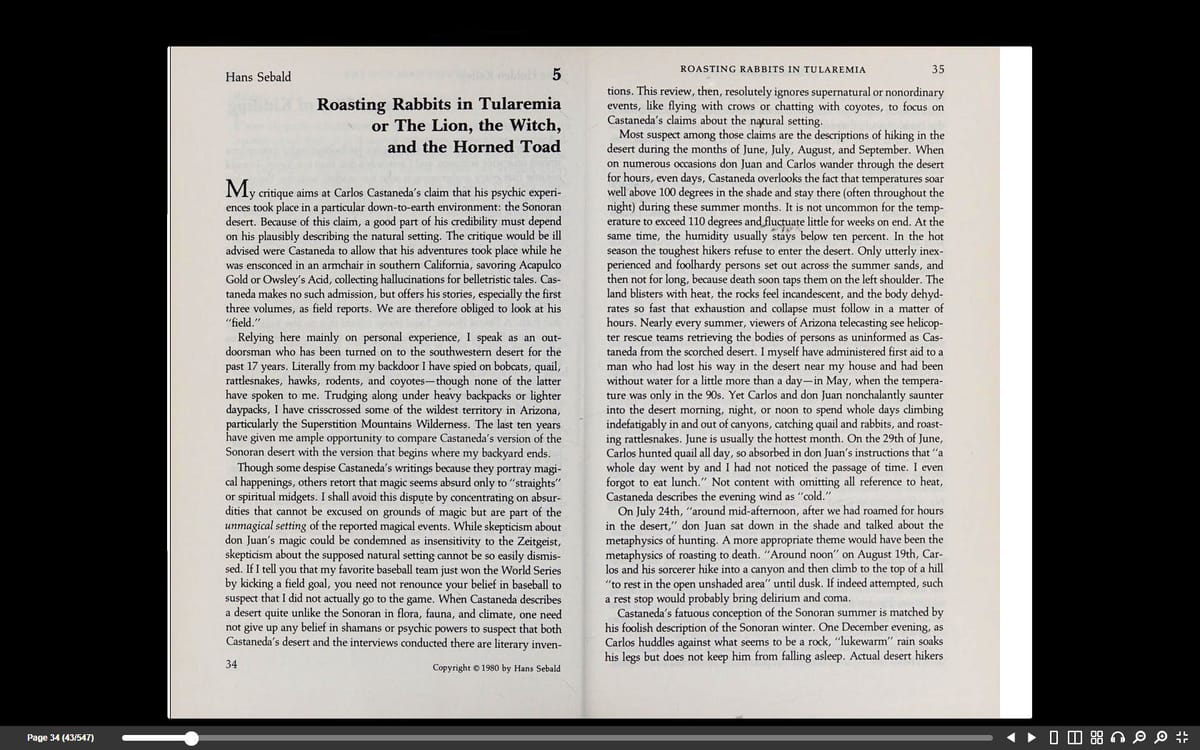
Roasting Rabbits in Tularemia; or The Lion, the Witch, and the Horned Toad, by Hans Sebald
From The Don Juan Papers: Further Castaneda Controversies.
(Note: the odd thing is that I first read this essay many, many years ago, and though it must have struck me as irrefutable at the time, it didn’t actually work as a crowbar to move the bolder of my belief, in the way it did this time. This time, with the additional weight of all the other evidence gathered, I read it as conclusive proof that Castaneda made up at least a major part of his early accounts of apprenticing with don Juan; which isn’t the same as saying there was nothing true, or even, accurate in them.)
My critique of Carlos Castaneda’s claim that his psychic experiences took place in a particular down-to-earth environment: the Sonoran desert. Because of this claim, a good part of his credibility must depend on his plausibly describing the natural setting, The critique would be ill advised were Castaneda to allow that his adventures took place while he was ensconced in an armchair in southern California, savoring Acapulco Gold or Owsley’s Acid, collecting hallucinations for belletristic tales. Castaneda makes no such admission, but offers his stories, especially the first three volumes, as field reports. We are therefore obliged to look at his “field.”
Relying here mainly on personal experience, I speak as an outdoorsman who has been turned on to the southwestern desert for the past 17 years. Literally from my backdoor I have spied on bobcats, quail, rattlesnakes, hawks, rodents, and coyotes—though none of the latter have spoken to me. Trudging along under heavy backpacks or lighter daypacks, I have crisscrossed some of the wildest territory in Arizona, particularly the Superstition Mountains Wilderness. The last ten years have given me ample opportunity to compare Castaneda’s version of the Sonoran desert with the version that begins where my backyard ends.
Though some despise Castaneda’s writings because they portray magical happenings, others retort that magic seems absurd only to “straights” or spiritual midgets. I shall avoid this dispute by concentrating on absurdities that cannot be excused on grounds of magic but are part of the unmagical setting of the reported magical events. While skepticism about don Juan’s magic could be condemned as insensitivity to the Zeitgeist, skepticism about the supposed natural setting cannot be so easily dismissed. If I tell you that my favorite baseball team just won the World Series by kicking a field goal, you need not renounce your belief in baseball to suspect that I did not actually go to the game. When Castaneda describes a desert quite unlike the Sonoran in flora, fauna, and climate, one need not give up any belief in shamans or psychic powers to suspect that both Castaneda’ desert and the interviews conducted there are literary inventions. This review, then, resolutely ignores supernatural or nonordinary events, like flying with crows or chatting with coyotes, to focus on Castaneda’ claims about the natural setting.
Most suspect among those claims are the descriptions of hiking in the desert during the months of June, July, August, and September. When on numerous occasions don Juan and Carlos wander through the desert for hours, even days, Castaneda overlooks the fact that temperatures soar well above 100 degrees in the shade and stay there (often throughout the night) during these summer months. It is not uncommon for the temperature to exceed 110 degrees and fluctuate little for weeks on end. At the same time, the humidity usually stays below ten percent. In the hot season the toughest hikers refuse to enter the desert. Only utterly inexperienced and foolhardy persons set out across the summer sands, and then not for long, because death soon taps them on the left shoulder.
The land blisters with heat, the rocks feel incandescent, and the body dehydrates so fast that exhaustion and collapse must follow in a matter of hours. Nearly every summer, viewers of Arizona telecasting see helicopter rescue teams retrieving the bodies of persons as uninformed as Castaneda from the scorched desert. I myself have administered first aid to a man who had lost his way in the desert near my house and had been without water for a little more than a day—in May, when the temperature was only in the 90s. Yet Carlos and don Juan nonchalantly saunter into the desert morning, night, or noon to spend whole days climbing indefatigably in and out of canyons, catching quail and rabbits, and roasting rattlesnakes. June is usually the hottest month. On the 29th of June, Carlos hunted quail all day, so absorbed in don Juan’s instructions that “a whole day went by and 1 had not noticed the passage of time. I even forgot to eat lunch.” Not content with omitting all reference to heat, Castaneda describes the evening wind as “cold.”
On July 24th, “around mid-afternoon, after we had roamed for hours in the desert,” don Juan sat down in the shade and talked about the metaphysics of hunting. A more appropriate theme would have been the metaphysics of roasting to death. “Around noon” on August 19th, Carlos and his sorcerer hike into a canyon and then climb to the top of a hill “to rest in the open unshaded area” until dusk. If indeed attempted, such a rest stop would probably bring delirium and coma.
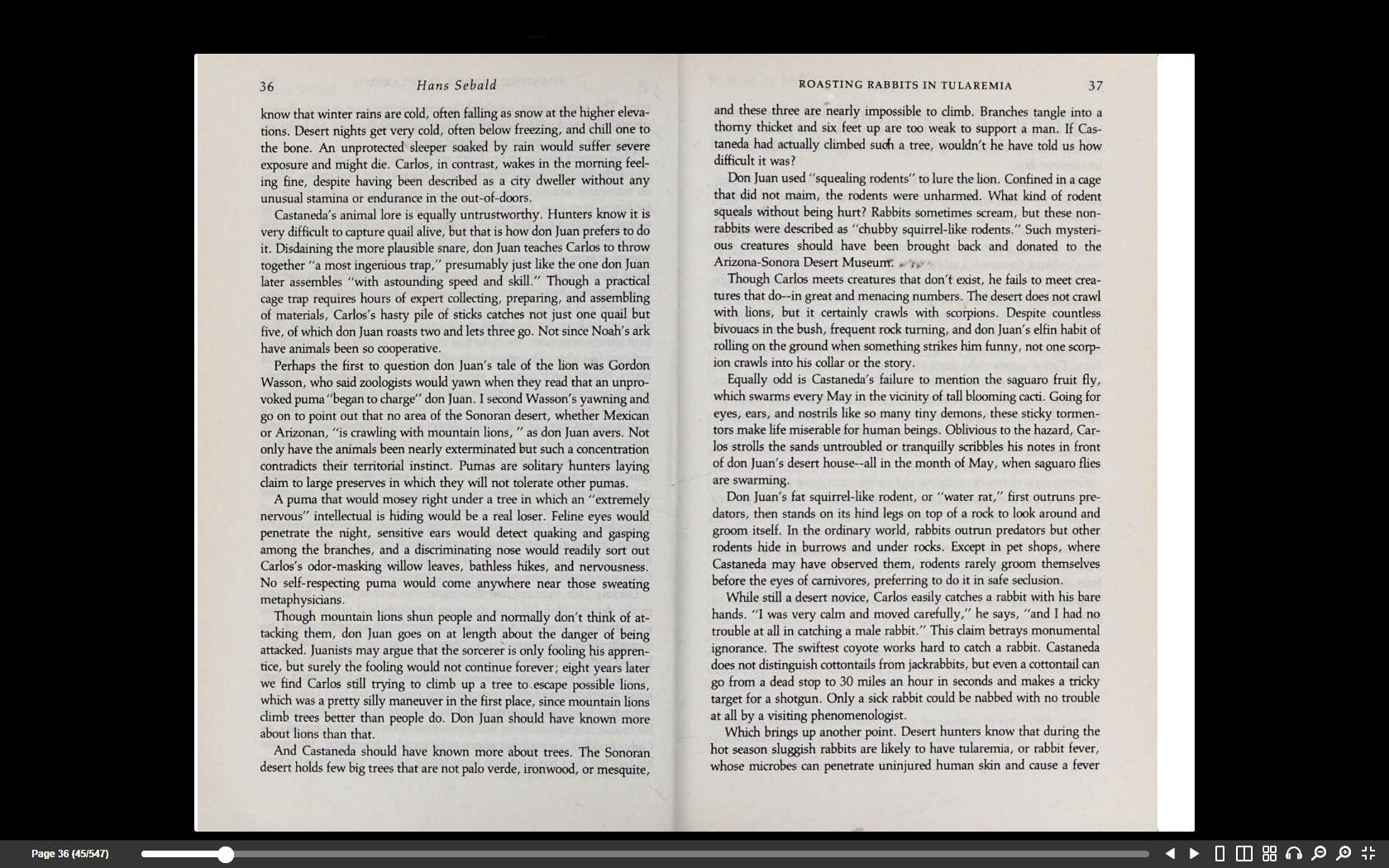
Castaneda’s fatuous conception of the Sonoran summer is matched by his foolish description of the Sonoran winter. One December evening, as Carlos huddles against what seems to be a rock, “lukewarm” rain soaks his legs but does not keep him from falling asleep. Actual desert hikers know that winter rains are cold, often falling as snow at the higher elevations. Desert nights get very cold, often below freezing, and chill one to the bone. An unprotected sleeper soaked by rain would suffer severe exposure and might die. Carlos, in contrast, wakes in the morning feeling fine, despite having been described as a city dweller without any unusual stamina or endurance in the out-of-doors.
Castaneda’s animal lore is equally untrustworthy. Hunters know it is very difficult to capture quail alive, but that is how don Juan prefers to do it. Disdaining the more plausible snare, don Juan teaches Carlos to throw together “a most ingenious trap,” presumably just like the one don Juan later assembles “with astounding speed and skill.” Though a practical cage trap requires hours of expert collecting, preparing, and assembling of materials, Carlos’s hasty pile of sticks catches not just one quail but five, of which don Juan roasts two and lets three go. Not since Noah’s ark have animals been so cooperative.
Perhaps the first to question don Juan’s tale of the lion was Gordon Wasson, who said zoologists would yawn when they read that an unprovoked puma “began to charge” don Juan. I second Wasson’s yawning and go on to point out that no area of the Sonoran desert, whether Mexican or Arizonan, “is crawling with mountain lions,” as don Juan avers. Not only have the animals been nearly exterminated but such a concentration contradicts their territorial instinct. Pumas are solitary hunters laying claim to large preserves in which they will not tolerate other pumas.
A puma that would mosey right under a tree in which an “extremely nervous” intellectual is hiding would be a real loser. Feline eyes would penetrate the night, sensitive ears would detect quaking and gasping among the branches, and a discriminating nose would readily sort out Carlos’s odor-masking willow leaves, bathless hikes, and nervousness. No self-respecting puma would come anywhere near those sweating metaphysicians.
Though mountain lions shun people and normally don’t think of at- tacking them, don Juan goes on at length about the danger of being attacked. Juanists may argue that the sorcerer is only fooling his apprentice, but surely the fooling would not continue forever; eight years later we find Carlos still trying to climb up a tree to escape possible lions, which was a pretty silly maneuver in the first place, since mountain lions climb trees better than people do. Don Juan should have known more about lions than that.
And Castaneda should have known more about trees. The Sonoran desert holds few big trees that are not palo verde, ironwood, or mesquite, and these three are nearly impossible to climb. Branches tangle into a thorny thicket and six feet up are too weak to support a man. If Castaneda had actually climbed such a tree, wouldn’t he have told us how difficult it was?
Don Juan used “squealing rodents” to lure the lion. Confined in a cage that did not maim, the rodents were unharmed. What kind of rodent squeals without being hurt? Rabbits sometimes scream, but these non-rabbits were described as “chubby squirrel-like rodents.” Such mysterious creatures should have been brought back and donated to the Arizona-Sonora Desert Museum.
Though Carlos meets creatures that don’t exist, he fails to meet creatures that do—in great and menacing numbers. The desert does not crawl with lions, but it certainly crawls with scorpions. Despite countless bivouacs in the bush, frequent rock turning, and don Juan’s elfin habit of rolling on the ground when something strikes him funny, not one scorpion crawls into his collar or the story.
Equally odd is Castaneda’s failure to mention the saguaro fruit fly. which swarms every May in the vicinity of tall blooming cacti. Going for eyes, ears, and nostrils like so many tiny demons, these sticky tormentors make life miserable for human beings. Oblivious to the hazard, Carlos strolls the sands untroubled or tranquilly scribbles his notes in front of don Juan’s desert house—all in the month of May, when saguaro flies are swarming.
Don Juan’s fat squirrel-like rodent, or “water rat,” first outruns predators, then stands on its hind legs on top of a rock to look around and groom itself. In the ordinary world, rabbits outrun predators but other rodents hide in burrows and under rocks. Except in pet shops, where Castaneda may have observed them, rodents rarely groom themselves before the eyes of carnivores, preferring to do it in safe seclusion.
While still a desert novice, Carlos easily catches a rabbit with his bare hands. “1 was very calm and moved carefully,” he says, “and I had no trouble at all in catching a male rabbit.” This claim betrays monumental ignorance. The swiftest coyote works hard to catch a rabbit. Castaneda does not distinguish cottontails from jackrabbits, but even a cottontail can go from a dead stop to 30 miles an hour in seconds and makes a tricky target for a shotgun. Only a sick rabbit could be nabbed with no trouble at all by a visiting phenomenologist.
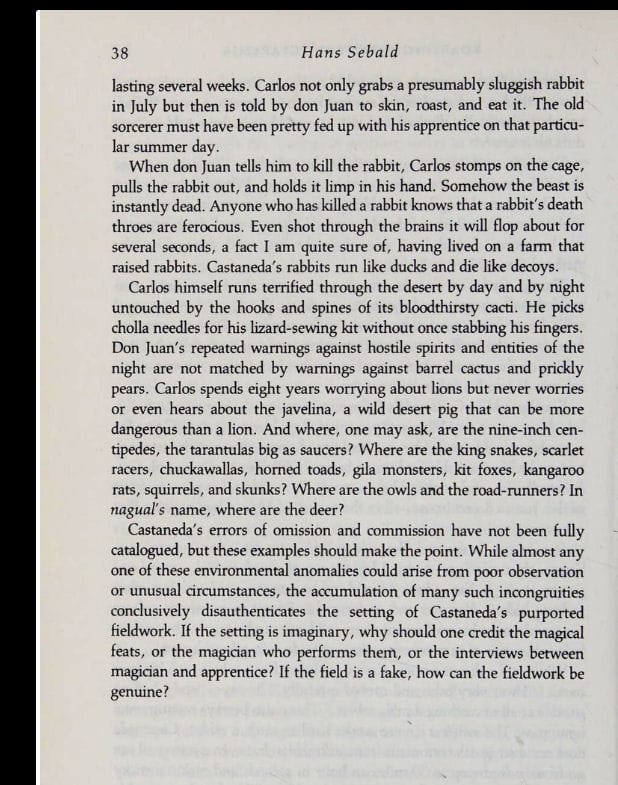
Which brings up another point. Desert hunters know that during the hot season sluggish rabbits are likely to have tularemia, or rabbit fever, whose microbes can penetrate uninjured human skin and cause a fever lasting several weeks. Carlos not only grabs a presumably sluggish rabbit in July but then is told by don Juan to skin, roast, and eat it. The old sorcerer must have been pretty fed up with his apprentice on that particular summer day.
When don Juan tells him to kill the rabbit, Carlos stomps on the cage, pulls the rabbit out, and holds it limp in his hand. Somehow the beast is instantly dead. Anyone who has killed a rabbit knows that a rabbit’s death throes are ferocious. Even shot through the brains it will flop about for several seconds, a fact I am quite sure of, having lived on a farm that raised rabbits. Castaneda’s rabbits run like ducks and die like decoys.
Carlos himself runs terrified through the desert by day and by night untouched by the hooks and spines of its bloodthirsty cacti. He picks cholla needles for his lizard-sewing kit without once stabbing his fingers. Don Juan’s repeated warnings against hostile spirits and entities of the night are not matched by warnings against barrel cactus and prickly pears. Carlos spends eight years worrying about lions but never worries or even hears about the javelina, a wild desert pig that can be more dangerous than a lion. And where, one may ask, are the nine-inch centipedes, the tarantula big as saucers? Where are the king snakes, scarlet racers, chuckawallas, homed toads, gila monsters, kit foxes, kangaroo rats, squirrels, and skunks? Where are the owls and the road-runners? In nagual’s name, where are the deer?
Castaneda’s errors of omission and commission have not been fully catalogued, but these examples should make the point. While almost any one of these environmental anomalies could arise from poor observation or unusual circumstances, the accumulation of many such incongruities conclusively disauthenticates the setting of Castaneda’s purported fieldwork. If the setting is imaginary, why should one credit the magical feats, or the magician who performs them, or the interviews between magician and apprentice? If the field is a fake, how can the fieldwork be genuine?