
The Sorcerer’s Circle
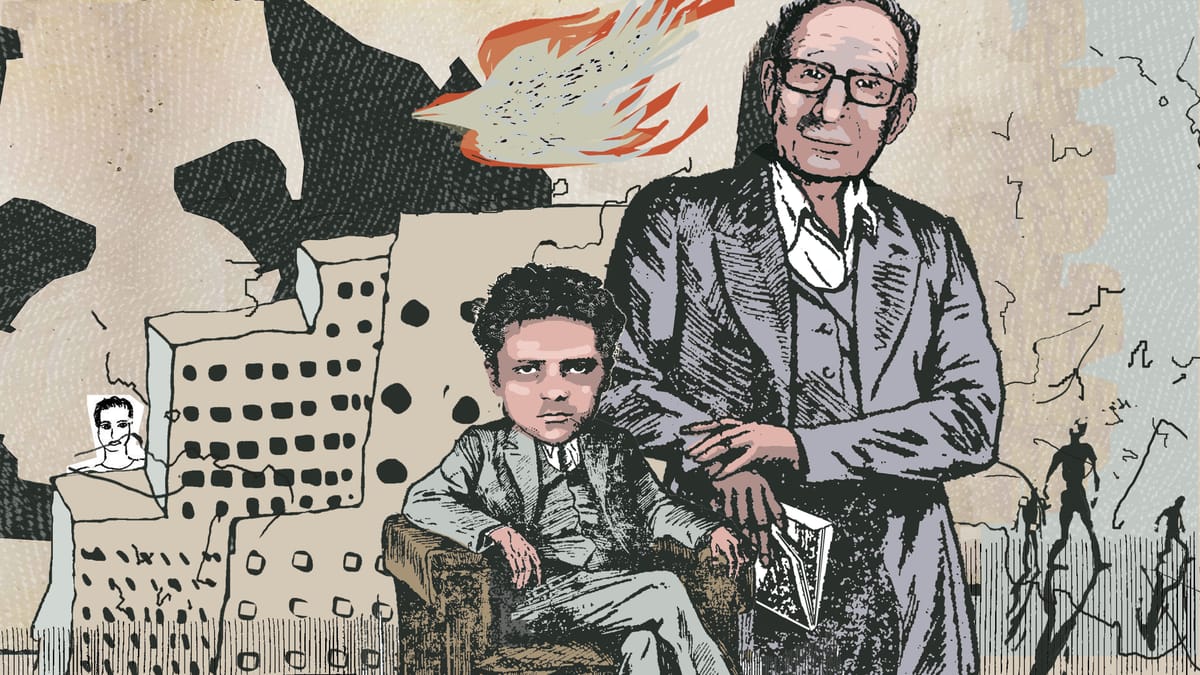
Carlos Castaneda, Harold Garfinkel & Postmodern Restructuring Reality as a Prototype of Wokism
This piece is based on a transcript of a recorded conversation between Mrs. Horsley and myself from April 9th, 2023. I am sharing it as a second interlude in my “Devil in Castaneda” series, since I came across it recently and was struck by how exactly it mirrors this current interest, right down to the context of my second Saturn return. This makes perfect sense: the conversation happened at the start of it, just as I am now at the end, a 3 yr + process. Book-ends. Coherence. The Castaneda goose is close to cooked?
Jasun: Have you ever heard of Harold Garfinkel?
Mrs. Horsley: No.
Jasun: He was one of Castaneda’s sociology professors, one of the ones that was most involved in The Teachings of Don Juan, apparently, including how it was written. Castaneda writes about Garfinkel in Active Side of Infinity, the book that came out after he died. You know about Wittgenstein. Wittgenstein was kind of a forerunner of Garfinkel. Garfinkel is considered one of the fathers of postmodernism.
Mrs. Horsley: That’s surprising.
Jasun: Garfinkel created something called ethnomethodology. From The Don Juan Papers:
Garfinkel’s creation developed into something more or less independent of sociology, whether one would call it a discipline, a specialty, a sect, a cult, a rebellion, or a conspiracy to destroy social science from within. The central idea of ethnomethodology was that every kind of reality was a subjective, or at least “intersubjective,” achievement of people talking about things. The fundamental practice was to question what usually went unquestioned, to make a problem in what had been unproblematical (p. 68).
Continuing:
Garfinkel visited the New School of Social Research [a Fabian institution] to study with Alfred Schulz, who thereby became the conceptual grandfather of ethnomethodology. Schulz defined intersubjective reality as a “world of the We,” a world not private though subjective, a world constituted in face-to-face exchanges between people who lived in the same physical and social environment. So situated, this shared subjective world could be constantly corrected by new readings of the environment which kept it stable and dependable. Other realities were possible if the normal assumptions were suspended, worlds of special interest or make-believe, but most people returned to and depended on the normal world of the We, the common-sense reality of everyday life (p. 69).
De Mille quotes Hugh Mehan and Houston Wood:
“I do not wish to call one or another reality paramount, it is my contention that every reality is equally real. No single reality contains more of the truth than any other. On this view, common-sense reality and scientific theorizing are not to be preferred to shared fantasies even by social scientists. All are constructed moment-to-moment by what people say to each other.” . . . Garfinkel thought up some diabolical schemes for calling assumptions into question, techniques labeled “breaching” procedures because they tore holes in people’s shared understandings and disrupted their social relations. Students were sent home on vacation with instructions to act like boarders. They were told to conduct conversations as though they suspected the other persons were trying to trick or mislead them.
He gave them all these exercises to disrupt reality. It’s kind of like gaslighting in a way.
Mrs. Horsley: It’s operational in the world now, all those techniques, that understanding; even in the universities.
Jasun: Some years later, Arnold Mandel, a brain scientist who was an apprentice of Garfinkel,
conjectured that making up field reports might be one way to satisfy Garfinkel’s insistence that realities reported by social scientists are not discovered “out there” in the world but “achieved” as meaning is achieved by two people having a conversation. Mandell thought don Juan might be the perfect example of such achievement, a separate social-science reality manufactured out of imaginary conversations to fulfill Garfinkel’s expectations. “OutGarfinkeling Garfinkel,” he called it. [Stephen Murray wrote] “Perhaps. . . the whole cycle of Don Juan is a giant breaching experiment showing how trust allows invention to be taken as ethnography” (p. 71).
Mehan and Wood’s book Reality of Ethnomethodology contains a section titled “The Permeability of Realities”; it “proposes that a change of social conditions may cause a person to pass from an old reality to a new and different one, as through a permeable membrane” (p. 71).
If Castaneda was practicing under Garfinkel, and Garfinkel was developing this methodology, the implication is that Castaneda turned his anthropological project into an attempt to practice what Garfinkel was proposing, by creating a fabricated reality on the premise that facts don’t matter, but that representations of reality, narratives, can create reality. That’s the premise, and one way or another it appears it was what Castaneda was attempting: to create “a separate reality” by inventing a narrative.
Jasun: There are two examples cited by de Mille, the content of which seem obviously connected to “woke” ideology. One is about the author of Keep the River on your Right, Tobias Shneebaum. The book is about him going into the Amazon jungle and spending time among a tribe of native people, where he overcomes his sociocultural conditioning and gets more and more involved in the weird behaviors of the tribe. Specifically, he gets involved in homosexual rituals, but eventually that extends to murder and cannibalism. The book is written as if he was a normal guy who went native, went Foucaultian, you might say.
When looked into more closely, however, as de Mille does, it turns out Shneebaum was a closet homosexual who had been indulging in fantasies about cannibalism since he was a child. While he did do some anthropological research, and even spent time with native peoples, he made up the parts about their devious behaviors, and certainly about his own resistance to such things. It turned out that was actually why he was writing about it, so he could liberate these desires and live them out.
(It is a bit like Margaret Mead’s infamous misrepresentation of sexuality among a Samoan tribe, a way of suggesting that these deviant desires are natural. Shneebaum misrepresented himself, but he also misrepresented a lot of the facts.)
The second example is even more telling, and concerns a transgender man, Agnes:
a nineteen-year-old, unmarried, Caucasian typist referred to the UCLA Department of Psychiatry for Clinical Evaluation. Agnes had long blonde hair, pretty face, a pleasant alto voice, and a tight sweater modeling a 38-inch burst. Agnes wanted a sex change operation (p. 75).
Agnes had a penis and balls, but also breasts, and was trying to pass for a woman. Garfinkel found out about her and turned him/her into a case study. (It was 1958, and Castaneda was around, but this was two years before he claimed he met don Juan.) Garfinkel was interested in the case as an example of constructed reality: here was a person that was neither sex, who was forced to conform to a single sex when in fact they were both/neither. He believed that Agnes was
“a unique type of a most rare disorder: testicular feminization syndrome,” a condition in which male gonads secrete female hormones in sufficient quantity to develop female genitalia, and eventually breasts for a person who began life as a genetic male. The uniqueness in Agnes’ case consisted in the possession of penis and testes along with ample breasts, beardlessness, soft skin, and feminized pelvis (p. 75).
Agnus had a “sex change” operation, but it later came out that he had been taking hormones for years and lied about it. Garfinkel was indifferent to the new data, however; he was only interested in demonstrating his premise. So here we have another kind of hoax that he was involved in, knowingly or not, and in which he was seemingly indifferent to the truth.
Donning his cap of naiveté and his cloak of mediocrity, [Castaneda] proceeded cleverly to construct a magic mirror that would reflect ethnomethodology back to its practitioners. Garfinkel’s bad sociologists and deplorable anthropologists appeared in the mirror as the Structural Analysis [the unreadable second part of The Teachings of Don Juan] and as a thick-headed Carlos who could never understand what don Juan was talking about and kept begging him to say it all over again in so many words. . . . The ethnomethodologists were flagrant rebels in sociology. A specialty in which truth is whatever anybody says it is was made to order for a man who had already changed his name, age, country of birth, native language, and family history (de Mille, p. 81, 84).