A Subtle Weave
The Old Testament, Holy Book or Blueprint for Sociopathy? (Worldview Warfare Part 7)
Reading from and responding to Our God Is Your God Too, But He Has Chosen Us: Essays on Jewish Power, by Laurent Guyénot.
Part 1 Part 2 Part 3 Part 4 Part 5 Part 6
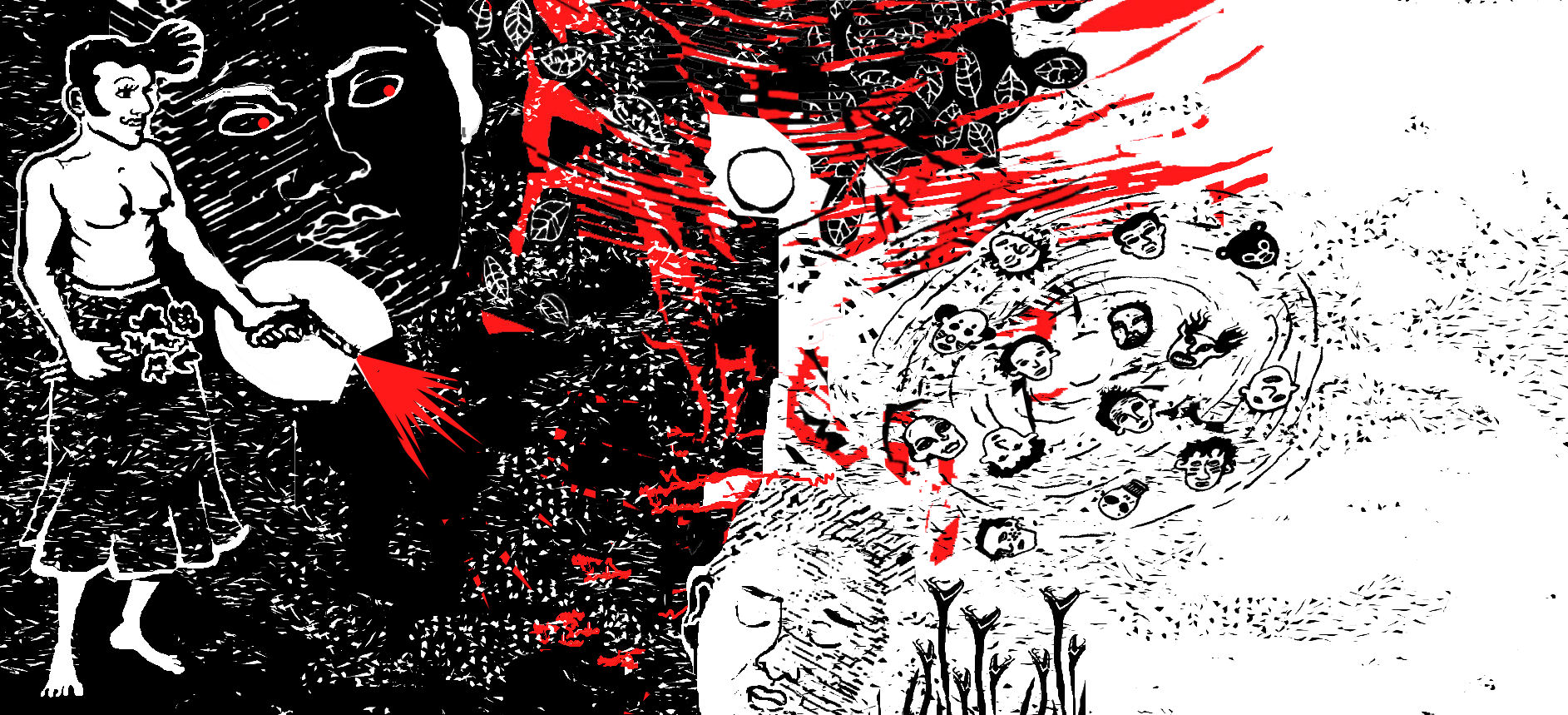
(Art by Michelle Horsley)
Moral Awareness
The Hebrew word for “knowledge,” daat, translates in Greek as gnosis, meaning inner awareness or insight rather than intellectual knowledge, so that “knowledge of good and evil” can be accurately translated as “moral conscience” (p. 153).
Funnily enough, this (very simple) thought occurred to me a few months back, though it is an idea consistent with the Gnostic inversions of the story, that the Serpent was setting Adam and Eve free from a tyrannical demiurge; so it is very far from a new idea. But then, also recently, I read Jacques Ellul’s Subversion of Christianity, which gives a convincing alternate meaning in line with the Judaeo-Christian view.
Certainly, the whole point of the story is that this knowledge came prematurely, before we were ready for such awareness, or to choose between good and evil. If a child’s conscience is awakened too soon, they may become ashamed of natural behaviors (imagine a baby made aware that its poop is dirty).
This is essentially what happened to Adam and Eve, making sin and shame both inevitable and interchangeable. Rather than the one being caused by the other, they may be roughly synonymous.
The fable has something to do specifically with prematurely awakened sexuality, and in a more general way with premature freedom. Children who are given too much freedom will choose unwisely, and then they will suffer. They will even bring terrible things into their lives, such as death! The moral of the story is that we need guidance from our parents—particularly the father—until we can stand on our own two feet and make wise choices.
Joseph & Judeo-Parasitism
Guyénot describes Joseph, son of Jacob, as an archetypal parasitic hero. Joseph starts out as a slave in Egypt, climbs the ladder to become chancellor to the Pharaoh, obtains land holdings in the best parts of Egypt, manages the national grain reserves, stores up large quantities while the harvest is good in preparation for the famine, gets a good deal on the monopolized grain, and thereby accumulates all the capital in Egypt and Canaan. After that, he gets the hungry peasants to relinquish their herds in exchange for grain.
This is a very different view of the Genesis story to René Girard’s, who saw it as a very early text exposing the scapegoat mechanism. It would be hard to reconcile those two perspectives, but not impossible, and to do so would make Guyénot’s arguments deeper and more nuanced, as well as more compelling (though also perhaps harder to grasp).
The difference is between, on the one hand, a “microcosmic” reading of the character dynamics and a macrocosmic one, of the sociopolitical mechanics; and on the other hand, between a subtle, symbolic, or internally focused reading, and a more literal, externally oriented one. Ironically, Guyénot is reading Genesis as if it were a reliable history of the Israelites, rather than a symbolic narrative meant to illustrate something else. This is an error that is central to the pathological behaviors that—as Guyénot is continuously arguing—have been fueled by the Biblical texts.1
Guyénot quotes Henry Ford’s The International Jew:
The Jews congregate in their greatest numbers in those places and among those people where they complain they are least wanted. The explanation most frequently given is this; the genius of the Jew is to live off people; not off the land, not off the production of commodities from raw material, but off people. Let other people till the soil; the Jew, if he can, will live off the tiller. Let other people toil at trades and manufacture; the Jew will exploit the fruits of their work (p. 51).
Guyénot, after Ford, sees this as parasitism: that Israel, in a metaphorical but to some degree literal sense, lives off other nations. He quotes Deuteronomy 6:10-11:
And it shall be, when the LORD thy God shall have brought thee into the land which he sware unto thy fathers, to Abraham, to Isaac, and to Jacob, to give thee great and goodly cities, which thou buildedst not, And houses full of all good things, which thou filledst not, and wells digged, which thou diggedst not, vineyards and olive trees, which thou plantedst not; when thou shalt have eaten and be ful;
And Isaiah 60:16: “Thou shalt also suck the milk of the Gentiles, and shalt suck the breast of kings: and thou shalt know that I the LORD am thy Savior and thy Redeemer, the mighty One of Jacob.”
Sins of the Fathers
Guyénot has a number of quotes to support his thesis, and while not necessarily taken out of context, they are (inevitably) isolated from other passages and from the overall picture created by the Old Testament. In Nehemiah 6, for example, there is a passage that is clearly an attempt to correct, not perpetuate, economic social injustice:
Moreover I and my brothers and my servants are lending the money and grain. Let us stop this taking of interest. Restore to them this very day their fields of vineyards, their olive orchards, and their houses, and the interest on money, grain, wine, and oil that you have been exacting from them.