
Wayfarers of the Lord
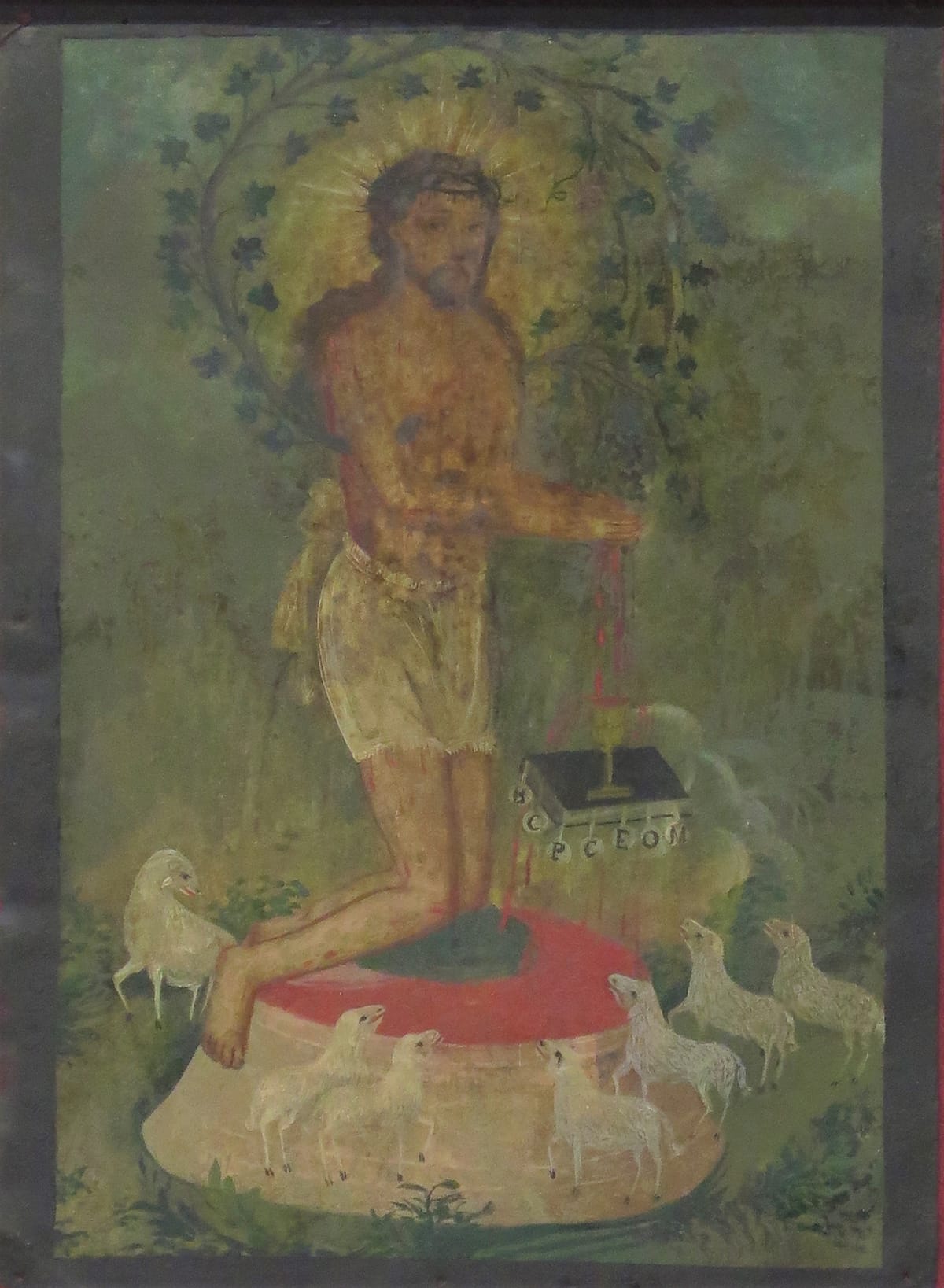
Christian Cannibalism
I have never, ever been able to understand the Eucharist. “This is my body: eat it. This is my blood: drink it.”
I’ve had pretty dark periods in my life, but I never went that deep or dark. I know it’s symbolic, but surely symbols should have resonance and not create a visceral disgust reaction? OK, Jesus Christ is supposed to be the skandalon, a stumbling block; but that’s the cross, not communion.
Although I never wanted to do communion myself, so never really cared about this question, I still have wanted to understand why it became so central, and what it meant. I’d heard that Steiner seemed to think the ritual did have meaning, which made me wonder even more.
It turns out that, in Steiner’s book, the Eucharist isn’t symbolic, because it’s literally the blood of the Earth, it’s literally the body of the Earth, since for Steiner, the Earth is Christ. That means anything that comes from the Earth is Christ’s body or blood.
Infinitely Expanding Christ
Last week I summed up my understanding about churchianity in a single tweet (which went almost totally unseen): The Gospel (& charismata) of Jesus Christ is infinitely greater than anything that could ever be confined to, or defined by, Christianity. Praise the Lord! (1 Corinthians 7:17-23)
I find this idea beautiful and moving. But it’s ironic, because I’m really saying the church sucks, though only because the church is claiming to have dibs on Jesus Christ. If it didn’t claim that, I’d be fine with churches, all of them, even the Mormons (though that’s a stretch). The problem is that they want to claim to be the Way (especially the EO, but essentially they all do).
But none of them are the Way. They might be a way to the Way, for some people; but they can’t ever be the Way, because the Way is Christ.
What Paul was doing in the pre-church days was proclaiming the gospel of Jesus Christ to anyone who would listen. If you were a Jew or a Hellenist or a Roman, it didn’t matter. You did have to listen, you had to hear the proclamation. The words meant something, of course. But there wasn’t the idea of a conversion (not even Paul converted, though he had a change of heart and mind).
There was baptism, true, but we don’t really know what baptism was in those early days. Steiner has his views on that, at least on what John the Baptist was doing, and it was a lot more than a symbolic act. Few Christians know that Jesus’ disciples were baptizing alongside John in the early days, which suggests that Jesus was too, even though John—or more likely a redactor—denies it a few verse later.
So we don’t know exactly what was going on, what the requirements were, or how official it was, joining an early ecclesia, as compared to how official it later became (maybe as early as the late first-century, but definitely after Paul died).
Earliest Ecclesia
Quick history lesson. The Pastoral letters (to Timothy and Titus) attributed to Paul, which no biblical scholar considers authentic today, are a sort of Pauline damage control. “We can’t handle this Paul guy, and we definitely can’t follow his example. All this charismata and the enthusiasm, it’s just a crazy house! It’s anarchy!” Which is probably true: even Paul had his hands full with the Corinthians going to prostitutes now they were no longer under the law, and gnostic elitism, etc.
So the very early, post-Pauline church had to impose onto this free ecclesia administrative offices, bishops, sacraments, etc., and turn everyone not officially appointed to some office into the laity. Gifts of the spirit no longer counted. 2 Peter (an obvious fake) even prohibits interpretations of scripture that aren’t officially sanctioned by the church!
Prior to that, when Paul was doing what Paul was doing, the ecclesia was a gathering of people interested in hearing the word of Jesus Christ, the proclamation, and that was it. You heard the good news, and you had to confess: things like “Jesus Christ, risen from the dead,” “Jesus is the Lord,” and so on. But it was the spirit that mattered.
Today, most people who confess that “Jesus Christ is the Lord” do it because the church tells them to, or at best, because they read it in the New Testament. They don’t have someone like Paul modeling the way and improvising. In that environment, in those initial days, there might have been all kinds of spontaneous proclamations which didn’t sound anything like what eventually made it into the New Testament.
It is the spirit that counts, not the letter. The letter killeth. The spirit giveth life. So if you have the word without the spirit, it just kills what spirit there is. If you have the spirit with the word, then the word gives life. You can have words, of course. But without the spirit, words are worse than nothing.