
The Spirit of Don Juan (A Novelist’s Dream)
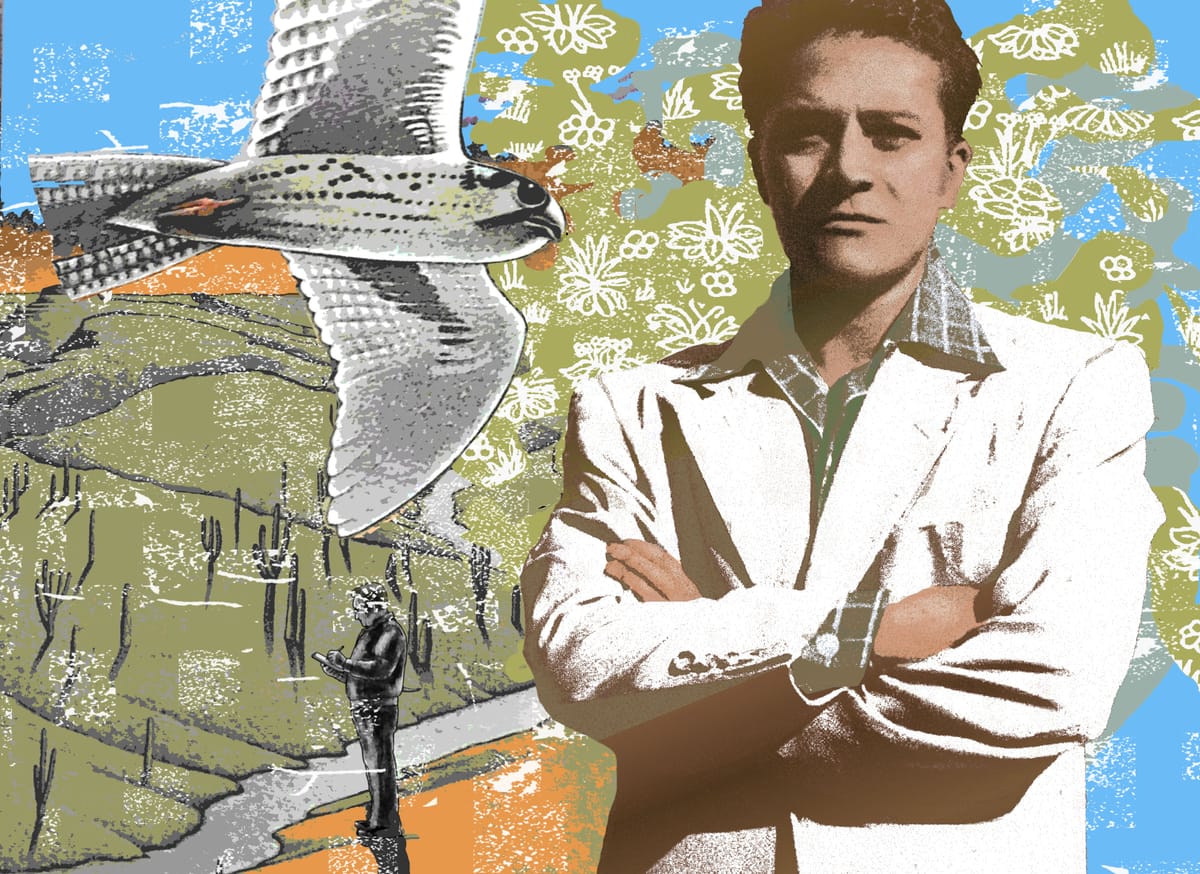
The Devil in Carlos Castaneda: American Trickster & a Sorcerer's Redemption, Part Four
(Audio at end)
Theodore Roszak: Just as a technical problem, how were you able to keep track of your experiences over such a long period of time? How were you able to record all of this?
Castaneda: It seems difficult, but since one of the items of the learning process is recapitulation [of] whatever you experience, in order to remember everything that happened, um, I uh had to make mental notes of all the steps, of all the things that I saw, all the events that occurred during the states of let’s say expanded consciousness. And then it was easy to translate a mental writing after, uh, because I had them all, uh, uh, meticulously filed, sort of, in my mind. That’s as the experience itself goes, but then the questions and answers, I simply wrote them down.
Roszak: Oh, you were able to take notes while you were —?
Castaneda: Not at the very beginning of our relation, you see, I never, I took notes in a covert manner. I had a pad of paper inside my pockets, you know, big pockets on my jacket, and I used to write inside my pockets. This is a technique, you know, that ethnographers use sometimes, to take covert notes. And then of course you have to work very hard to decipher what you’ve written. But it has to be done very quickly, see, very fast. As soon as you have time, you cannot postpone anything. You cannot let it go for the next day, because you lose everything. Since I think I work compulsively, I was capable of writing down everything that took place, uh, very, very shortly after the events themselves.
One wonders how this was possible in the early period, when Castaneda reports being with don Juan for prolonged periods of time. Obviously, he wasn’t traveling from Los Angeles to Sonora and back again as a day trip, so how would he be able to transcribe his secretly scribbled notes into something legible immediately after, without don Juan being around to see it?
On the other hand, the fact Castaneda mentions the recapitulation as early as 1969, though it doesn’t come into the books until The Eagle’s Gift, twelve years later, is a significant indication that Castaneda wasn’t simply making things up as he went along.
The Books
“I had astonishing experiences with Carlos that are difficult to explain. . . You can’t say his work is factual, but you can’t say it’s false either. It’s so much more complex than that. He did have profound experiences of his own. And he had a great deal of ethnographic knowledge. He also engaged in elaborate role-playing that he pushed to the point that I think he could no longer tell the difference. But the thing that set Carlos apart was his genius for taking all this and communicating it in a way that truly moved people.” —Douglass Price-Williams (quoted in “Dreaming Castaneda,” LA Weekly, July 1, 1998)
The main exhibit for the case for the defense—not of Castaneda per se, but of the books and for the reality of don Juan (or at least of some sort of “Toltec” sorcerers lineage that Castaneda encountered)—is the books themselves. American Trickster never resolves this question. Instead, it preempts the need to do so, with recurring subjective statements presented as facts.
The assertion, for example, that the first book is the best-written of the series (I always considered it the least). Or that the subsequent books get sloppier and more “tortured” as they proceed, less and less coherent and more obviously fiction.1 Or the common claim—made by almost all critics of Castaneda, including Manuel Carballal—that Castaneda was opportunistically inventing, and then back-dating, material for each new book, in response to the growing demand.
In the only radio interview CC ever did, on 30th January 1969, with Theodore Roszak, he said this:
The way the books are presented seems to heighten some dramatic sequence, which is, I’m afraid, not true in real life. There are enormous gaps in which ordinary things took place. They are not included. I didn’t include them, because they did not pertain to the system I wanted to portray. I just simply took them away. That means that the [material] crescendos, a kind of sequence leading to a very dramatic solution. In real life . . . it took years [and] in the meantime we did all kinds of things. We went hunting. He taught me how to trap things. . . very old, old ways of setting up traps, and how to catch rattlesnakes. He taught me how to prepare rattlesnakes.
The accounts of hunting rattlesnakes are a central part of Journey to Ixtlan, not published until 1973. This means either that Castaneda was telling the truth, or that he had planned the first three books well in advance, more or less as they appeared.
My own experience of the books (which I read probably between 15 and 20 times between the age of twenty-one and forty) was, consistently, that they went from strength to strength, delving deeper and deeper into the sorcerers’ world. They also, I would say indisputably, became increasingly esoteric, strange, and complex in their metaphysics.
In the last two books (at the time, that is, The Fire from Within and The Power of Silence), there are descriptions of the methods, exploits, and knowledge of the seers, old and new, that seem to me—then and now—to be utterly original.
American Trickster wants us to believe that Castaneda made them up, and/or plagiarized them from a very obscure occultist source. I have very little doubt that he didn’t simply invent these accounts, and I have yet to encounter any fully convincing evidence for an outside literary source (Carballal’s book comes the closest to making a persuasive case for “many don Juans,” making don Juan a compensate, a literary conceit along the lines of Sherlock Holmes).
In decades of occult reading, I have never come across anything remotely similar to some of these later accounts. Rudolf Steiner would be the closest, but even there there’s no significant overlap. There isn’t even any prior equivalent that I know of in esoteric writing for the assemblage point, a central tenet of Castaneda’s sorcery system, one he introduced with The Fire from Within. Of any of this, American Trickster has nothing at all to say, though Carballal claimed to me that the AP, or something similar, is found in Eastern writings.
The other question American Trickster never addresses, besides the occasional reference to Castaneda’s “genius,” is the kind of prodigious literary talent that would be required to write a set of novels this compelling, suspenseful, humorous, moving, thought-provoking, philosophically coherent, and dramatically convincing—enough to persuade the world, for more than a decade (in a sense, to this day), that they belong in the non-fiction category.
It is every novelist’s dream, and if Castaneda achieved it, it would make him, not only the greatest hoaxer of the 20th century, but the greatest novelist. Ironically, the books are increasingly condemned as fiction, without the corresponding recognition, if such they are, of their unique brilliance as 20th century literature.
This is only possible because of the train wreck as which Castaneda’s journey ended. The whole thing has simply become too distasteful to contemplate, and almost no one (beside the true believers) wants to try and redeem the books, within the historical framework of a sexual abuse suicide cult.
A Transmission
“Carlos was an expert navigator of that other world. Frankly, I believe Don Juan was an entity—a spirit, if you will—that Carlos encountered while dreaming. There is a deep wisdom in his texts that cannot be regarded as either fiction or knowledgeable fabrication.” Larry Peters, “Dreaming Castaneda”
Below is an excerpt from a “channeled” text, transcribed by Liz Wu, the woman (the “sorceress,” as I referred to her at the time) I was with for four years, from late 2002 to 2006. Liz had a natural (?) ability to communicate with discarnate entities. This was an unusually long and coherent transmission, however, hence she wrote it all down as best she was able. I include only the pertinent passage, though I may share more or it at later time, as there’s a lot in it.
Knowledge is power and power is dangerous.
(I think again of Castaneda’s depiction of inorganics).
Castaneda (was afraid) because he wanted power —there is a method in awakening, a method— he was obsessed with power.
(I think of Castaneda’s depiction of the inorganic realm.)
Castaneda noticed we are communal—honeycomb like a great brain—network. We are not fixed there, (that is) just a description of what it would look like on that level—ex. the moon. The moon is a processing plant for shells.
Don Juan?
Don Juan is not/was not a man—(he is) a spirit—works to awaken you. The Castaneda books —all dreams.
The Art of Dreaming?
Written by an apprentice when he (Castaneda) went mad.
Why did he go mad?
He would not relinquish his mind.
He was tied to the body?
Yes, but more attached to the mind—wanted control, but (to) keep the shell, distrust the Spirit, distrust us.