Tanakh On Trial
The Old Testament, Holy Book or Blueprint for Sociopathy? (Worldview Warfare Part 6)
Reading from and responding to Our God Is Your God Too, But He Has Chosen Us: Essays on Jewish Power, by Laurent Guyénot.
Part 1 Part 2 Part 3 Part 4 Part 5
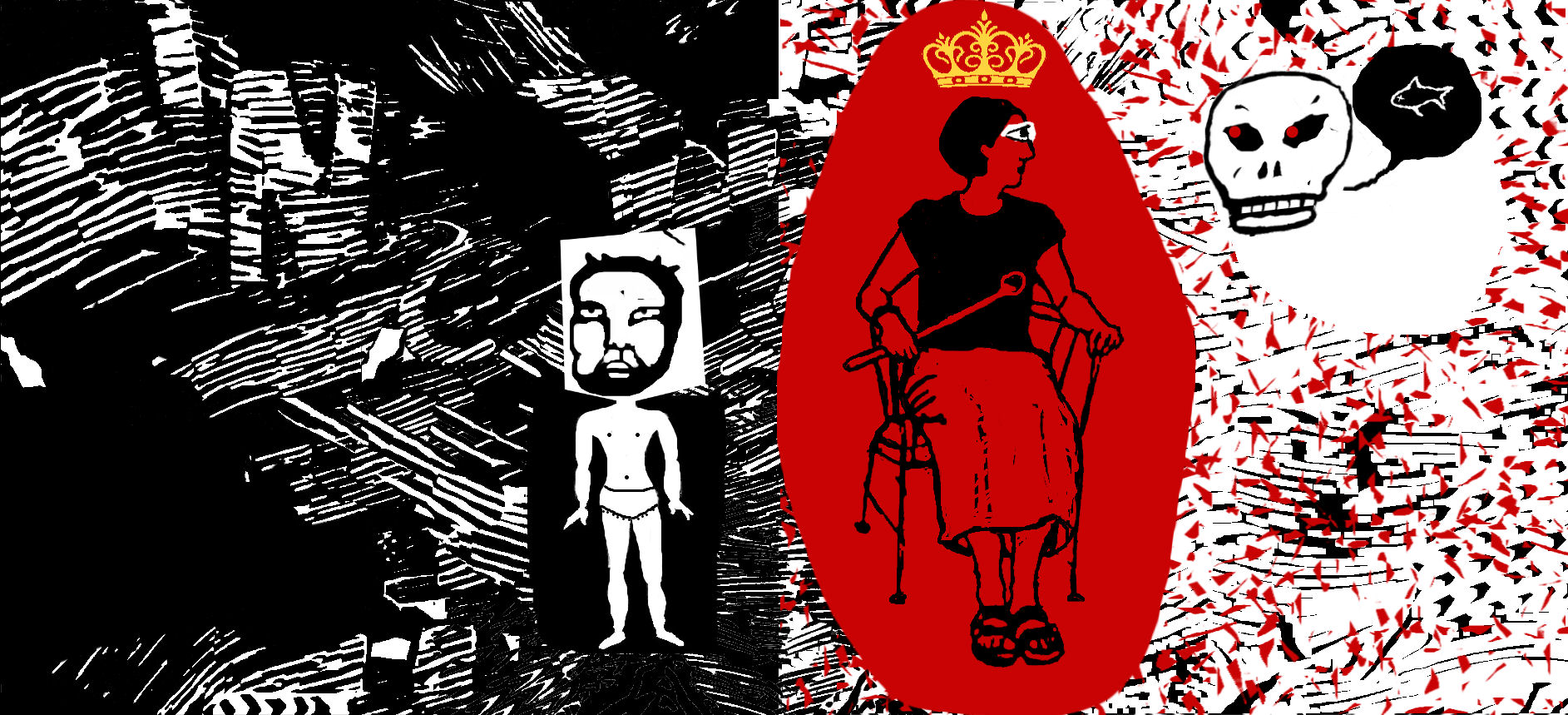
(Art by Michelle Horsley)
An Indefensible Attack
From chapter 8, “The Devil’s Trick and Masking the Psychopathic God of Israel”:
I’m neither Darwinian nor an atheist. Simply, I have reached a conclusion that the Old Testament has nothing of any worth to tell about the origin and purpose of the universe, of life and of humanity, nor any useful guidance to provide in our search for truth, beauty and justice (p. 147).
(Guyénot goes on to describe how he’s not a Gnostic either.)
While not a thesis statement, the above is a clear indication of Guyénot’s position, as regards the Old Testament, one that seems to me emotional rather logical. Guyénot is grouping the many books, and every single passage in the OT, together, and saying that there is no value in any of it.
Clearly this is a false statement. It cannot be defended on any but moral(-istic) grounds. It would be impossible for the Tanakh to have been as profoundly influential—even in a negative way—if it had no worth. One cannot move masses or shape history with a document, creed, or philosophy that has no value. It is ipso facto impossible.
As I’ve said to Guyénot directly, it is also impossible, hence unwise, to separate the good from the bad when it comes to the Old Testament; by this I mean that, any abuse of power that can be laid at the feet of the OT, cannot be separated from the power it does hold. Power can only be abused if there is power to be abused.
If Guyénot’s position about the OT is an emotional one, it raises the question as to how much this holds true for his larger—much more persuasive—argument about organized Jewry in world history.
Good & Evil
The desire to throw out baby and bathwater—to condemn something or someone that has caused us suffering—is understandable, if unreasonable.
Let us use the example of a human being, as opposed to a book: the sexual predator Jimmy Savile did a lot of “good” in his life, in terms of raising money for charity and building hospitals (which later became his hunting ground). He also did incalculable evil, and once the truth came out about Sir Jimmy, almost no one tried to argue that we shouldn’t condemn him, just because he did bad stuff, in light of all the good he did.
Jimmy Savile is perhaps not the best example, however, since the evil he did was so prodigious, and so prolific, that it’s more than enough to cancel out almost any good deed. We could certainly cite a legion of lesser examples, however. Cancel culture proceeds along the rationale that even a racially insensitive comment on social media cannot be redeemed by any other apparently good deeds or words, prior or subsequent. One can have a perfect reputation effectively destroyed overnight, within the larger community of the global village, by a single wrong word.
Somewhere in between these extremes, with cases such as Woody Allen, Roman Polanski, Kevin Spacey, or Bryan Singer—filmmakers who appear to be morally bankrupt and quite reprehensible in their private lives—it seems only reasonable to reevaluate their work through the lens of their sins, insofar as the medium is the message.

One cannot separate good from evil in human beings (only God can do that). A person can do a thousand good deeds, but one evil deed—while it doesn’t cancel out the effects of the good—in terms of our perception it becomes as if the goodness never existed. If they could commit even one such heinous act—whatever it might be—we presume they probably did similar things on other occasions, and that they will do them again, given half the chance.
With the Bible, this sort of reasoning hardly applies. Yet Guyénot has found sufficient passages in the OT to convince him of malevolence, and, like finding cyanide in the Kool-Aid, he wants to throw out the whole barrel.
Holding Texts Accountable for Influence
First of all, this depends on interpreting the text both literally and through the lens of our current cultural moral framework, which is something one simply cannot do with ancient mythological texts. One can certainly evaluate the ways in which scripture is being applied, believed, and taken literally by others—in both the past and the present—and how this can lead to great evil. But to extend that judgment automatically to the text itself is unreasonable.
It is true that I have made the opposite case with Aleister Crowley’s writings (in Vice of Kings), by arguing that they seem to advocate child sacrifice and other things. I cite this as evidence, both that Crowley was committing such acts in his lifetime, and that people who followed him were likely to commit similar acts (and that Crowley would have to have known this and even intended it to happen).
The difference, first of all, is that Crowley’s life, his actions, writings, and influence, covers a much shorter time frame that didn’t begin very long ago; secondly, it is just one man whose life can be evaluated for moral qualities (or the lack of them) and juxtaposed with the writings.
With the Old Testament, nothing of the sort is possible—even if Guyénot wants to argue that it is. There are certainly injunctions which were considered moral at the time that seem very obviously immoral to us now. Clearly, there’s a problem when such writings are applied in today’s context (vis a vis Netanyahu and the Ammonites). To say that the Old Testament is deeply flawed—even potentially catastrophic—as a moral compass for social policies is a fair, even necessary, statement; but that is very far from showing it to be worthless.