Sex, Shoah, & Sacrifice
The Old Testament, Holy Book or Blueprint for Sociopathy? (Worldview Warfare Part 5)
Reading from and responding to Our God Is Your God Too, But He Has Chosen Us: Essays on Jewish Power, by Laurent Guyénot.
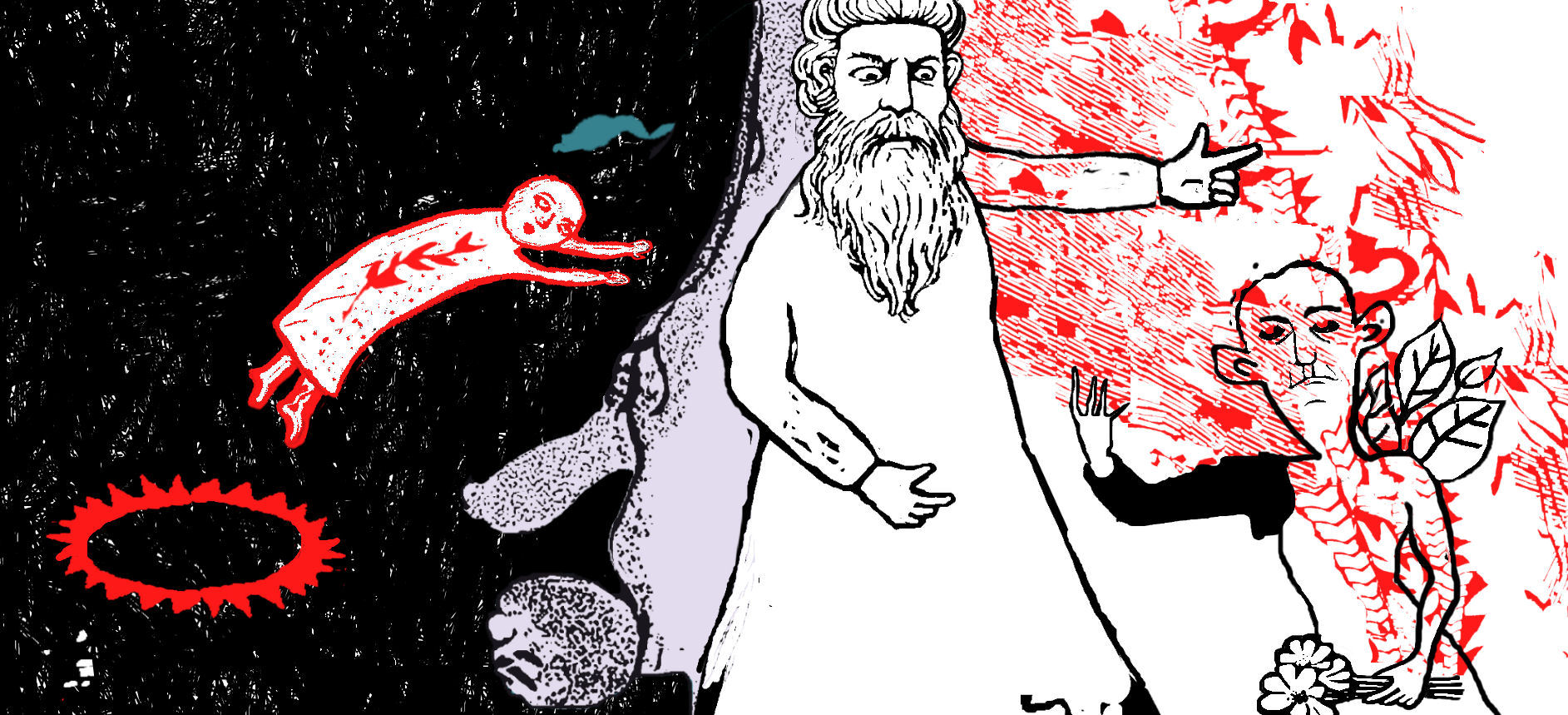
(Art by Michelle Horsley)
(This chapter mostly consists of excerpts and summations of two chapters, with minimum commentary. Next week, I hope to provide some responses.)
Sex Trafficking and Prostitution
In the sixth chapter, “The Crucified Goddess: The Rise and Fall of Western Romanticism,” Guyénot makes the claim that “Pornography, a specialization of prostitution, is almost a Jewish monopoly (p. 107).
He quotes professor Nathan Abrams, of the University of Aberdeen, who “broke the taboo” in 2004 with an article in The Jewish Quarterly about how “secular Jews” have played a “disproportionate role throughout the adult film industry in America [and] have helped transform a fringe subculture into what has become a primary constituent of Americana” (ibid.).
Leaving aside the somewhat oxymoronic meaning of “secular Jew” (what kind of Jew is he referring to, genealogically speaking?), passages of this sort run the risk of feeding into (and off) a pre-existing narrative that is content (even eager) to make correlation equal causation.
(To cite another example Guyénot gives, Jewry’s association with usury: is it a case of something innate to Jewish character, or of Jews being corralled by a social system they are prohibited from integrating with (both by their own laws and, later, by the society’s laws against them?)
Guyénot then cites Numbers 31, in which Moses “ordered his men to slaughter all the Midianites, because they had persuaded the Israelites to intermarry with the Mobites. Moses’ soldiers killed all the men but took ‘the Midianite women and their little ones captive’” (p. 108).
Moses is angry that they have spared the life of the women, since it was they who caused the Israelites to be unfaithful to Yahweh. He compromises by saying: “So kill all the male children and kill all the women who have ever slept with a man; but spare the lives of the young girls who have never slept with the man, and keep them for yourselves.”
There were 32,000 women they kept, in all, most of whom would have been children (since girls were married off as young as 11 and 12). Obviously—Guyénot points out—they were not taken as wives, because “the whole story is about the prohibition against marrying non-Jews. So we have here, I think, an unmistakable biblical precedent for the sexual enslavement of Gentile girls on a massive scale” (p. 108, 109).
Id & Yid
Having conjured thoughts of Jeffrey Epstein as a modern Moses, Guyénot moves from the particular to the general, quoting John Murray Cuddihy’s essay, “The Ordeal of Civility,” claiming that Freud’s theory of sublimation by repression comes straight from
the shtetl Jews’ inner struggle over integration: “In psychoanalysis, the ‘id’ is the functional equivalent of the ‘Yid’ in social intercourse.” Sexual liberation became a new version of the messianic ideal of universal redemption by the Jews, the “light of the nations.” And as we know, in practice, the Jewish way to save the nations is to defile their most sacred values—their gods, and, above all, the Goddess (p. 125).
Do we know this? Defile is a loaded word, but it is part of the deck Guyénot is stacking.
Guyénot cites Wilhelm Reich’s The Mass Psychology of Fascism, which argued “that anti-Semitism is a symptom of sexual frustration and can be cured by liberating the Gentiles’ libido (a message echoed in Herbert Marcuse’s Eros and Civilization, as well as in Theodore Adorno’s The Authoritarian Personality, 1950)” (p. 126). He quotes Isaac Rosenfeld—“I regard anti-Semitism as a symptom of a serious underlying psychosexual disease of epidemic proportion in our society”—and Josh Lambert:
“Much of the sexual utopianism and amateur sexology has appeared in the fiction and essays of Norman Mailer Saul Bello, Alan Ginsburg and Isaac Rosenfeld in the 1940s and 1950s elaborated upon Reich’s attempt to cure the sexual ills of all of western civilization and in so doing to relieve Jews of their role as scapegoats.” And this should not be mistaken as the traditional Jewish resentment against Christianity. It is not “Christian values” that are attacked with extreme by Hollywoodism, pornography, psychoanalysis, feminism, and homosexualism (not forgetting modern art); it is the western tradition of love, the miracle of our civilization (p. 127).
There certainly seems to be a corrosive agenda at work here, and some predominant and influential modern Jews would seem to be at or near the heart of it. But Guyénot seems to be overlooking the extent to which the Western tradition of (romantic) love came out of Christianity, if it came out of anything; and Christianity came out of Judaism. The value of love is central to the Old Testament, though admittedly not especially romantic but more of a tribal allegiance that bleeds into passages (many of which Guyénot cites) that seem to advocate the opposite values.
I may be reading him wrongly, but Guyénot here seems to be leaning towards a sort of Nietzschean nostalgia for Greco-Roman values, one that sees Judeo-Christianity as a lamentable deviation from, or degeneration of, a more authentically Western tradition. This is a mindset I am not especially well-versed on—though it seems quite familiar to me—and one I find inherently unconvincing.
For all its flaws, I see Christianity (which evolved out of Judaism), in essence if not its many institutionalized formats, as the single, all-but lost guiding star, for a rapidly darkening human culture.