(No) Technicians of the Holy
X Marks the Spot, Part Two
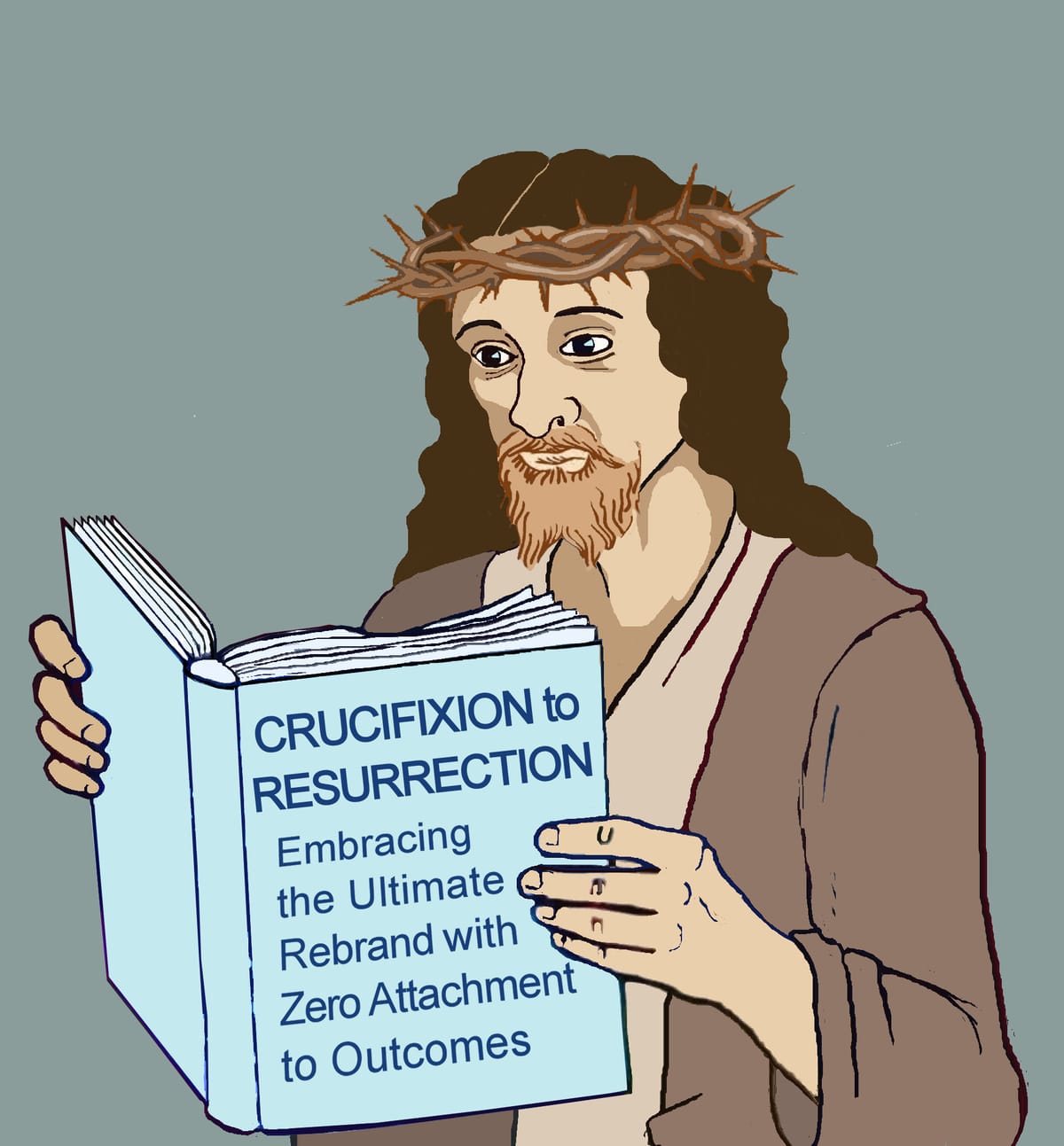
Reading from The Subversion of Christianity, by Jacques Ellul
(Audio version at the end)
(Art by Michelle Horsley)
A Church of Two
Success and the alliance with social categories of power initiated a process whereby the church became an affair of the masses. Jesus told his disciples that they were a little flock. All his comparisons tend to show that the disciples will necessarily be small in number and weak: the leaven in the dough, the salt in the soup, the sheep among wolves, and many other metaphors. Jesus does not seem to have had a vision of a triumphant and triumphal church encircling the globe. He always depicts for us a secret force that modifies things from within, that acts spiritually, that shows us community, unable to be anything else but community. . . . Christianity bears indeed an inverse relation to numbers. When all become Christians, the concept of Christianity is void. This concept is indeed a polemical one. One can be a Christian only in opposition. When opposition is suppressed, there is no more sense in saying “Christian.” Christendom has astutely abolished Christianity by making us all Christians. . . . People cannot see or understand that Christianity has been abolished by its propagation. Again, history does not offer any other example of a religion being abolished by reason of its prospering (p. 35, 36, emphasis added).
A bit later, Ellul talks about the necessity of imposing a “numerical limit” in order to practice “the Way” as the original apostles did in Acts: a small number of people who are “fully adult both in their humanity and their faith and can bear the risk of freedom” (p. 72).
To be a Christian in this original sense is to be isolated, ostracized, misunderstood, even persecuted. It is not to be part of a social set or religion. Christ was set apart from his religion, and he was condemned by the majority of practitioners of it.
This means, in our present world-context, that to be as-Christ-was means to be rejected by Christianity. At least, this would be the most obvious equivalent in our present time. It certainly would not mean belonging to any kind of large social group.
Outer Structure vs Inner Sense
The church adapted itself integrally to the pagan world. It accepted its form and even its morality. This brought with it two serious consequences. First, Christianity became what one might call the structural ideology of this particular society. It ceased to be an explosive ferment calling everything into question in the name of the truth that is in Jesus Christ, in the name of the incarnation. It gave a new basis and vitality to what was in difficulties in the empire. It restored the taste for life and culture. The problem is not merely that of the transformation of Christianity into a state religion but of the diffusion of this faith that has stopped being a faith and has become a collective ideology, a kind of manifestation of thought that collects all the commonplaces, the legends, the miracles, the “prophecies,” the apocalypses, the thaumaturgies, and formulates for the people a facile, moralistic, and constructive set of beliefs. . . . But there is no formulation of a Christian morality that is independent of faith (p. 39-40, 41).
The paradox in this is obvious. Christianity, if we allow it to work for and through us, must lead to an auto-excommunication from Christianity. One must be aware of Christianity, and of scripture, and of Christ, but then one must renounce all dependence on everything except for Christ—a Christ that cannot be defined, understood, or perceived through the Church, nor even through the scriptures, since these are all among the “things of men.”
The Way is a process of giving one’s attention to, and in some sense accepting and believing, these things, and then rejecting, renouncing, and cutting clear of them. What remains is then only the felt sense of the truth, which they were a necessary—or at least invaluable—reference point for.
They have given us the rough coordinates of something that we must now use our own inner senses to locate, and follow. We can of course still refer back to them; but they can’t ever be perceived as indispensable; not once they have given us the coordinates that we need to proceed.
Logos Beyond Logic
“We never find a single, logically connected truth followed by another truth deduced from it. There is no logic in the biblical revelation. There is no ‘either-or,’ only ‘both-and.’ We find this on every level” (p. 44).
Ellul here talks about Luther’s idea that we are both sinners and justified, that there aren’t two stages, by which we sin and then are justified through faith and acts. He points to the apparent contradiction of Paul, that we are saved through grace, and then have to work out our salvation.
We have to realize that everything in the Bible is contradictory. Yet there is revelation only as the contradictions are held together. God the Wholly Other is incarnate in a man. He is still the Wholly Other. And we have to understand—I repeat this because it is essential—that the truth is made up of the actual contradictions. Each aspect of truth is true only because it is linked to its radical opposite (p. 45).
Divine revelation transcends logic. This is because Logos is the source of logic, just as God is the source of goodness, of morality. The ultimate morality is to go beyond morality. This is indicated in the Sermon on the Mount, when Jesus says that it is not enough simply to avoid adultery, but to avoid even so much as looking at a woman with lust in our hearts.
By so saying, Jesus is taking the commandments to an inner level that is by definition far more profound and subtle, and that extends into everything—not just our actions but our thoughts, our feelings, our perceptions, even to where our eyes fall; or where we let them fall.
It turns morality into way of being: embracing a God’s eye view of ourselves, in existence. It transcends morality, not in the sense of abolishing any basis for it, rather because this is the basis for morality. We don’t need external morality, or law, because we are going directly to the source of morality.
It is becoming a slave to God; which is, paradoxically, ultimate freedom.
Ultimate Freedom
God is undoubtedly almighty and we are free. Unbelievers can never understand this. If God is almighty, they think, then we are not free. Or we are free and God is nothing. I could give multiple examples of this kind, but will stop at just one. God is absolutely transcendent. He is in heaven and we are on earth. In a radical sense, he is unknowable. No one can mount up to heaven, no one can see him, no one can know anything about it. Only a negative theology is possible (p. 44).
Ultimate freedom is ultimate responsibility. God is letting us be his instruments because we are volunteering to be God’s instruments.
Similarly, the supreme use of logic is to find a mode of perception of truth, and of reality, beyond logic. It is without logic, in the sense that ecstasy is “without” the body: not that it is lacking a body, but because it happens outside of the body, even while the body is included in the experience. (When we have an out of body experience, our senses extend both within or through the body, and outside of it.)
This relates to why scripture, as Ellul insists, must always be contradictory, because our experience of reality, as consciousness, spiritually speaking, is equivalent to bilocation: being in two places at the same time.
If we are in two places at the same time, we are seeing the object, reality, from two perspectives, perspectives that by definition will always contradict one another, because the angles of perception are different.
God in Man
At the extreme limit [God] incarnates himself wholly as man. He is fully and totally present in this Jesus Christ. He is not somewhere else. All that we can know of God is there. We do not find only a bit of God in Jesus. Everything is there, vowed and devoted to us. Humanity is the condition of God (p. 44, emphasis added).
God realizes himself as human beingness, as a human being, as human beings, or as the human, being. There is no God that is not transcendent and unknowable that can be known, beside the God that is immanent in human beings, and that is knowing himself thereby.
We can say only what God is not. Nothing more. He is the Wholly Other whom we cannot know. There is nothing in common between him and his creation. He is sovereignly himself. He shares his glory with no one. Yet at the very same time he is the God who enters human history, who accompanies Abraham and Moses and his people, who is very close and intimate, who speaks with us, who imparts to us by revelation and love all that we can bear. As Barth says, he is the hidden God precisely in that he reveals himself. And he reveals himself as the hidden God (p. 44).
This is a paradox and a contradiction in itself. Human beings can only know God as God knows himself? But then the human being is no longer himself, but God knowing himself as human? Or is it that human beings can only know God as themselves?
If we can only know God as ourselves, then we are no longer ourselves but God knowing himself through us, through being human. Yet, at the same, it is the same transcendental Wholly Other God, that is unknown and unknowable; making God, in effect, unknown even to himself, except through and as human(s) being?
Make sense of that, if you dare.
CoJ is maintained by paying subscribers; become one for a month or a year.