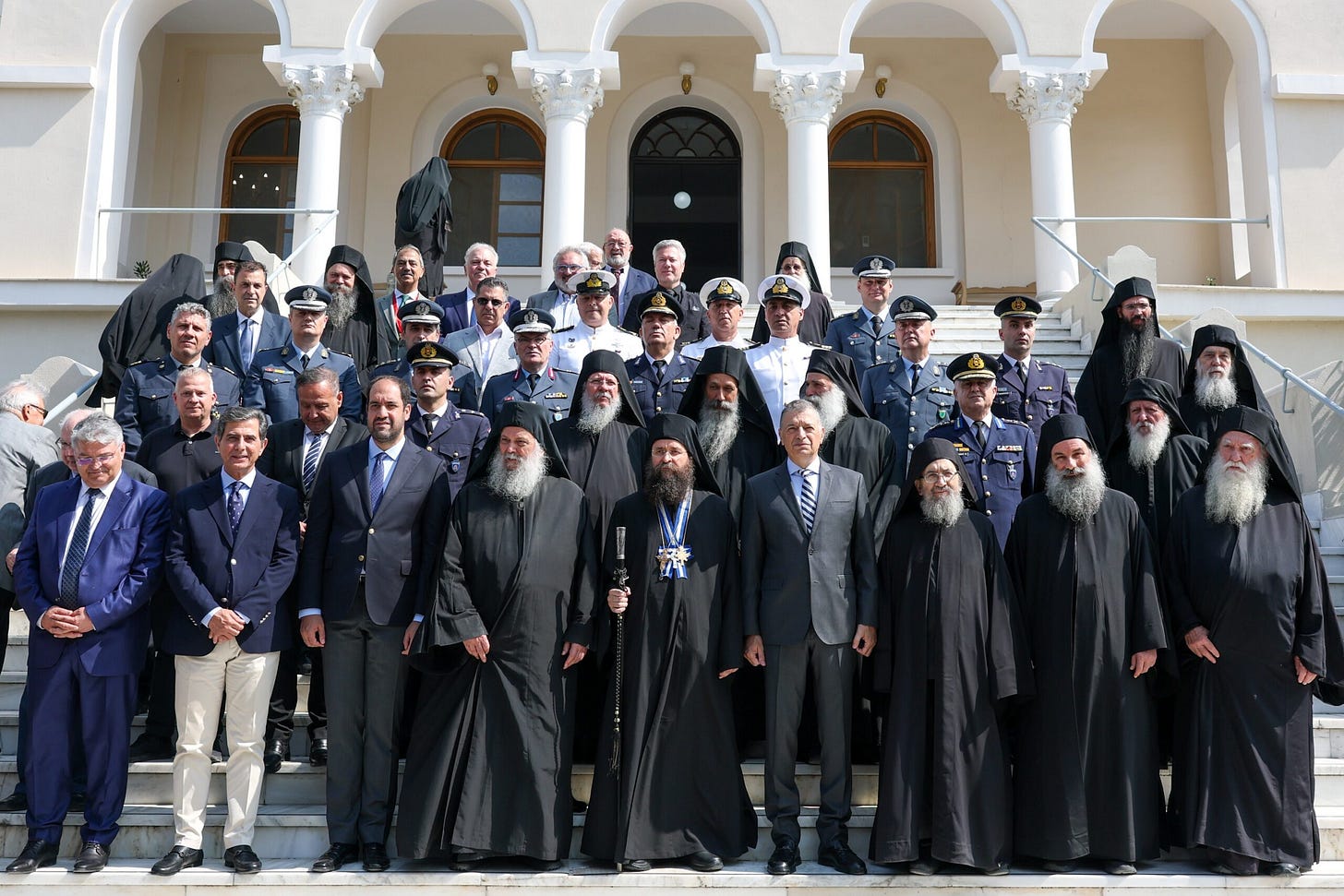
Keep Your Eyes on Hell (Trip to Mount Athos)
Note: There may be a “Christ without Christianity” online meeting this Saturday at 1 pm UK time (8 am EDT), but it will only happen with enough sign-ups. If you want to help make the meeting happen, sign up now (msg or email me). It is free for paid subscribers, nonpaid subscribers can make a donation to attend (donate tab at top, mention what it is for). This meet is not geared towards denominational Christians (though they are welcome), but to anyone seeking a deeper sense of God/Christ, and a practical understanding of Jesus of Nazareth and the scripture.
March 19th, 2026, back to journaling. Lost my recorder between Thessalonica and Ouranoupoli, on my way to Mount Athos. On the ferry now, to Dafni.
The ferry is full of men. No women are allowed on Mount Athos. All the men are between twenty and fifty, roughly, with a few older; most of them are around thirty. A bunch of them are from Lithuania, and probably other Eastern European countries, but mostly Greeks. All men seeking Christ—or refuge and respite, from jobs, wives, life in the modern world.
Losing my recorder has left me strangely bereft, a sacrifice before entering the monastic realm. Talking to it gave me a sense of connection and companionship, now suddenly gone. Hence I am journaling again: to hear my inner voice more clearly, or to personify or formalize it, by speaking, or writing. No doubt it affirms my sense of identity, as if I need it for company. Yet it is my identity, surely, that seeks comfort? Perhaps it is a progressed part that speaks, or writes, to a regressed part. But which feels bereft without?
Either way, it seems as though losing it was necessary, or at least useful. I have been wondering more and more why I kept up my auto-logs, for a future that may never arrive, especially since the act of doing them was feeling increasingly forced.
There must over a hundred guys on the ferry, and this is just one morning (7 a.m.) of the year, and not even peak time. I had to stand in line to get the permit to board, i.e., to visit Mount Athos, all done online in advance by my wife. It was the fastest moving line I have ever been in—fortunately, as I only got there ten minutes before the ferry was supposed to leave, with more than twenty guys ahead of me. The permit was thirty euro.
All the guys are dressed in dark colors, and most have red caps, similar to MAGA hats. I stand out as a foreigner. There is a dress code for the island, that stipulates plain and dark clothes, roughly, which I haven’t brought because I don’t really own any. Not everyone is wearing dark clothing. Beyond this, I am now just one more man in a crowd—absorbed into a Christ-seeking collective. It is an unprecedented experience, to be surrounded by men with whom, I presume, I have something essential in common, a shared orientation.
A group of them are luring seagulls on the deck now, food held out in their hands. I am tired from not enough sleep.
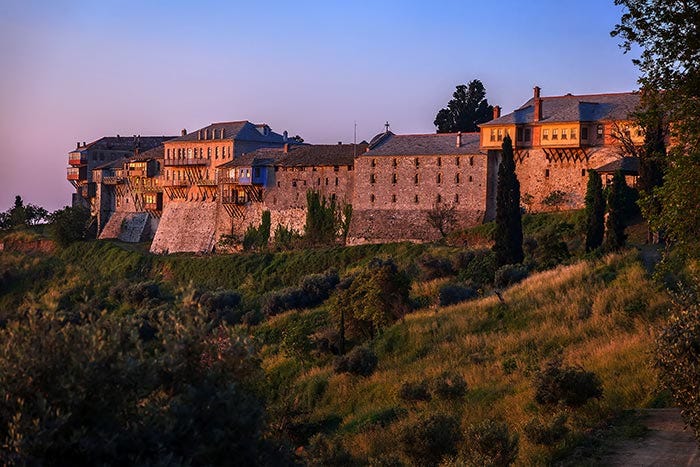
Some hours later, at the Lavra monastery (the first built on Mt Athos). I am having serious misgivings. I just ate the worst food I have ever had in my life. It was like prison food, or how I imagine prison food to be: overcooked potatoes and peas, literally grey, devoid of flavor, and stone cold. I was told it is because it is Lent, and “It is hard for all of us.” This wasn’t simply austere food, however; it seemed deliberately grueling, as if meant as punishment.
The minibus here was also a grueling experience. Being crammed in with my knees pressed against the plastic seat in front, on the worst road I have ever been on (including Central America), for one and a half hours, felt like a taste of hell.
I am in a dorm with eight beds—all to myself, thank God. I have lured the monk cat in for some company. It feels like being back at school. The Vespers was dull and uninspiring, no comparison to the Benedictine services that I attended at Randol, France, in my twenties, which were melodious and sensually relaxing. This mass was a grind, two hours of mumbled incantations with occasional candle lightings to break the tedium.
I did my best to stay open, kept a Jesus prayer going in my head. I tried to tell myself it was more than met the eye, or the ear, but I kept thinking of Rudolf Steiner’s “5th Gospel,” which describes Jesus falling into despair when he realizes that all the Jewish rituals are empty and futile, devoid of spirit. What would he make of these rituals, I wondered?
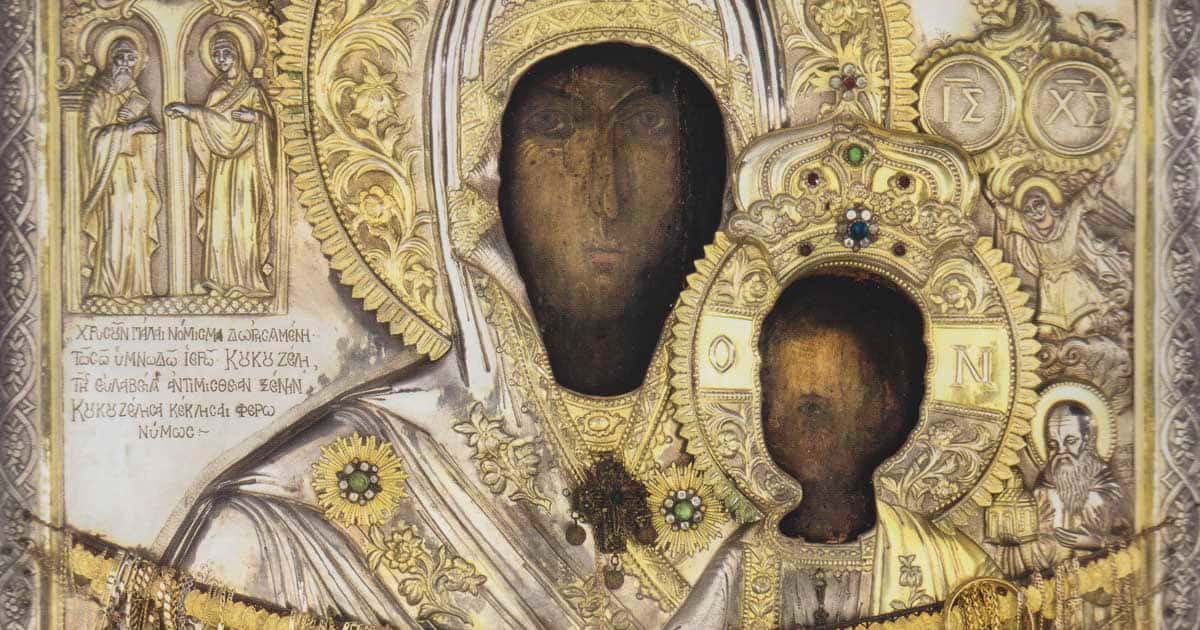
The monks are in black from head to toe, invoking Saturn. Are they in touch with Jesus via their relentless discipline? If so, I haven’t felt it yet. There is no sense of joy. All the young men, about twenty in all, showed up to the service. They went through motions which they clearly knew by heart, genuflecting, kissing the icons, etc. They are all Eastern Orthodox. For some reason, I expected some unaffiliated pilgrims like myself, curious travelers; but I am surrounded by true believers. I am unsure now why I am here, besides “research” for the book. Next Vespers is at 3.30 am, and is two hours long. If I go, I will surely nod off. I have no desire to attend, but then, why be here?
Day 2, March 20th. I made it to the morning Vespers, two hours of relentless boredom—beyond boredom, a kind of rising discomfort that I endured for the sake of protocol. “In for a penny.” I also thought, or felt, that there might be a genuine purging going on, if only a test of my ability to relax into discomfort. Maybe the demons in my soul were protesting? Certainly, my antsiness—anxiety isn’t quite the word, it really was like being covered by ants—seemed disproportionate to the apparent cause.
The church was dark, which made it easier. About halfway through, watching the long-bearded monks in black, solemnly reading from the book, it struck me, with the immediacy and the simplicity of intuition: They’re Jews! As soon as I had the thought, it felt weirdly, irrefutably true. There was something fundamentally Jewish about the whole ritual, revolving around reading from the sacred text (I presume the New Testament). It was also a continuation of my impression the day before about Saturn, since Judaism is a Saturnine cult, according to many researchers (including Steiner; the Sabbath = Saturday).
Before the end, my physical discomfort and impatience grew so intense that I started to think about being buried alive, or enclosed in a tomb. I was trapped by the interminable ritual, unable to find a release inward, where the only relief can be found. Being buried alive is a fear I’ve had since childhood, maybe due to seeing Premature Burial, a Roger Corman Edgar Allan Poe adaptation, or other horror films. I began repeating the Lord’s prayer over and over to distract me. It seemed the only recourse. If one could get to a place, as when falling asleep, in which consciousness is no longer contained in the physical body, then the prison of the tomb would no longer hold one. “Chain me down, but I am still free.”1
This led to thoughts of initiation rituals that entail this very method, putting initiates into a coffin and closing it, leaving them there (until they are able to leave their bodies?). A literalization, perhaps, of the purpose of these law- or text-bound traditions and rituals, of an entire life constrained to endless repetition (these monks are supposed to pray all day and night, really). One simply has to break through into a deeper layer of consciousness to be free. Does the end justify the means, when the end is as profound as this? This is even assuming it works in a way that doesn’t involve dissociation from physical reality rather than genuine transcendence.