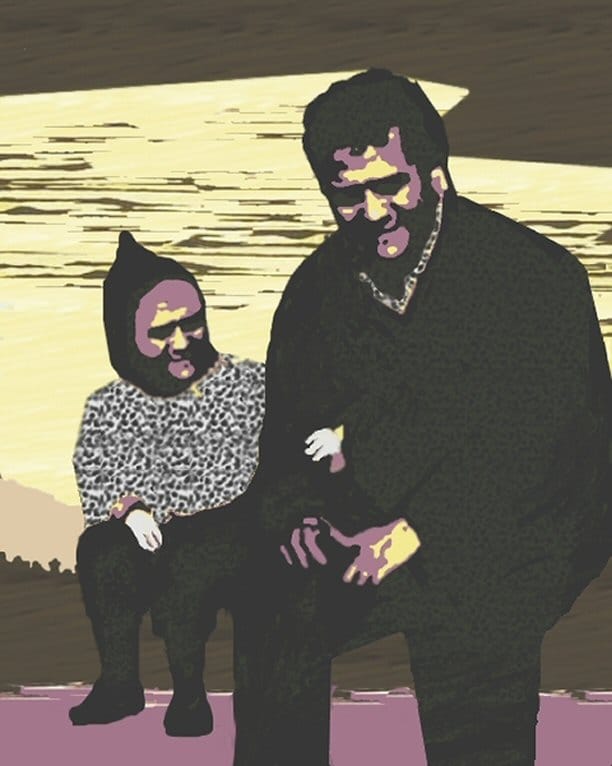
X Marks the Spot
Reading from The Subversion of Christianity, by Jacques Ellul, Part One

(Art by Michelle Horsley)
“If we tried to abolish the word Christianity, what would we have to say? First, the revelation and work of God accomplished in Jesus Christ, second, the being of the church as the body of Christ, and third, the faith and life of Christians in truth and love. Since we cannot keep repeating this long triple formula, we shall now use the word X to denote these three aspects. We need keep the word Christianity only for the ideological and sociological movement which is its perversion.”—Jacques Ellul, The Subversion of Christianity (p. 11).
One: The Christ Impulse
Tao of Jesus
We must not make this, as is often done, into opposition between the pure message of Jesus and either the terrible God of the Jews or the detestable Paul, a false interpreter. There is complete coherence between what we know of Jesus the Christ and the God of Abraham, Isaac and Jacob (p. 6).
Rene Girard and Rudolf Steiner (probably my two primary guides in this current journey through Christianity) might agree (though Ellul would probably not agree with them); I would say that a major part of the coherence relates to the apparent incoherence; or even, that the incoherence is evidence of a higher coherence.
Ellul then makes a thesis statement: “If Christians are not conformed in their lives to their truth, there is no truth” (p. 7)
The only real Christianity, or X, is the embodiment of what Steiner called “the Christ Impulse,” which is also perhaps (at the risk of conflating Persons) another word for the Holy Spirit.
To be as Christ was is to embody the Holy Spirit. It is not to embody scripture, which is impossible (and brings to mind Max Cody in 1992’s Cape Fear). Christ himself didn’t embody the scriptures: the scriptures about Jesus weren’t written yet, and nor did he embody the scriptures he knew, the Torah, etc.; not, at least, to the letter.
If we think of the Tao as an earlier word for the Holy Spirit, then we have “the Tao that can be spoken is not the true Tao” conundrum. Yet the Tao/HS can be allowed to inform our thoughts, words, and actions. To allow the Christ Impulse, the Holy Spirit or the Tao, to move us and shape us, both internally and externally, to live within us and through us, does not require paying lip service to Jesus (or to Lao Tse).
Speaking of these things is closer to the counterfeit of them. It is all too easy to feel like we are possessed by the Holy Spirit by talking about it, or to feel like we are following Christ by talking about Jesus, by quoting Scripture, or by repeating words attributed by Scripture to Jesus. If it were that easy, then Billy Graham (or Russell Brand) would be God. But he isn’t.
This raises the question: does coming closer to embodying the Christ Impulse, or being truly Christ-ian, require not speaking (too freely) about Jesus Christ, and not identifying as Christian?
To talk about water has nothing to do with swimming, this much is clear. But also, while swimming, it is usually best to save one’s breath, and not to waste it talking. Except, perhaps, when giving swimming lessons.
The Golgotha Moment
The moment the mutation takes place from existential thinking to existentialism, a living stream is transformed into a more or less regulated and stagnant irrigation channel, and as the thought moves further and further away from the source it becomes banal and familiar (p. 10).
A movement requires a fixed point. For a movement to arise, the individuals behind it need something in which to find their meaning and purpose. A movement comes out of the identification of a value, philosophy, or individual that is thereby fixed by that identification, and by that movement. Christ on the cross is a literal image of God fixed, pinned, in time and space. “The Golgotha moment.”
Yet what moves the movement itself then ceases to move, or cannot be allowed to move. Christianity then becomes that which pins Christ, and prevents him from moving. Specifically, it prevents him from moving in our awareness and understanding; and that means that he—the Christ impulse—can no longer move us.
So we have a movement being moved by something that itself cannot move; and so the word movement is a contradiction, since it actually denotes stasis, stagnation. As soon as something becomes a movement, it ceases to move; worse, it frames and imprisons the very force or presence that was the initial impetus for movement.
“Dry canals” is a term used in the (Gnostic) Gospel of Philip, and Ellul may even be alluding to it when he talks about Christianity being a “stagnant irrigation channel.”
Gnosticism vs. Christianity
Gnosticism was, to some extent, an anti-Judaism movement, just as Satanism is an anti-Christian one, or the shadow of it. Gnosticism, identified historically, emerged at the same time as Christianity (before it even, but certainly parallel with it). It was perceived from early on as anti-Christian, though not, of course, by the Gnostics themselves.
By defining Gnosticism as anti-Christian, the early Church administrators (I won’t call them fathers) thereby defined Christianity. Just so, the assemblage of the texts that became the New Testament was a reaction against the Gnostic movements that were trying to establish other texts, as legitimate Christian scripture.
To the degree that Gnosticism, historically and to this day, is a reaction against Judaism and Christianity, the opposition between the two movements became complimentary: Gnosticism began to define itself against Christianity, just as Christianity defined itself against Gnosticism.
From here, it’s easy to understand how Gnosticism devolved, over the centuries, into a transhumanist, quasi-satanic movement for the elite, and how it has been trickling down into the culture now for a century or more. And how Christianity has been morphing and upgrading itself in recent years, as an attempted sociological counter-movement to this.
Modern transhumanist forms of neo-gnosticism are not Gnostic, in any true historic sense, but then neither is historical Christianity actually the legacy of Jesus Christ in any true spiritual sense; though one can trace the different factions and movements and philosophies, and so on, with some degree of continuity.
Gnosticism did possess these sorts of reactionary elements in it from the beginning. Insofar as it was anti-nature and saw matter as evil, it was reacting, not only against Judaism and Christianity, but against existence itself. It was a form of insistence that, seeing physical reality in its brutality and unpleasantness, defined it as evil, and tried to take refuge in a purely spiritual realm.
This may have been a fundamental flaw in Gnosticism from the start, but if so, it was also present in early Christianity, and is even evident in some of Paul’s writings; or at least, one can interpret them in such a way that would lead to a kind of dissociative practice (such as self-flagellation).