Worldview Warfare
The Old Testament: Holy Book or Blueprint for Sociopathy? (Part 1)
Reading from and responding to Our God Is Your God Too, But He Has Chosen Us: Essays on Jewish Power, by Laurent Guyénot (the chapters of which are standalone essays that were first published on the Unz Review website).
Part One: How to Prophesize with a Hammer
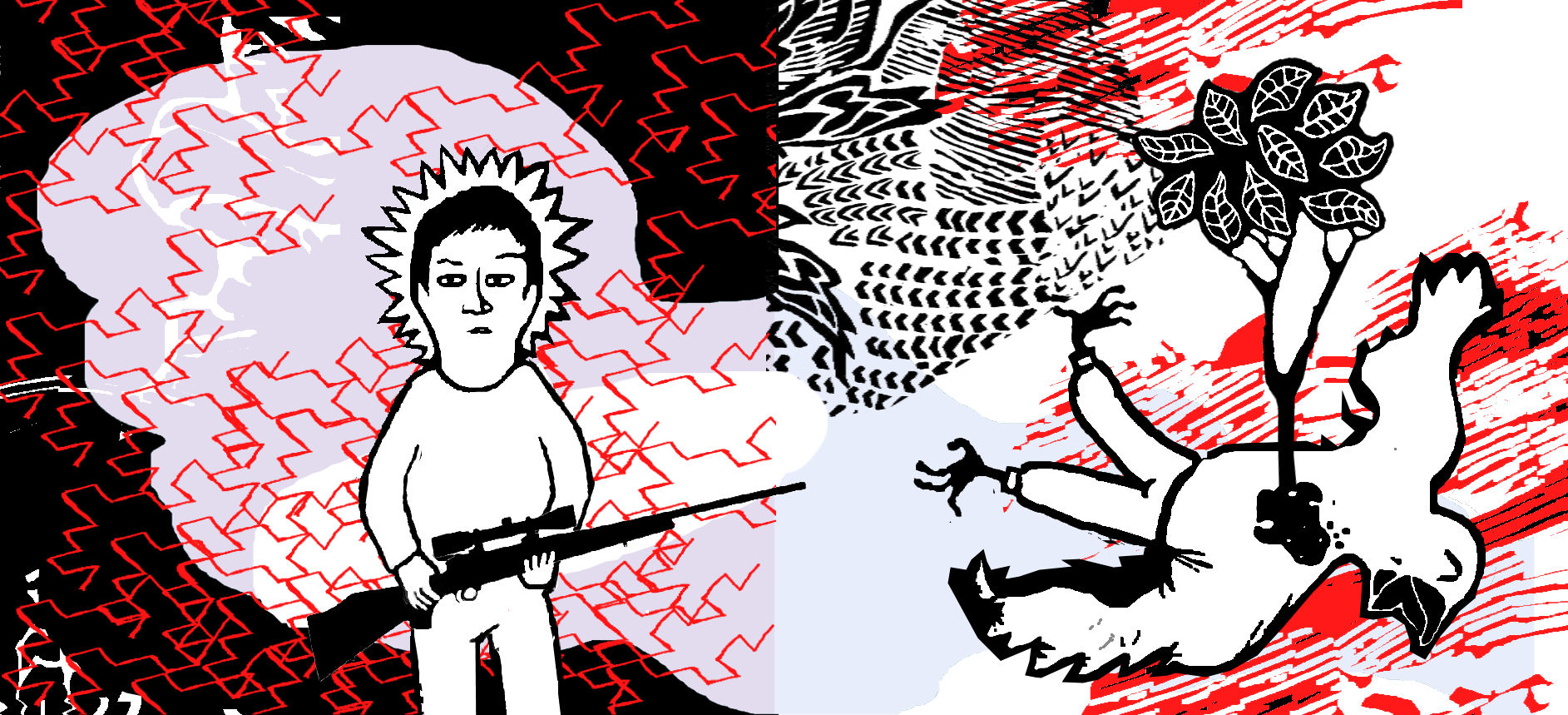
(Art by Michelle Horsley)
Case for the Prosecution
Christians today believe that the God of humankind decided to manifest himself as the jealous “god of Israel” from the time of Moses, whereas the real historical process is the reverse: it is the tribal “god of Israel” who impersonated the God of humankind at the time of Ezra. Worshiping a national god with imperialistic ambitions while pretending to the Gentiles that they are worshiping the One True God is manufacturing a catastrophic misunderstanding (Guyénot, p. 41).
My first general comment about this book is that it’s very one-sided.
It’s a thorough, relentless, and seemingly robust and scholarly condemnation of Judaism, Jewishness, the Old Testament, and Yahweh. Yet, in a strange way, paradoxically, the tightness and consistency of Guyénot’s argument undermines it as much as it fortifies it.
Simply stated, things are rarely this cut-and-dried; and when it comes to the most influential book ever written, to reduce, as Guyénot does, the wisdom of the ages to a blueprint for sociopathy is taking reductionism to a dangerous extreme.
It would be perhaps too easy to say that this betrays a bias on the part of Guyénot. Is he so thoroughly convinced of his thesis because of all the evidence he’s presenting? Or is he selecting and arranging the evidence because he’s already convinced, for whatever reason?
The answer is, a bit of both, though based on the overall quality of the writing, it’s more the former than the latter. My only real complaint, before getting into the specifics, is that Guyénot’s argument is not sufficiently balanced. By the time I had finished his book, I wished it was twice the length, and that the missing material was the evidence for the defense, woven into his case for the prosecution.
Ironically, I think this would potentially make Guyénot’s charges all the more compelling, since no one could accuse him of stacking the deck or of framing the accused. I certainly came away from his book convinced by the evidence, and accordingly Judeophobic.
But this is precisely why I missed hearing the case for the defense. In what follows, I will try to make that case, while acknowledging the value of Guyénot’s work.
Judaism Weaponized
This is from the second chapter, “Cryptic Jewishness”:
Although it appears to be contradictory for non-Jews, this dual standard is not necessarily so from the point of view of Jewish intellectuals. They may really believe in their universalistic message addressed to the Goyim, while simultaneously believing that Jews should remain a separate people. Implicit logic is that it is good that Jews remain Jews in order to teach the rest of mankind to be universal, tolerant, anti-racist, immigrationists, and caring for minorities (especially Jews). This logic falls under the “mission theory,” the secular version of the “messianic nation” theory: Jews, who have invented monotheism, the Ten Commandments and so on, have a moral obligation to keep educating the rest of humankind (p. 33).
This closely parallels a point I made in the recent post “Knock Knock, Who’s Jews: Seeking the Real Remnant of Israel”: a group that creates a system must remain outside of the system—or at least move freely in and out of it—in order to maintain that system. You don’t build a temple from the inside out.
(When you start, there is no inside or outside. By the time you finish, you may be on the inside or the outside, but you certainly know the way in and out.)
Judaism and the Torah requires recognizing, serving and obeying the one true God—leaving aside how true he is, for now—and this involves commandments, laws, and specific regulations on how to live. Because of this, there is no way for members of the Yahweh tribe to integrate into societies they exist within, without breaking those commandments.
The Jews’ mission is to bring monotheism, Yahweh, the one true God, to all nations. They preach and proselytize universalism, potentially towards mass conversion, from a position of separateness. They are essentially saying, “We as a people are separate from all the rest of you; we cannot join you; but you can join us.”
The problem begins with the imposition by force of the monotheistic creed and when it gets all mixed up with land-grabs. Since the Torah dictates submission to Yahweh, there is no clear line, socio-politically speaking, between converting to Judaism (and submitting to Yahweh) and submitting to the “chosen people” who submitted first, and who are now busy proselytizing to and purging the pagans, on the orders of their God.
The opportunity—or inevitability—for abuse of power is enormous, as well as the opportunity—as also happened with Christians—for rogues who preach but do not practice, whose intentions are impure or dishonest, applying a religious doctrine as a means for worldly dominance and exclusivity.