When God Becomes a Trauma (Solving the "JQ")
A Continuum Between Man & God & Testaments Old & New
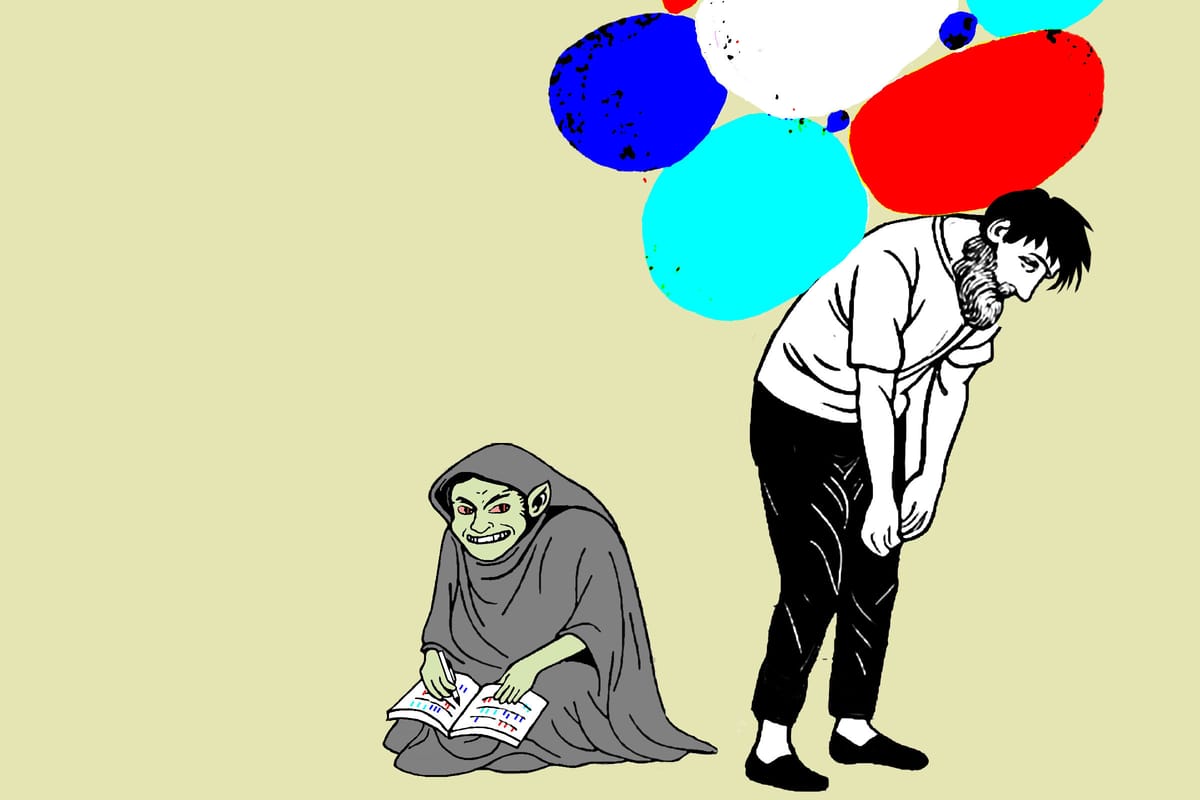
(Art by Michelle Horsley)
How essential is the Old Testament to Christianity?
First up, if by Christianity we mean sociocultural Christianity in its various denominations, there might be some denominations that don’t refer much to the Old Testament, but if so I don’t know of any (the Marcionite thing didn’t take off).
More broadly, the question is: how essential is reading the Old Testament to understanding and finding faith in Christ?
The word essential is like the word unique, it’s really either/or. If I had to say either yes or no, I’d say it’s not essential. But if I could put it on the spectrum, I’d say it helps, but it also doesn’t help.
This is what Jacques Ellul writes in The Subversion of Christianity:
If God had wanted to give us a philosophy he would have given us a coherent book and not the vital incoherence of the Bible . . . There is no logic in biblical revelation. There is no “either-or” only “both-and.” . . . We have to realize that everything in the Bible is contradictory. Yet there is revelation only as the contradictions are held together. . . the truth is made up of the actual contradictions. Each aspect of truth is true only because it is linked to its radical opposite.
The Bible is made up of contradictions and you have to hold those contradictions together.
The cognitive dissonance of holding two things that are opposed, in consciousness, at the same time, can allow for a different kind of consciousness. That is the real transmission that reading the Bible allows for.
In that frame, then, I’d say the Old Testament is essential. Which means I have already contradicted myself; which is fitting. It’s both essential and inessential.1
The fact the Old Testament is easy to reject because of certain things in it, is an awesome example of this principle.
You don’t like this version of God? Imagine how the Hebes felt!
The Struggle within Abraham
When God tells Abraham to sacrifice his son, God is telling Abraham to do the unthinkable, and Abraham has to think about it. He has to think about it to the point he’s willing to do it.
Not because he wants to, but because his faith in God is absolute.
Then God says, “Don’t do it.”
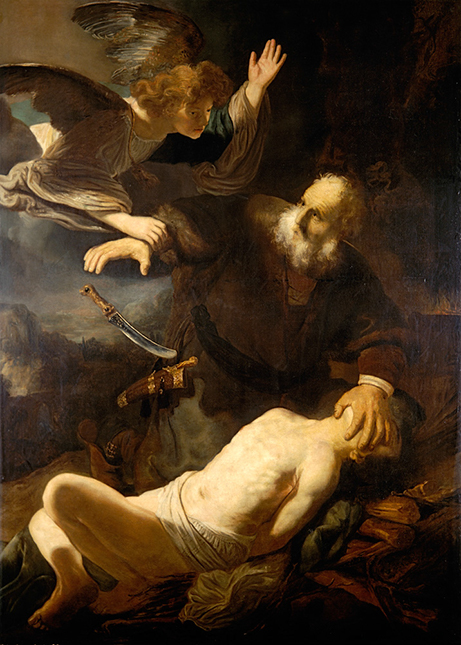
The easy interpretation is that it was a test, just as the easy interpretation of the book of Job is that Job was being tested. But this view depends on having a split view of human beings and God, rather than allowing for a continuum.
I think this is a better way to understand it: There is a continuum between God and human beings.
In the Old Testament, it’s a continuum between Yahweh and the chosen people. In the New Testament, it’s a continuum between God the Father and God the Son, Jesus Christ, and Christ is on a continuum with his apostles, and thus with the whole of humanity.
There is a continuum between God and all human beings, even though God is transcendent.
God being transcendent means God is beyond anything human. So, by that same token, human beings are also beyond human.
With the story of Abraham, something within Abraham is struggling: his self-will, or self-interest, even though it’s the highest thing—a father’s love for his child—is still a form of self-interest compared to serving God with all his heart, soul and body.
His paternal self-interest is struggling with this other, divine imperative within him, which is saying “Give up everything and follow me” (like Jesus told the rich man).
There is an agonizing period in which Abraham thinks he might have to kill his own child to prove his loyalty to God to himself (child sacrifice was a very real thing back then), followed by the dawning realization that he doesn’t have to prove it.
His willingness to do it is the proof, not the actual doing it.
Fear of God is the Beginning of Madness
The willingness to do something like this does require some sort of lived experience of sacrifice. Being willing to sacrifice what one cherishes most in the world is the way to test it.
What is being tested is one’s attachment to whatever that thing is, that makes it central to the relinquishing of self-will, as it was central to sacrifice pre-Abraham.
Human beings who believed in God asked themselves, “What’s the most valuable thing that we can prove our love of God by sacrificing?” So they killed their first-born male children. (There’s more to it than this, but this is one particular angle.)
It is a kind of pathological behavior, of course, because it’s a literalizing of something that doesn’t need to be literalized.
The Abraham story illustrates the same pathology and a move towards sanity. It’s a lack of understanding that is also the beginning of understanding.
It’s a turning point, when the sense of an external God demanding sacrifice shifts to the experience of an internal God, having mercy.
God is within us—or we are within God—so God doesn’t need any external shows of obedience.
If God is within us and we know it and we move as God moves and we trust in our own movements, then of course, God would not ever will to kill a child. (It wouldn’t be God if it did.)
But human beings who are possessed by fear of God might.
The Bible Mirror
The whole of the Old Testament is struggling with this problem, the right and the left side of the brain, the localized awareness of the ego-id, the tribal identity, the group mind, and the non-local awareness of Yahweh, the life force, the soul, and what’s beyond, the Holy Spirit in its earlier iteration.
If we want to understand Jesus, we have to understand Yahweh and how they’re opposites that are also ends of a spectrum.
That spectrum is the spectrum between God and Man.
Insofar as Man was brutal and primordial and savage and ignorant of God, then God itself, God himself, took that guise, as a mirror by which this chosen people—a particular portion of humanity—could start to see itself.
And then the mirror gets held up for the rest of humanity, via the Bible.
The chosen people then inevitably become a kind of scapegoat within that larger body. They become the embodiment of old humanity, of the primordial, the devious, the diabolical.
Insofar as they still cling to the identity of “the chosen people,” and insist on a worldly power-base such as Israel, they become, observably, the embodiment of the worst of humanity.
The wandering Jew.
“Noticing” is noticing our own atavistic attachment to old rituals of sacrifice.
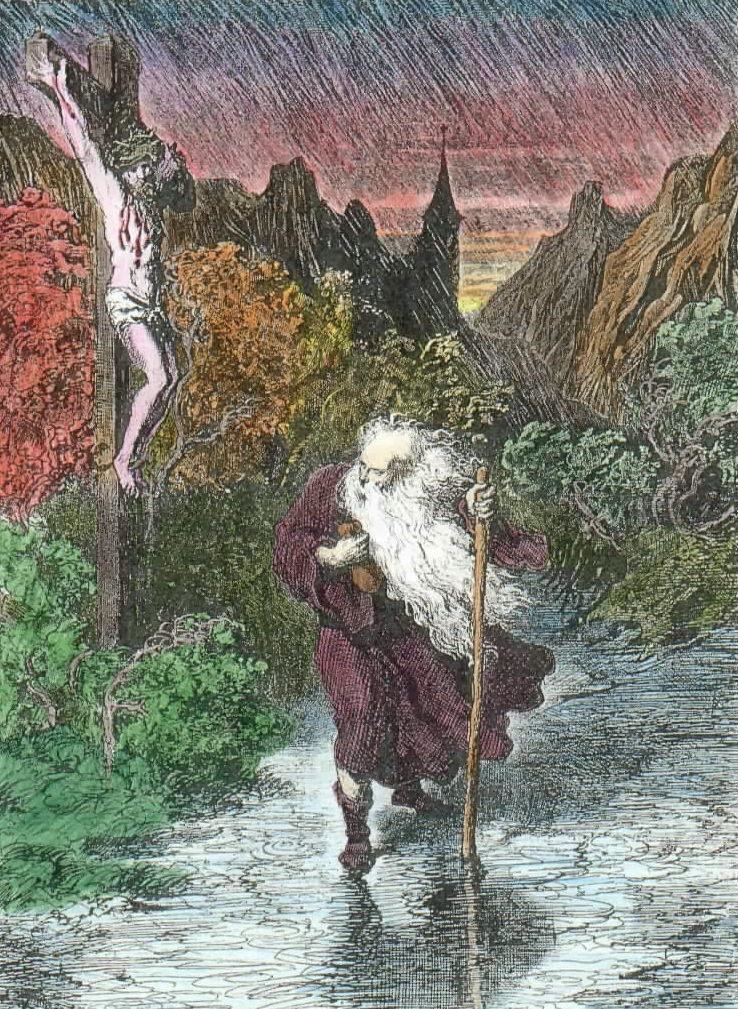
Is the Christian God the same as Yahweh, the God of the Tanakh, Old Testament?
No is the short answer. But it’s “no, but,” or it’s “yes, but.”
No, but: in the same way that a man is not the same as he was when a child.
Yes, but: at different stages in the development of human consciousness and understanding.
Extremely different views of the divine; almost diametrically opposed, but not actually opposed, because on the same continuum.
Whatever metastasized in the period of the Patriarchs, fictional or not—Abraham and Moses, et al.—as Yahweh, metastasizes later as Jesus Christ, the anointed, in that later period.
And we are left trying to square that circle, to balance out the opposites.
Are Jews still God’s chosen people? Were they ever?
The terminology is problematic. The word “Jews” is problematic. The words “chosen people” are problematic.
Let’s say this: once upon a time, there was a tribe of people. . .
Scratch that; even that seems problematic. Start again:
Once upon a time, there was a part of the planet where a new kind of consciousness began to emerge, within human beings in small groupings.
That is now the earliest recorded historical account of a transcendent or supreme power, the unknowable, the highest principle of all existence, coming into human consciousness.
It got called Yahweh, and, via scriptures, it became associated with a “chosen people of God,” a nation of Israel, and so on, and so forth.
As with Jesus, there was a historical turning point that was recorded—with whatever degree of fidelity—and became the Old Testament; and then later, the New.
In both cases, there was a Chinese whispers mission creep, from the experiences of Abraham, Jacob, Joseph, Moses, and the prophets, to the way it was acted on, understood, written down, and the way it was interpreted.
And while what’s in the Old Testament—and even the New —is very far from historical truth, it still has the kernel of the truth in it.
That kernel is like the mustard seed of the Kingdom of Heaven.
Is it okay for God to have a chosen people/national identity?
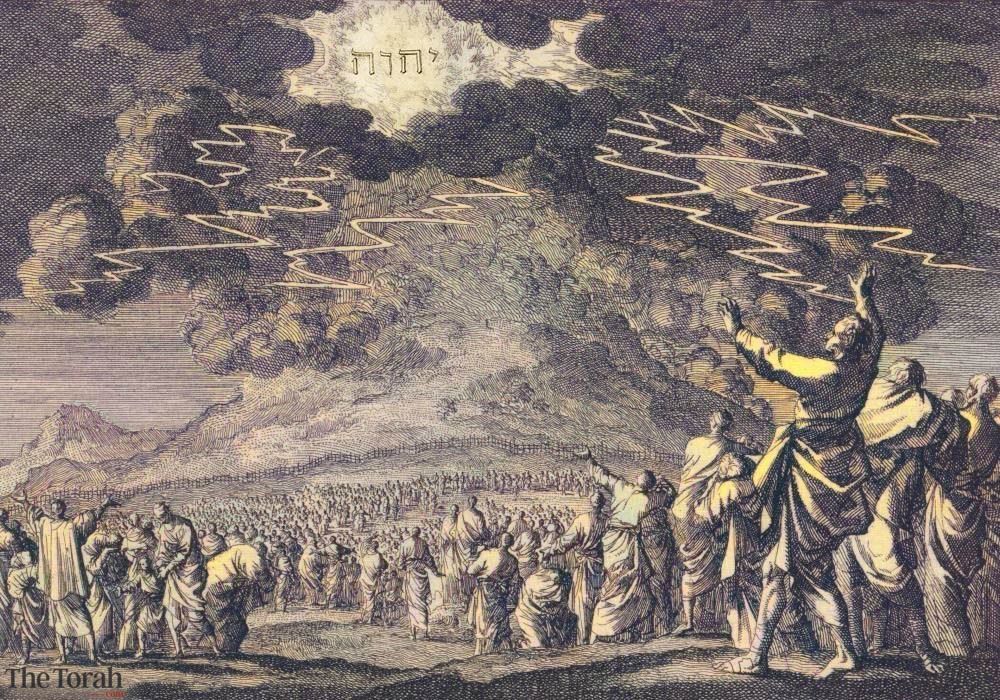
This question answers itself. “Chosen people” was never meant to be “national identity.”
Imagine an irrigation system, moving through the entire organism of the planet and the entire human species. Water has to pop up somewhere before it can pop up everywhere. It’s not going to come out evenly, all over the planet, through all human beings everywhere. It’s going to start at one particular point within that system.
Water happened to pop up in Palestine, a few thousand years ago, through different individuals, however many. They were then written about by followers or descendants as Abraham, Jacob, and so on. Whether or not the accounts are historically accurate—or even meant to be read that way—this God-force did emerge locally before it spread.
That’s the origin of the idea of a so-called “chosen people.”
It is a bad idea, insofar as the source of the water essentially has nothing to do with any particular point where it springs forth, since the source is underground and everywhere.
One could even argue that it is the weakest point on the earth that is where the water pressure manages to break through, into a spring.2
The chosen people indicate the first point of the breakthrough.
And the first shall be the last.
Thanks for reading. This post is public so feel free to share it. Comment below.
(This piece was based on a segment of the upcoming Jobcast, “Cognitive Dissident” # 11, in which I go a bit deeper into the JQ & other Biblical conundrums. Catch it this coming Saturday.)