
The Devil’s Junction
The Devil in Carlos Castaneda: American Trickster & a Sorcerer's Redemption, Part Five
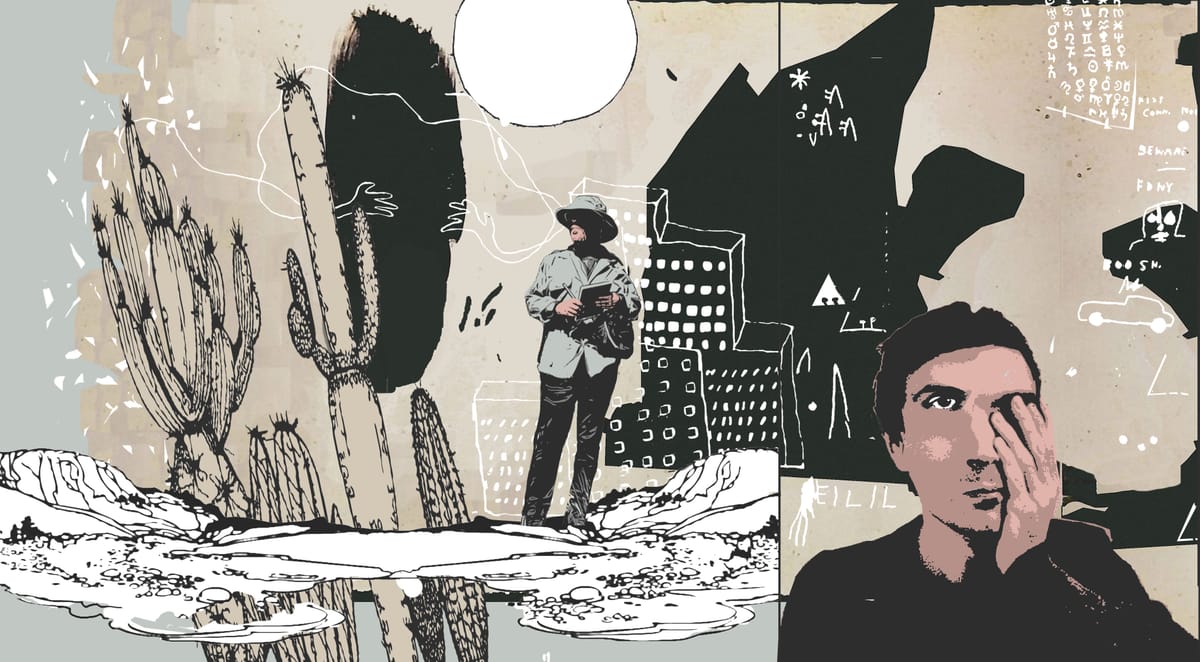
(Art by Michelle Horsley)
Part One Part Two Part Three Part Four
“I have sold my soul to the devil.” —Carlos Castaneda, American Trickster (p. 343).
“No Exit,” as the first title for this series, was taken from Paul Bowles’ translation (the title) of Sartre’s play Huis Clos; the subtitle, “The Devil in Carlos Castaneda” is taken from The Devil in Miss Jones, a soft-core porno movie loosely(!) adapted from No Exit.
That’s an awful lot of cultural references, a veritable devil’s junction. I never saw the movie, and I never read or saw No Exit (the source of the famous line, “Hell is other people”). But I did know Paul Bowles personally, and I was influenced quite a bit by Sartre’s Nausea. It was the first book that came close to describing my own psychological “setting” at the time (age nineteen), that of intense “derealization.”
The second subtitle, “American Trickster and a Sorcerer’s Redemption,” is what I want to get to, however. It is a wishful title. I have no idea whether such redemption is forthcoming for Castaneda, much less whether it can become part of this current series. Yet, as someone who dedicated a portion of his life to redeeming Lucifer, it goes without saying, perhaps, that such is my aspiration with poor don Carlos.
Those whose malignant spell we fall under, it behooves us to try and redeem for our own salvation. Why else would they fall under our jurisdiction (or we under theirs)? Why else would Christ go to Hades?
An Identity-Based Fantasy Realm
The implicit—sometimes explicit—assumption in American Trickster is that there was a clear continuum between Castaneda (the best-selling author) and Castaneda (the toxic cult leader), insofar as both were liars and deceivers. The obvious overlap would be that of convincing people to believe in sorcery, in the first instance to sell books, in the second to have power over them.
Strangely, Marshall includes accounts in his book which suggest that Castaneda was a sorcerer, even a kind of devil. He therefore validates at least some of the things Castaneda was writing about. This is clearly at odds with the book’s thesis, however, that Castaneda made it all up and then lied about doing so. The way the author squares this circle is by suggesting that Castaneda’s hoax was his sorcery, and that persuading people to believe was enough to generate “genuine” sorcerous effects. All of which intersects, or collides, somewhat confoundingly, with Marshall’s own postmodernist-transgender rubric.
Whatever the case—as regards Castaneda having actual sorcerous powers—there is no logical continuum between Castaneda being provably a liar in his relationships, and his having lied about the existence of don Juan. Castaneda’s books cannot be understood simply as novels. Either they are non-fiction or they are hoaxes; and whoever sees them as hoaxes, understandably, is unable or unwilling to give them their due as novels. They are seen not as literature but as pernicious frauds. This is perhaps largely the case because Castaneda continued to insist upon their reality, and to use people’s belief in them as a means to gather personal power (wealth, fame, sex).
I don’t personally believe the books can be reduced to anything quite so straightforward. Castaneda’s personal story is simply too strange and twisted—and too tragic—for that. If we think of L. Ron Hubbard as a counterpoint, his novels, from all I have heard, were trash; and while his cult was far more successful than Castaneda’s, it revolved around a metaphysics that is sci-fi garbage compared to Castaneda’s eerie metaphysic, and Hubbard almost certainly had hidden backers. Castaneda’s hidden backers, on the other hand, are proving a lot harder to establish.1
American Trickster argues that Castaneda plagiarized all of the esoteric stuff, without saying where exactly he got it from (with a couple of minor exceptions).2 The alternate interpretation, which the book cannot entertain, is that he encountered real powers, real sorcerers, and real teachings, and was unable to apply them outside of his books, in the ordinary world, in a human, relational way, that was not deranged and destructive.
American Trickster tosses Castaneda’s inorganic baby into the sewer along with the bathwater. Any real magic is banished along with the fake, to make room for another kind of fraudulence (the Trans/woke, Trump-deranged kind). Ironically, this puts it fairly close in spirit to Castaneda at his most toxic and delusional, being the kind of magic that is pitted against all the aspects of reality which the ego feels confined or oppressed by—such as sex and death—in favor of an identity-based fantasy realm.
Marshall even stole “a separate reality” for the title of his own novel, about queer identity in a “cis” world.
The Witches
The premise of AT and of La Vida Secreta de CC is that Castaneda invented his accounts using real persons and real experiences as a kind of loose template, or inspiration, and that he turned mundane life events into a fantastic sorcerer’s tale by rendering them symbolic. Some of these were actual shamans, male and female, whom Castaneda contacted during the period between the 1950s and the 1980s. (Marshall hardly even touches on this possibility, making his book far weaker than Carballal’s.)
Many were men and women he knew, some of whom he seduced, or recruited, or both. Carballal believes that Castaneda met and worked with at least eight different Native American shamans over the years, and that the ever-mutating don Juan character was a composite of all these. One of these can even be seen on YouTube, now 110 years old (meaning he would have been around 48 in 1960).
Taisha Abelar, Florinda Donner, and Carol Tiggs, as Donner herself admitted in an interview, “all knew don Juan with a different name. He was a multi-faceted being.” Code for compensate character? In 1992, in her first international interview, with the magazine Dimensions, she said, “In reality I am not don Juan’s apprentice. I was an apprentice of Castaneda, who was the apprentice of don Juan” (Carballal, p. 507). Donner was exposed in a plagiaristic fraud with her first book, Shabono, which Castaneda endorsed.3
Only a handful of the characters in his books are identifiable as people Castaneda knew, such as Donner and Abelar (who wrote their own books but didn’t appear in Castaneda’s), and Carol Tiggs (the “nagual woman” who is the star of The Art of Dreaming). It seems likely that Castaneda himself wrote—or at the very least oversaw and polished—Donner’s Being-in-Dreaming and Abelar’s The Sorcerer’s Crossing (both of which he features in, as the new nagual). The former includes an anecdote about Calixto Muni that echoes Castaneda’s own description in The Power of Silence. Calixto Muni, it transpires, never existed, but was a mash-up of two Yaqui folk heroes. Revelation of the method?
Tiggs was clearly not the nagual woman as described by Castaneda in The Eagle’s Gift, however: a “peerless warrior” on a par with Sylvio Manuel (the man behind don Juan and the real leader of the sorcerers party). Castaneda claimed Tiggs disappeared into the second attention for ten years and then re-materialized during a book reading. The truth, as Manuel Carballal painstakingly reconstructs it, was that she became disillusioned with the nagual’s endless deceptions and left to get married and lead an ordinary life. Ten years later, she showed up again (perhaps after reading the glowing descriptions of her in The Fire from Within), and wanted back in.
As early as the early 70s, Castaneda was talking about the four winds and convincing young women to have sex with him as part of their initiation into the sorcerer’s world. Ramona Du Vent and Marjorie Dill are two examples cited in La Vida Secreta. As was his M.O. in the 1990s, Castaneda made them diet, cut off relations with all their friends, get rid of their pets, and abstain from having sexual relations unless it was a brujo or a brujo’s apprentice. Before initiating them, Castaneda assured them he had to consult with don Juan, kept them waiting for several weeks, then returned to campus and told them he had consulted don Juan and they had been accepted.
The initiation consisted in a ritual of coitus.
The Walter Mitty of the Occult?
Did Castaneda merely recruit fellow hucksters, or did he actively bring some or all of these women to whichever actual shamans or brujos he encountered in Mexico? Were the books supposedly written by Donner and Abelar also a mix of true encounters with fiction, or were they pure fantasy, as American Trickster simply presupposes?
It is easy enough to see how almost irresistible the temptation would be for a biographer (one who is basically skeptical) simply to delegate everything on record—all the claims—to the category of fiction. This black-or-white logic might even feel necessary to former true-believers, once they start to see the many holes in Carlos’ plots. Anything rather than remain caught—like Tiggs—in an inorganic limbo realm of uncertainty, helpless to decide between fantasy and reality. With certainty comes relief, even when the news is basically all bad. As demoralizing and humiliating as it might be, it also offers a kind of relief, the relief of clarity (the second enemy of the man of knowledge).
Yet, barring an intentional, highly sophisticated psyop by a team of professional anthropologists, occultists, and spooks—with Castaneda as their public-facing representative to receive the credit, and later take the blame—there seems no way to rule out some truth mixed in with the fiction, as the background to the books.
Neither Carballal nor Marshall seriously consider the possibility that, if the second attention is a real proposition, and a separate reality does exist, Castaneda could have gained access to it, legitimately or otherwise, and incorporated those experiences, also, into his novels. Did Castaneda cast a net, woven from his own secret dream life, in which he was a three-pronged nagual, and then try to force ordinary reality to conform to his fantasy? Such a possibility would seriously undermine any arbitrarily-imposed dividing line between fact and fiction.
What if don Juan Matus was not only a fantasy-composite of real-life shamans, but an authentic spirit which Carlos contacted, and for which he became a vessel?