
The Devil Drives (Evolution’s Design)
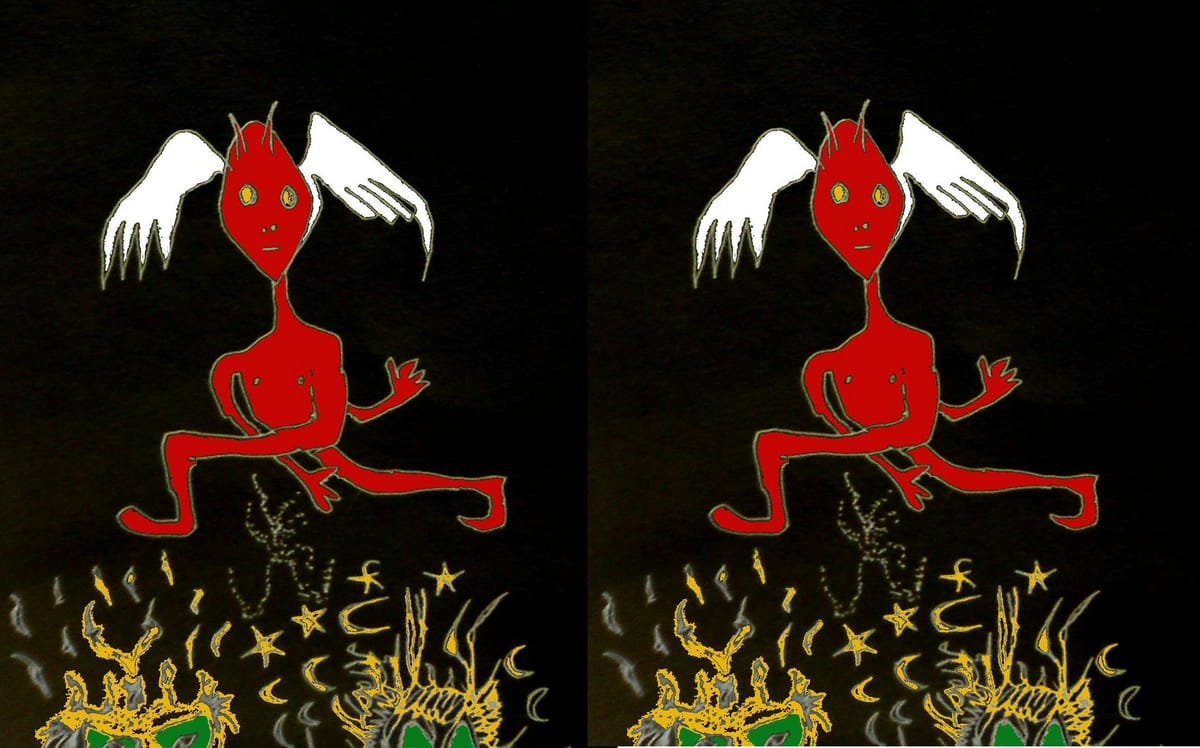
The Pros and Cons of Dualism
(Audio at the end)
Thomas Milliary has said a few times over the years (on Psyop Cinema) that the goal of marrying good and evil—which he associates with the neo-gnostic, supercultural, transhumanist super-psyop—leads only to evil.
The suggestion is that good = purity, and that to mix even a little bit of evil with it leads to impurity. This makes goodness like spring water, and evil a deadly pollutant. Ironically, however, the implication becomes that evil is more powerful than good, though I’m sure Thomas didn’t intend it this way.
I don’t know if this is an Eastern Orthodox perspective or not, and while I previously felt I understood Thomas’ point, and even might have agreed with it, I now think the truth is closer to the reverse. I think even an infinitesimal amount of good is enough to redeem and transform the greatest of evils.
Isn’t this what the Gospel states, both in the parables and the events, the words and acts of Jesus?
Good & Evil
Just last week, I spoke to Travis Dumsday for the Jobcast, and found out during the course of our conversation that he is Eastern Orthodox. We were talking about Travis’ piece, “Alien Abduction as Enlightenment: Whitley Strieber’s Trauma-Fueled Spirituality,” which, as the title suggests, draws on my own Prisoner of Infinity thesis about traumagenesis. We mostly agreed, though Travis is quite a bit more tolerant than I am regarding the lies and distortions around the abduction phenomenon, human and otherwise, and its misrepresentation as something neutral, or even benign, by academics like Jeffrey Kripal and Diane Pasulka.
Towards the end of a two-hour conversation, I found myself unintentionally quoting a previous Pope, I forget which, who said that aliens are part of God’s creation. In fact, I was conflating whatever that Pope said about ETs with something a Catholic priest allegedly said to Strieber, as recounted in Transformation: “No matter what they are, they can only increase the glory of God.”
My point was rather more subtle, however, being that, whatever the means, methods, and goals, even the ontological status, regarding the apparent evil of demons, it all hinges around how we respond to them. This was, is, tantamount to saying that evil is a subjective designation rather than an objective reality. To my slight surprise, Dumsday agreed with me (though I didn’t reduce it to that last statement).
The next day, by chance, I read the following passage, in Rudolf Steiner’s The Fall of the Spirits of Darkness.1
To bring about birth and death, the gods need entities whose minds and whole way of looking at the world give them the urge to destroy and lay waste to everything which provides for the welfare of human beings here in the physical world. We have to get used to the idea that the world is not made as people would really like it to be, and that there exists the element which, in the Egyptian mysteries, was known as “iron necessity.” As part of this iron necessity, entities hostile to the physical world are used by the gods to bring about birth and death for human beings (p. 44).
And a bit later, Steiner is even more explicit:
It is the devil who will and must be the bearer of our future civilization. This is a harsh truth, but it is important. It is intimately bound up with the fact that destructive powers will have to enter into the future progress of civilization (p. 53).2
Ripe for the Slaughter
Strieber might well agree with these sentiments. In the context of talking to Travis, they struck me as a potential (undesired) validation for some of his more questionable claims, his insistence, for example, that the visitors are both good and evil, that they “use the dark side, to test us and test us,” and so on.
Strieber’s own words in the mash-up song I did for my Crucial Fictions series:
Strieber’s philosophy of good and evil is, I think demonstrably, batshit crazy and harmful. It is the exact kind of sub-Nietzschean, pseudo-Catholic, New Age malarkey that Thomas Milliary is talking about, that leads to the total loss of the ground of goodness, and into a Luciferic, dissociative fantasy realm.
As it happens, Steiner also warns about this in a later lecture (lecture 6):
We can use the powers of the normal intellect to reflect on the phenomena belonging to the world of nature. But we cannot use this intellect to reflect on social phenomena. People believe that the way of thinking which enables them to reflect on the events of the physical world can also be used to establish social laws and political impulses. They are actually doing so now, but the laws and impulses are of correspondingly poor quality (p. 77).
In his story “Pain”—the last thing he reputedly wrote before the abduction experience that kick-starts Communion—Strieber writes about higher angels fattening humanity up as livestock for the slaughter. He writes that our growth comes about only through the intentional infliction of suffering on us by higher beings. “Ripe for the slaughter. Ripe also for growth.”
This is traumagenesis at its lewdest, most grisly and grotesque.
“Earmarked for Special Suffering”:
Strieber is taking a spiritual principle—true or false, but one that loosely corresponds with the natural world—and imposing it onto the social order, the human realm. As a result, he comes up with the worst kind of New Age Nietzschean crap: an orgiastic glorification of war and destruction.
Of course, with my track record for imbibing bad teachings, I must remain deeply suspicious of Steiner’s reliability as a source of esoteric wisdom also. But, in the case of the above, there is something closer to my own felt sense of what is true being expressed here. And, while clearly “dangerous” if taken as a true interpretation of spiritual realities, it does at least come with a suitable degree of cautionary context.
Don’t Eat Shit
Aleister Crowley wrote in his Confessions, “The only adequate way of overcoming evil was to utilize it fully as a means of grace” (p. 147). To prove his point, Crowley ate feces as a “Eucharist” and ritually abused small children, and all it led to was an abomination of desolation: decimation, death, and disgrace.
Steiner would seem to be addressing this danger directly in lecture 4:
If people who are quite unable to deal with their instincts and drives, with their passions, had known that destructive entities were present around them all the time, they would have used the powers of those destructive entities. They would not have used them the way that gods do in birth and death, however, but within the realm of physical life. If people had felt the desire to be destructive in some sphere or other, they would have had ample opportunity to make these entities serve them, for it is easy to make them serve us. This truth was kept hidden to protect ordinary life from the destructive elemental spirits of birth and death (p. 44).
If a human being, who is not a god, lacks the moral core to prevent these sorts of beings turning them into an agent of destruction, we get someone like Crowley. Ditto, to a lesser degree, with Strieber.
The magician’s hubris is in thinking he can work with evil actively, as the gods do, rather than simply (though this is also perhaps much harder) regarding evil dispassionately, with equanimity and acceptance: not resisting it, but also not trying to engage with it in any way.
One may then begin to see how an apparent evil is an instrument of goodness—not via an engagement with it by human will, however, but strictly via God’s will.
The higher, deeper perspective of equanimity both recognizes dualism—the beings are destructive and antithetical to human life—and transcends it: they are part of the divine evolutionary plan.
The principle is not an abstract one, though it pertains to higher realms that we cannot perceive directly. It is not abstract because we can perceive it directly in the lower dimensions, in nature. Fire, for example, is a destructive force that benefits us. Death itself benefits us when we kill vegetables and animals to consume them; and so forth.
The problem comes when, rather than knowing shit has its place and taking care not to let our distaste for it prevent us from turning it into fertilizer, we decide to completely “transcend” our natural responses, and turn it into a sacrament.
(The second, even more profound, part of this post is behind a paywall; the free portion you have read was made possible by paying subscribers; thank them by liking, sharing, commenting, or becoming one.)