
The Abyss of Unbecoming: Steiner's Antidote to the Problem of Damnation
Continuing to riff off Steiner’s “Meaning of Life” lecture (one of two) given in Copenhagen, on May 24th 1912, that makes up the first two chapters of Christ and the Human Soul. (All emphasis is mine.)
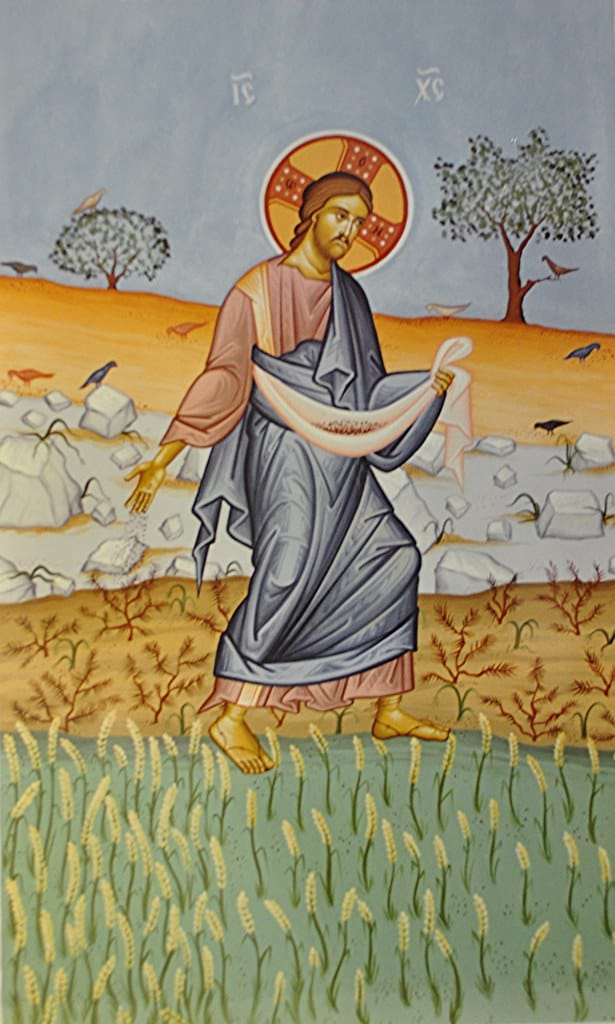
“Except a corn of wheat fall into the ground and die, it abideth alone: but if it die, it bringeth forth much fruit.” (John 12:24)
Consider the earlier example of the wheat field. Suppose all the grain kernels growing there were to achieve their goal and become new ears of wheat. What would be the result? The world could not exist, since the creatures for whom the grains provide nourishment would have no food. In order for these creatures, creatures so well known to us, to reach their present stage of evolution, other living things must fall short of their goal and sink into the abyss, as it were, with respect to achieving their own goal. Despite this, we have no reason to be sad, unless we wanted to claim that the world means nothing to us.
This material got my attention because I am working on the final chapters of my next book, on Christ, and there addressing the problem of (the idea of) eternal damnation.
Christian doctrine (i.e., church doctrine, not the New Testament) has created a dire dichotomy that is predicated on the idea that each human individual corresponds with an eternal soul, and that the fate of that soul is decided, eternally, at the time of death (or at least, cannot be altered after death).
In the last chapters of Christ and the Human Soul, Steiner gets into the very deep metaphysics of this question (i.e., what “salvation in Christ” via the forgiveness of sins really means, and how it squares with “karma” and reincarnation, etc.). Here he is effectively laying the groundwork, so to speak (a fitting enough metaphor), by presenting a perspective that, at first glance, seems “collectivist” (someone commented last week on “eugenicists rubbing their hands” at Steiner’s model).
Yet it is perhaps, once followed through, the only solution to the conundrum of a universal salvation that only a tiny few will ever experience, thereby spelling eternal damnation for all the rest.
Continuing:
If the world does mean something to us, and since it consists entirely of living creatures, then we also know that it must be possible for these beings to find nourishment. If they are to find food, then other beings must sacrifice themselves. Therefore, only a few seeds of life can actually reach their final goal, while others must go another way. They must go another way, because the world has to remain in existence, because this is really the only way in which the world can be wisely ordered. The only reason, then, that we are surrounded by a world such as ours is that certain creatures sacrifice themselves before they reach their potential goal.
[It] is precisely in this reality of life that wisdom and meaning of existence are revealed, and that it is only our understanding that it is not comprehensive enough, when we lament that so many things must sink into the abyss in such a seemingly pointless manner.
What is the abyss exactly? Christianity has turned it into a lake of fire where souls are tormented eternally. That this is a pathological notion is a fact that no amount of liberal-theological spin (“It’s just the way a sinful soul experiences God’s love,” etc.) can obscure.
If a soul is being tormented indefinitely by God’s love, and not being either transformed or destroyed by it, then either God’s love has failed, or it wasn’t love to begin with, but something very different.
Transformation vs. destruction may be more of a spectrum than a polarity. Transubstantiation entails one substance being turned into another. We could say its nature is destroyed, but its essence is incorporated into a new life.
Food is a perfect analogy. We don’t ever refer to eating as an act of destruction, especially if we are vegetarians, but that is exactly what it is. The word “destruction” has a wholly negative connotation, hence we cannot think of eating that way. Firstly, it is essential to our continued existence—it gives us life; secondly, we intuit, at some level, that what is being destroyed is entering into a new life within us. Any gardener knows this—life cannot be diminished, much less destroyed, by the natural destructive processes by which it sustains and renews itself.
This principle, Steiner is suggesting, also applies at the higher spiritual levels, where physical survival is transcended. Last week, I quoted his analogy between seeds and eggs in the natural world and visions within the supersensible realms. The third level would be where souls, or consciousness itself, becomes part of a harvest, precisely as the gospels (and the book of Revelation) refer to it, in symbolic form or parables (the wheat and the chaff, and the wheat and the tares).
Just as we are confronted in external life by the fact that only a few beings reach the potential goal, so can only a small part of the immeasurable spiritual life enter our horizon. Why? Contemplating this question can teach us a great deal. If you were to simply give yourself up to the immeasurable variety of visions streaming in on you, once this visionary world had opened up for you, you would then have these visions streaming into you continually, one after another. They would come and go and surge and flow into one another. It would be quite impossible to shut yourself off from the images and impressions pulsating around you in the spiritual world. . . . In short, we are dealing here with an immeasurable variety of phenomena.
In case we think this is leading to a sort of spiritual Darwinism and “supernatural selection,” Steiner makes a proviso that spiritual vision is in itself neither the measure nor means of a soul’s survival. One can’t transpose the biological imperative for survival onto the life of the soul. Entering eternity is not becoming an immortal being. Spirit is not a measurable substance.
A Darwinist sees only beings that achieve their goal and others that perish. It is a fact, however, that spirit flashes up from the beings that perish, meaning that further development is occurring not only for those who win in the physical struggle. The ones who seemingly perish go through an evolution in the spirit. That is the important thing. This is how we get closer to uncovering the meaning of life. Nothing perishes. Neither that which is defeated nor that which is eaten. It is all fertilized spiritually, and springs up spiritually again.1
. . . . We see that, ever since the beginning, and all throughout human evolution, countless things sink down into the abyss. While innumerable things sink down in the external evolution of human culture, and of human life, up above, the Christ impulse is developing. Just as in the human being, the fertilizing seeds develop for the world around us, so does the Christ impulse develop for the sake of all that seemingly perishes in the human being. Then the mystery of Golgotha that takes place is the fertilizing from above, the fertilizing of all that is perished. And with this, a real change takes place in what has seemingly fallen away from the divine and sunk into the abyss. The Christ impulse takes effect and fertilizes it.
And from the mystery of Golgotha onward, we see a renewed blossoming and a new continuation in the course of Earth evolution, through the fertilization received with the Christ impulse. And so, what we have come to know about this polarity also proves to be true even for this greatest event in earthly evolution.2
The above gets very close to my own “non-dualist” understanding of existence. I have always felt it was one that was consistent with Christianity, even though the latter has become, over the centuries, a seemingly dualistic religion. To blend Christian doctrine (the gospels, Paul, etc) with Eastern religion is tempting, but probably finally futile. To blend it with a “spiritual scientific” frame, or metaphysics, as Steiner does, may seem equally misguided, like trying to mix oil and water.
Yet, if Christian doctrine contains the truth, then it must correspond with an objective spiritual reality that, to some extent at least, can be understood, cognitively and/or sensibly (or supersensibly), as a metaphysic. The alternative is to draw a hard line in the sand between doctrinal faith (or worse, faith in the church), and cognitive understanding (apprehension) based in science, which is to say, knowledge. It is to draw a line between pistis and gnosis.
There is nothing to suggest this in the NT.
(Children of Job is how I earn my living; I make as much free content as I can afford to, thanks to paying subscribers. Become one for 1 month or 1 year, or make a one-time donate here.)