Self-Willed Sorcery
The Judaic Strand from Homo Serpiens Revised & Redacted, Part 1
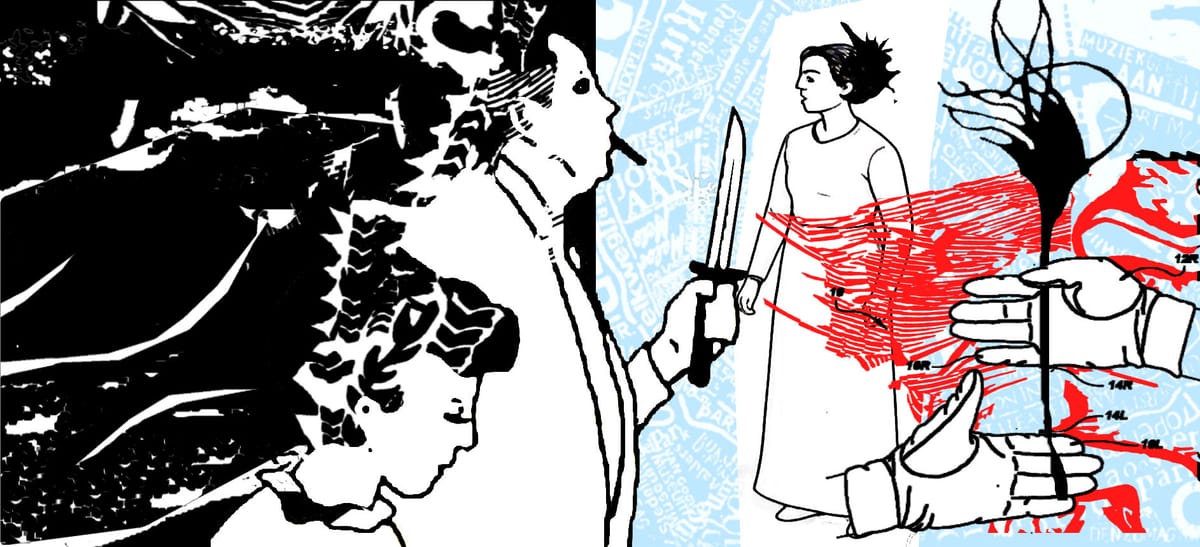
(Art by Michelle Horsley)
Old Homo Serpiens text in bold.
“Unconsciousness has an animal nature. Like all old gods, Yahweh has his animal symbolism with its unmistakable borrowings from the much older theriomorphic gods of Egypt, especially Horus and his four sons. Of the four animals of Yahweh only one has a human face. That is probably Satan, the god-father of man as a spiritual being. . . . This symbolism explains Yahweh’s behavior, which, from a human point of view, is so intolerable: it is the behavior of an unconscious being who cannot be judged morally.” —C. G. Jung, Answer to Job
I note how CGJ slips in the idea of Satan as our spiritual godfather without citation or explication; probably 50% of why I quoted that passage at all. The idea that Yahweh cannot be judged morally because He is unconscious is curiously anthropomorphic: as if it were a court of law and we are trying to determine whether God can tell the difference between right and wrong, and thereby be held accountable.
Moses and Yaldaboath in Egypt
“Myth is not raw matter waiting to be transformed into the precious metal of science; it is already a metal, a refined and complex technical language of an initiatic elite.” —William Irwin Thompson, Coming Into Being
As everyone knows, the Jewish sect is historically the most persecuted and abused of all “races.”1 Since the revelation of the horrors committed by the Nazis in the 1940s, they have been granted a kind of unofficial moral and social immunity. The implicit assumption is that, after such persecution, it would be insensitive to treat them with anything less than absolute deference. As a result of World War Two, then—and of collective guilt over it—Jews (most especially Israeli Jews) have managed to consolidate their special status as a “chosen people” (albeit as chosen “victims” more than anything).
So far, so good, nothing much to disagree with here; even the sentence construction doesn’t make my fingers itch.
In his profound work The People of the Secret, Ernest Scott is unafraid to say the unsayable, and observes how
So far as I know, Scott is not suggesting that the Nazi persecution benefited Jews socially, in the terms mentioned above (specifically by gaining them their own nation in Israel, but also, more generally, by affording them special treatment thereafter). He is speaking in more esoteric terms, and probably referring to how repeated persecution and suffering serves to strengthen the Jewish character (and weltanschauung) through duress, increasing the solidarity of the group as a whole.
The passage quoted sounds compatible with social benefits arising from persecution to me; and, while always controversial, it is hardly a stretch to say that the creation of Israel, that resulted directly from the persecution of European Jews, constituted a social benefit for Jewish survivors.
Today, in a world where ethnocentricity is becoming less and less “permissible,” Jews remain the most insular of peoples, and nothing brings people together more than unjustified persecution. By stubbornly retaining their individuality and distinctness as a sect, preserving their particular strength and character, the influence of the Judaic paradigm in the world remains undiminished.
First genuinely audacious statement!?
The most insidious thing about this paradigm is not that it continues to hold sway over Western thought and politic—when we might reasonably expect it to have been superseded long ago—but that it does so unremarked upon. Indeed, even to suggest this possibility is to call down the full force of moral indignation of the legions of decency and political correctness, to be instantly lumped amidst the ranks of Neo Nazis, Ku Klux Klansmen and other, equally unsavory groups. The mere mention of a “Jewish conspiracy” brands the hapless author not merely as a fool and a dupe but a scoundrel to boot; yet for all that, the fact remains that the Jewish ideology of One God, jealous of all other gods—and the central practice of blood sacrifice—continues to hold sway over Western society. The English Poet William Blake (surely nobody’s idea of a bigot) was quite clear on this point in The Marriage of Heaven and Hell:
We of Israel . . . so loved our God that we cursed in his name all the deities of surrounding nations, and asserted that they had rebelled; from these opinions the vulgar came to think that all nations would at last be subject to the jews. This said he, like all firm perswasions, is come to pass, for all nations believe the jews’ code and worship the jews’ god, and what greater subjection can be?
This is the simple and unpalatable truth. The Judaic paradigm is the dominant system of worship in the world today.3
So far, what’s disappointing isn’t that I can’t in good conscience stand by what I wrote 18-25 years ago, but that it’s not that different from things I wrote a year ago, here at Children of Job. This brings to mind something the film critic Pauline Kael said: that she knew it was time to retire when she read a phrase in an old review of hers, and realized she had reused the exact same phrase just the week before.
How long have I been beating this drum?
“Who changed the truth of God into a lie, and worshiped and served the creature more than the Creator.” —Romans, 1:25
This rule began with Moses, born of the Jews but raised by Egyptian royalty at a time when his people were “enslaved” (though this history is somewhat in doubt) to that same “spiritual aristocracy.” Since Moses was the “adopted” son of a Pharaoh, and grew up to become a High Priest of the Temple, he would have been versed and trained in Egyptian soul craft and the secret symbols thereof.
The Judaic paradigm, then, must be seen as having sprung from, or evolved out of, the Egyptian one.
And yet, it is with Moses himself—most specifically his handing over of the world throne to the demiurge Jehovah—that Judaism per se originates.
Since If the esoteric science of Kabbala—even to an extent the Hebrew language itself—have their true source in Ancient Egypt, they do not so much belong to Judaism as inform it, being its base and foundation.
The two lines I left un-redacted aren’t claims I am that much more confident about arguing today than the lines I struck through; but they are definitely more interesting, especially as circumcision was practiced by the Egyptians before any Israelites became enslaved there. Is it possible that old Moses got it from them? If so, what else did he inherit?
According to the traditional narrative, Moses took the “Jews” out of Egypt in search of the Promised Land. (According to Ralph Ellis, they were actually driven out after a civil war between two sides of Egypt, but we will get to that later.) Since the Egyptian paradigm was already in full decline by this time, it is likely that the Israelites’ bid for freedom (whether in revolt or civil war) was a genuine one, signifying a strong racial spirit. As already noted, the decline of the Egyptian Pharaonic paradigm, the “sacred” science, appears to have been a direct result of the encroachment of “personal egotism” due to unwisely conferred initiation. This led to “the magic of self-will, the sorcery of the self against which Moses inveighed” (Scott, p. 193). But if it was the virus of self-importance corrupting Egyptian rule that led to Moses and the Jews uprising, it seems fair to suppose that the chosen people themselves were already infected with this virus by the time of their “liberation”—and that they would have carried it with them, into the desert, and into the formation of their new paradigm.