
Pluribus: The Beast with Many I’s
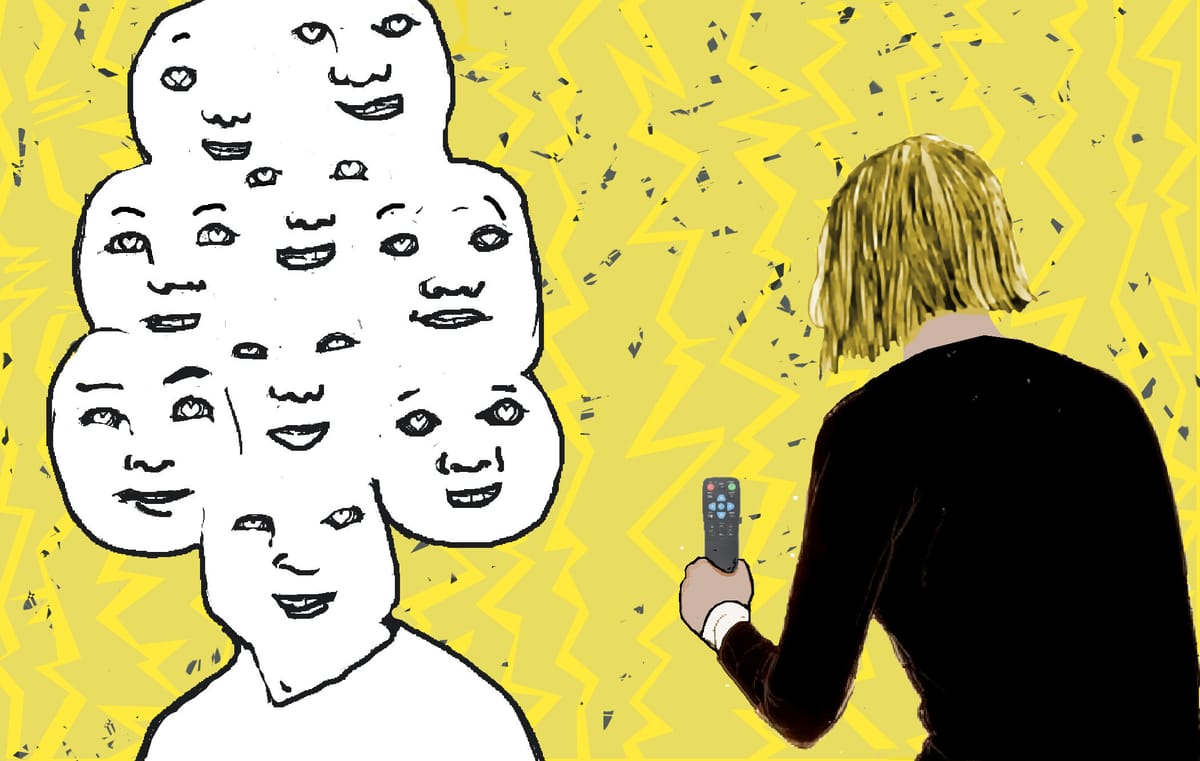
The War Between the Many and the One
(Audio at the end)
One: The Teleology of Technology
Why Write About a TV Show?
I am giving in to the temptation to write about the new TV show, Pluribus. This is not because it was practically the only show in 2025 that really held my attention (it was), so much as for the intersection of interests that the show touches upon, making it a veritable spaghetti junction of themes I have explored, throughout my writing life.
First up, and most obviously, is film, which has been the focus of my writing from the very beginning, from the age of about 14, and with my first published book, The Blood Poets.
Secondly, there is cultural engineering: the question of film and TV as propaganda and, more subtly and controversially, “prescriptive programming.” This latter is a kind of psychic priming, by which future scenarios are played out through fictional media, as a way to prepare the public for them, and to seed ideas in our consciousness, that over time can be brought to flower.
This speaks to a kind of irrigation system of mimetic and memetic engineering, whereby the agendas of the so-called “elite” unfold, not merely upon but through the populous, as we are turned into the instruments, not merely the victims, of cultural engineering.
Similar to this but not quite the same is the idea of the “revelation of the method.” This 2nd matrix-y concept has to do with the self-exposure of the sociocultural, religious engineers, via the same media, as a means to acclimatize us to their values, methods, and goals, to make us increasingly complicit with them.
Implicit consent comes out of a growing awareness of the truth, and our passive response to it.
This involves a splitting, a schismogenetic (as well as traumagenetic) compartmentalization. We are made aware, at a sensorial, perceptual level, of the truth of certain agendas, while cognitively, as we are subjected to the propagandist “spin” which they bring with them, we are coerced into believing something diametrically opposed to what we are knowing, at a bodily level.
This gives rise to a tension between our cognitive (mind) and perceptual (body) awareness, and leads to doublethink, compartmentalization, fragmentation, and dissociation.
Next up, we have the AI and UAP themes implicit in Pluribus, the hints of a shadowy and non- (or anti-) human technocracy, as what lurks behind these all-encompassing agendas.
The “Joining” of the “Others” via an extraterrestrial signal that provides a code for the creation of an RNA virus is akin to Teilhard de Chardin’s technological nöösphere. It is the simulation and counterfeiting of the Body of Christ, a pseudo-spiritual community of saints, via technology, in which bodies are fused together in a shared absence of soul.
Parallel to this, though not quite the same, we have Ahriman/Satan and the explicit idea of soul-harvesting, an idea consistent with alien abduction and UFO narratives, factual and fictional, but also with the teleology of technology, as it becomes an increasingly invasive means of colonizing human consciousness with something other than human.
Evolution of the I
Lastly, and most broadly and intriguingly, for me, Pluribus explores the tension between collectivism and individualism, between the group-mind and the individual ego.
This is something, I would argue, that is in many ways the most fundamental theme, and the deepest source of tension, in all human endeavor, whether philosophical, religious, scientific, economic, political, cultural, artistic, domestic, romantic, or whatever else.
One way or another, this tension can be found, like yeast in bread, baked into everything we do (and avoid doing) as human beings.
Every collective is made up of individuals, with at least some semblance of subjective awareness. Likewise, there is no possibility of a subjective, individual self that is not part of some collective. Not even Jeremiah Johnson—or Pluribus’ Carol Sturka (Rhea Seehorn)—can stake a claim to being an island.
This brings us to perhaps the most recurring recent theme at Children of Job: that of the evolution of the I. From the pantheism and paganism of early human consciousness, with its rituals of worship, to the tribal monotheism of the Hebrews that eventually developed, via Gnosticism and Christianity, into the “ego” of the modern individual.
All this in a single TV show, you ask? If we want to look for it, and I do. My aim is to see the ways in which a show of this sort is both emerging from the collective human psyche—as a waking dream trying to make sense of something incoherent—while at the same time being implanted into it from the outside, via forms of cultural engineering.
To what extent are we being primed, manipulated, directed, steered, coerced, influenced, towards a particular goal, and rendered compatible with supercultural agendas; to what extent are we the driving force—however unconsciously—behind it.
And is it possible to separate the two?
Poltergeist or Zeitgeist?
A year ago, during Lent 2025, I was working on a book I was planning to call “Zeitgeist versus Poltergeist,” named after a Pauline Kael piece from the 1950s. This is now a book I may never finish, because my focus has shifted away from culture and onto scripture.