
God’s Orphans
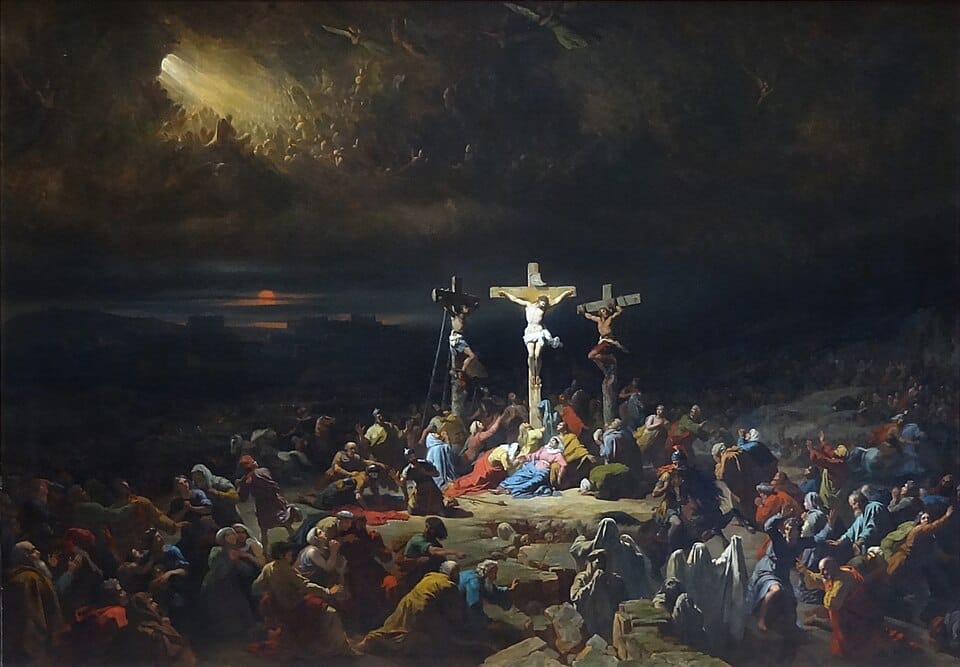
Crucifixion as Mass Trauma Event & the Retroactive Divinity of Jesus
The fundamental religious experience is one of powerlessness. We are powerless to control or dictate the presence of the spirit by which to inspire ourselves. One cannot, by definition, inspire oneself. And what inspires, by definition, cannot be commanded or controlled.
If Jesus was God, how could he have faith in God? How could he obey God? The formula doesn’t work.
If we can’t inspire ourselves, what do we do to get inspired? We have to make ourselves available to the spirit. How do we make ourselves available to the spirit? We have to let go of all of our usual tricks and strategies, tools and skills, all things that we rely upon to navigate life, to make sense, to feel effective or in control or powerful.
That’s why it’s Job and Jesus all the way. Being nailed to the cross: you can’t get more powerless than that.
Jesus Christ is the most successful human being who ever lived, culturally and socio-politically speaking. That was all by accident. Okay, obviously, it was by design, but I mean that this sort of worldly success was all secondary to the mission. The only reason Christianity had to exist was so that we would hear about the Christ-event. Otherwise, it would all be in the dream realm, in the etheric and the astral.
We would know that it happened bodily, but we would have no cognitive awareness of it. And we’re currently in a period in history where pretty much all we’ve got is cognitive awareness. If we can’t cogitate it, it doesn’t exist.
The powerlessness of being on the cross is the only position of true power, because that’s when God has the power—both over us and through us. We only become an instrument of God when we surrender all our personal power. Being nailed to the cross is a literalization. It is enough (and hard enough!) if we are willing to be crucified.
In Jesus’ case, it had to be seen through to the very end; and now we have that traumatic imprint on all of our culture and society. It’s literally everywhere.
Everywhere you go, you’re going to see the cross, you’re going to hear about Jesus till you’re sick to death of hearing about Jesus. I wasn’t even raised Christian but I was sick of hearing about Jesus before I became an adult. I was already sick of Jesus before I even heard about Jesus. My father framed it that way. It was pre-bunked.
There’s a reason for this; it is the secret that reveals itself by concealing itself.
My latest book (the follow-up to The Gospel of Job, out in September) is called Crucial Fictions, and I gave it the right title, because it turns out it is a sequel to Prisoner of Infinity. I had no idea it was going to be that when I chose the title, however, because it’s all about Jesus Christ and Paul and Lucifer and God, and has nothing to do with aliens. I thought it had nothing to do with trauma, but that was obviously because I hadn’t thought it through. Now it seems as obvious to me as Jake Gittes’ nose that the crucifixion was a mass-trauma event.
Forget about 9-11, that’s just kid’s play. This was the ultimate traumatic event and it imprinted the whole collective human psyche, forever. It turned out there was a whole thesis in my book that I hadn’t even realized was in there. I thought I’d been writing one book, but I was writing another. Lightning struck, the Holy Spirit descended, I received inspiration, and . . . everything fell apart. This is not my beautiful book! How did I get here?
It was like Frankenstein’s monster, only with (I hope) a happy ending. The book was alive, it was talking, and it was saying: “No more circumcision!” If babies could speak at seven days, you’d bet that circumcision would have ended thousands of years ago.
Traumata. The sins Jesus was atoning for: thousands of years of ritualized child abuse.
Such was (part of) the inspiration.
As a writer, I have spent my whole life developing mastery over the writing process, and now here I was losing control of it. It happens every time. Without losing control of the book, it’s not worth writing it. It’s only then that the spirit can start to move, to rearrange things and determine the direction they are going in, and write the book for me; or through me.
Not that I had to rewrite the whole thing. Fortunately, it wasn’t that catastrophic. It wasn’t like I had almost finished building my goat barn (I have only just started, so let’s hope this doesn’t happen!) and I realized the main beams were nowhere near strong enough and had to take it apart to remove them and replace them with stronger ones. Or that, in the process, it turned out it was a temple and not a barn! Not quite like that—but almost.
The matter itself dictates the shape and structure of it. It requires giving up control and letting the structure come apart, in order to uncover what I was being guided to write unconsciously.
Mastery involves letting go of mastery. However good I get at writing books, it never gets easier because I can’t ever hold onto or repeat what I learned the last time. I don’t get any merits or credits or Pulitzers. Most people don’t even notice. Even Wikipedia ignores me.
A few will notice, and the main thing is that they have that experience for themselves, of losing control and feeling the spirit taking over, in their own lives, by witnessing the tight-rope act of an author who gets undone by his own subject matter.
How can a man be fully God and fully human at the same time? Why are we interested in Jesus Christ at all, and how does it help to (try to) understand that figure, that truth? Of course, everyone will have a different take on it. If I were to say you “Jesus Christ is the way, and without Jesus Christ there is no way!” how would you feel about that?
If it were me, hearing somebody say that, unless I felt they really knew what they were talking about, which people who say this sort of thing never seem to, I’d probably think, “Fuck off.” Part of my “Fuck off”—the emotional resistance to those words—is all tangled up with the idea that “Jesus Christ was God”—the idea there’s a man in history who was, and is, infinitely superior to me, and that there’s nothing I can do about it but submit.
This is probably a guy thing. Women probably don’t have this particular problem with Jesus Christ. But I do. It’s not really with Jesus Christ, though, but with the idea which people are asserting about Jesus without understanding it (or at least, I don’t understand them when they assert it).
It has to do with the ego, obviously. But what made Jesus the Christ was that he gave up his ego to God. He just let go of who he was, let go of everything, and said, “I’m yours God!”
And into that vacuum that was created, by the arrival of freedom,1 by the surrender of the ego, of the false self, the divine I could descend and enter all the way into the body of Jesus of Nazareth (which took three years according to Steiner, but these are just details). That was when/how God became a man.
How could Jesus be God when, if he was God he couldn’t obey God, and he couldn’t really be fully a man if he knew he was God, or even a god. I recently read (most of) a book called Jesus: God and Man, by Wolfhart Pannenberg, that helped me to make some sense of this mystery. It gave me the idea that, though Jesus only fully became (a) God—explicit in Romans 1.3 and elsewhere in the NT—via the crucifixion-resurrection, the effect was retroactive, because when God acts, He acts in eternity.
Jesus as a man performed the full act of surrender, historically. He surrendered everything he had and everything he was to God, over the process of the three years; finally, by being willing to die, and then dying, Tetelestai, it was finished.