
A Tradition of Christian Hubris
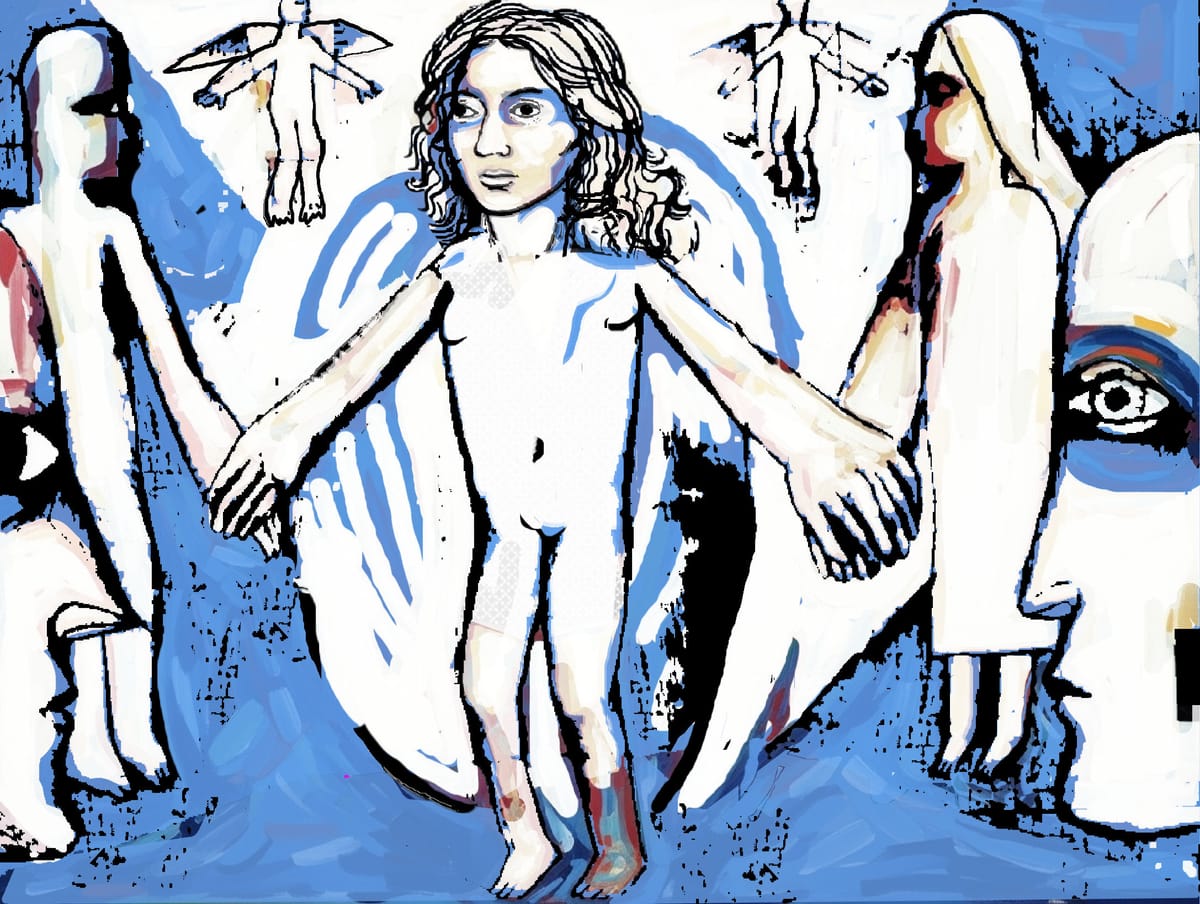
The Virgin Conception & the Literalization of a Mystery, Pt 1
(Audio at end)
“Modern man has got to refuse having his religion measured by the number of miracles he believes in, even if he has to pay for freedom of thought by loss of the gospel. . . . Whoever decides in favor of faith in the miracles denies and foregoes thought. Whoever decides to deny faith in the miracles denies and loses the gospel.” —Emil Bock, Studies in the Gospels vol 1 (p. 108).
Part One: Schismogenesis of the Soul
Phenomenology or Theologoumenonology?
Raymond E. Brown’s The Birth of the Messiah (1977) is a 500-page immersion in the minutiae of a scholastic tradition of hundreds of years, determining the basis for the notion of a virgin conception.[1] Reading it, I was increasingly left with the sense of an unnatural preoccupation with the supernatural. Would Jacques Ellul have approved, I wondered?
There is, of course, no possible way to determine—by scholarly methods at least—whether a virgin conception ever occurred. There is not even a way to determine whether early Christians, much less the earliest, believed in a virgin conception, or if they did, what those words meant to them. There is, after all, room for a symbolic, metaphorical, or metaphysical “virginity,” as well as literal (by which today we mean biological).
It is hard enough, it seems, to be sure what Luke and Matthew believed (the nominal authors of the only two canonical sources for the virgin conception), and how faithful and accurate the surviving versions of their Gospels are to the earliest manuscripts. There’s no way of knowing who first came up with the idea, where, how, or why.
Then we have the problem that the nativity accounts from these two Gospels are far from “synoptic,” or even compatible. If Mary existed historically, and if an angel of God came to her and told her she would conceive while still a virgin (but betrothed to Joseph), and if this miracle came to pass—how closely do the accounts passed down to us represent what actually happened? How closely were they ever intended to? (i.e., how literally were the accounts meant to be taken?)
There are valid reasons for flattening out a profound metaphysical event and making it simple enough for a child to understand. Children do not understand the nature of sex, and have been told for centuries that babies come from storks. Similarly, perhaps, childlike adults, lacking the capacity for deep intellectual thought, can likewise benefit from a “dumbed down” version of the virgin conception tale, in its Gospel form, as a mental place-keeper that allows the reality behind it to take root in their hearts.
There is no actual deception or delusion necessarily involved, any more than the tradition of Santa Claus involves parents deceiving their children. It is only when the intellect becomes more developed that such ideas need to develop along with it. Not to allow this risks turning stories of this sort into the cognitive equivalent of ancient Chinese foot-binding: the cause for the deformation of a natural growth process.
So how could the Gospel authors have access to the details about the conception of Jesus? The best-case scenario is, directly via Mary, or at least via someone who knew Mary directly. But even then, the way an Angel of the Lord communicates with a 12-year old girl[2] is presumably not the same as how humans communicate with one another, etc.
The point is that the entire frame for such events is foreign to us, not only because of the distance of hundreds of years, and the corresponding cultural and cognitive gulf, but as a supernatural event that today we lack a consensual framework for understanding, or even interpreting. This is true even relative to most of the other supernatural events in the Gospel.
The virgin conception more or less stands alone, with the resurrection and the raising of the dead miracles of Jesus, all of which have to do with the power to give life outside of normal biological means. Are these accounts meant to be historical, or are they meant to be theological, i.e., are they meant to represent an exact version of a historical event, or are they meant to represent a truth in its essence?
This latter is known as a theologoumenon: “the historicizing of what was originally a theological statement” (Brown, p. 505). And it overlaps with another problem that is central to this current inquiry: the physicalization of the metaphysical.
Why Does it Matter? (The Un-Ending Quest for Specialness)
The questions that arise out of the question of the virgin conception are countless, and they tend to multiply, without necessarily being fruitful.
Perhaps the final question I am left with, which I want to place here at the start, is the question of “Why does it matter?” Why does it matter if Mary was a literal virgin or not when she conceived Jesus? How relevant is the literality of truth, in the sense we mean it today?
The first answer is that, clearly, it matters a hell of a lot to millions of Christians, especially Catholics. For Catholics, there is even the tradition that Mary remained a virgin afterwards, a belief based on less than nothing in the scripture (i.e., proudly going against the evidence of the Gospels, such as Jesus’ brothers and sisters).
Yet for Catholics, evidently, perpetual virginity is a necessary requirement for the Mother of God. It is even necessary to believe Mary’s hymen remained unbroken by the birth of Jesus, as if even this would compromise her perfection. I consider these questions to be beneath the interests of a serious inquiry, though they are not irrelevant to it (which is why I mention them at all).
Returning to the question as to why Mary’s virginity matters, there are a number of answers. First of all, if such a miracle occurred, it was the first and last time it ever did, in our knowledge of human history. The metaphysical, or theological, question it raises is then: how and why was it a necessary part of the means by which God/the Son of God incarnated, etc.? Seen from a different angle, why do Christians need to believe in a virgin conception to believe that Jesus was the Son of God, and/or God the Son?
Did the theology lead to the mythology, and from there to the alleged history, the belief in a literal, biological event? Or did the mythology (whether or not it was based in facts) lead to the theology? Was there first a story, an account, a belief around the virgin conception, that led to ideas around Jesus as the Son of God? Or did the idea of Jesus as the Son of God somehow lead, theologically, to the imagining, the intuiting, or the assertion of a virgin conception?
In every case, the prevailing factor is one of absolute uniqueness. Christians must believe Jesus was unique in every way—that he was not only uniquely divine but uniquely human (a paradox, as we shall see)—and so everything about him had to also be unique, starting with conception.
Jesus Christ’s unique status as the Only Son of God was steadily backdated, from the resurrection, to the crucifixion, to baptism, to incarnation, to conception, and finally to the beginning of time (with John’s Christology of the pre-existent Logos).
This development is almost parodied by the Catholic effort, not only to make Mary sinless, not only to keep her hymen intact even after Jesus is born (despite the many brothers and sisters mentioned in the Gospel), but to establish the sainthood of her mother, Anne. Catholic mythologizing hits a double-bind, however, when it comes to making Mary herself the result of an Immaculate Conception, since to do so would create an endless recursion, as well as detracting from Jesus’s uniqueness.